


What is CoreFreq in linux

In Linux, CoreFreq is a professional tool for monitoring CPU. It is a CPU monitoring program for Intel 64-bit processors and supports Atom, Core2, Nehalem, SandyBridge, and AMD 0F families. CoreFreq is used to retrieve internal performance counters from each CPU core and works in conjunction with a daemon that collects the data. A small console client connects to the daemon and displays the collected data.

#The operating environment of this tutorial: linux7.3 system, Dell G3 computer.
CoreFreq is a CPU monitoring program for Intel 64-bit processors and supports Atom, Core2, Nehalem, SandyBridge and above, as well as the AMD 0F family.
Its core is built on the kernel module for retrieving internal performance counters from each CPU core, and works with a daemon that collects the data, a small console client connects to the daemon and displays Collected data.
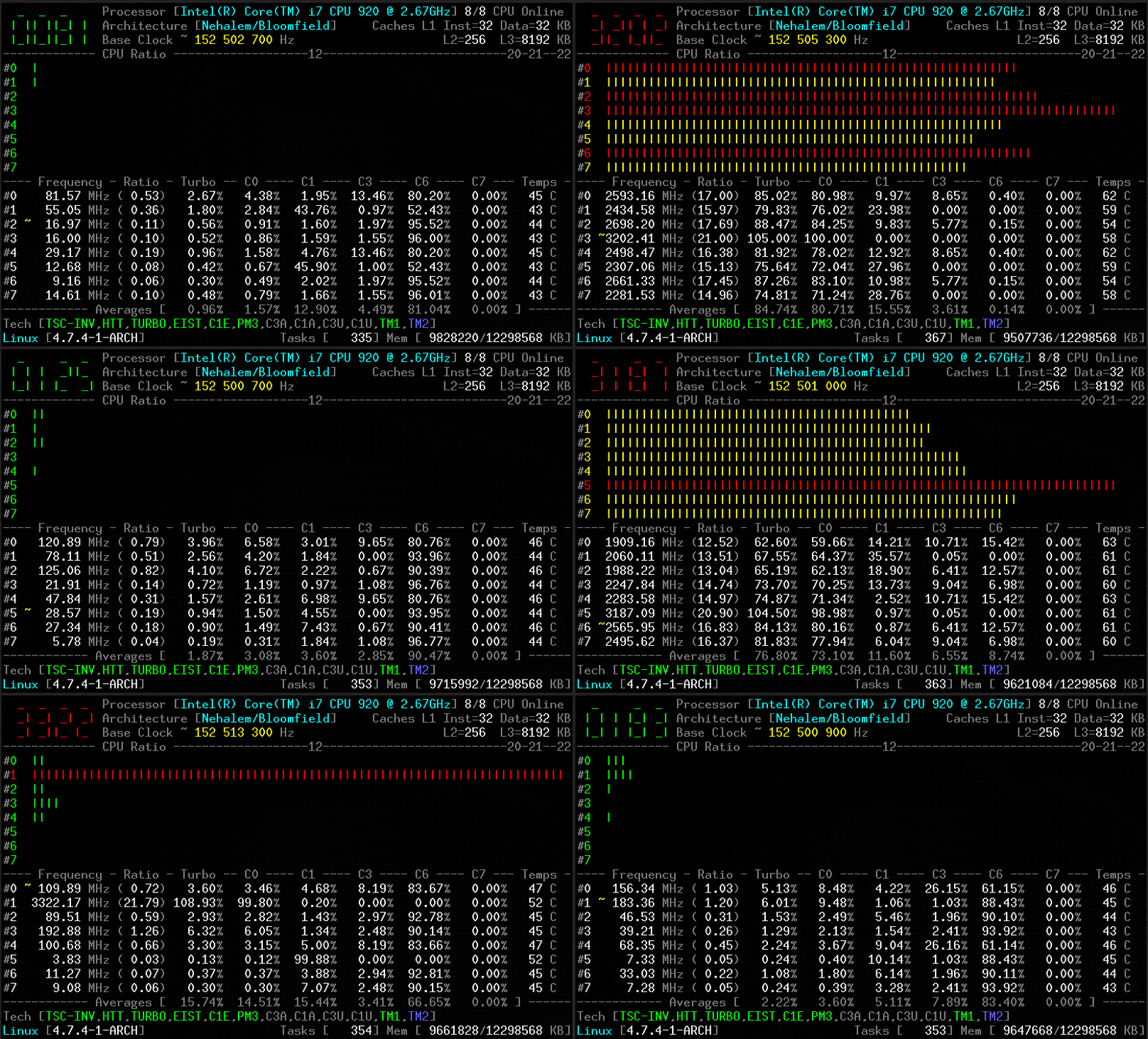
CoreFreq CPU Monitoring
It provides the basis for re-capturing CPU data with high accuracy:
Core frequencies and ratios; SpeedStep (EIST), Turbo Boost, Hyper-Threading (HTT), and base clock.
The performance counter combines the timestamp counter (TSC), non-stop core cycle (UCC), and non-stop reference cycle (URC).
Instructions per cycle or per second: IPS, IPC, or CPI.
CPU C status: C0 C1 C3 C6 C7 - C1E - Automatic/non-degraded for C1, C3.
DTS temperature with Tjunction Max, Thermal monitoring TM1, TM2 status.
Includes cache and application CPU topology maps for bootstrapping.
Processor characteristics, brand, architecture string.
Note: This tool is more suitable for expert Linux users and experienced system administrators, but novice users can learn how to use it step by step.
It is implemented by calling a Linux kernel module, which uses:
Assembly code keeps performance counter readings as close as possible.
Slab data memory affected by each CPU plus high-resolution timer.
Supports CPU suspend/resume and CPU hot plug.
Use shared memory to protect the kernel from damage from user space programs.
Use atomically synchronized threads to eliminate mutual exclusion and deadlocks.
To install CoreFreq, you first need to install dependent programs (development tools) to compile and build the program from source.
$ sudo yum group install 'Development Tools'           [On CentOS/RHEL]
$ sudo dnf  group install 'Development Tools'          [On Fedora 22+ Versions]
# sudo apt-get install dkms git libpthread-stubs0-dev  [On Debian/Ubuntu]
Next, clone the CoreFreq source code on Github, enter the download folder and compile the build program:
    $ git clone https://github.com/cyring/CoreFreq.git
    $ cd CoreFreq
    $ make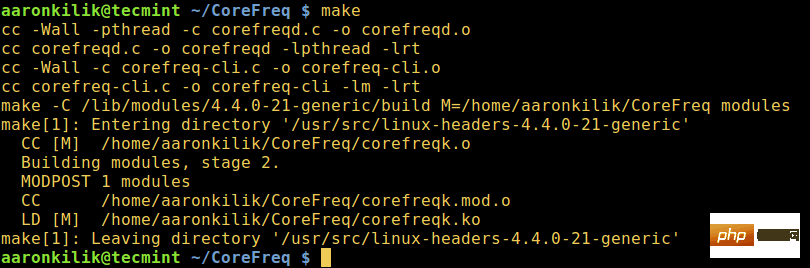
Build the CoreFreq program
Note: Arch Linux users can install corefreq-git from the AUR.
Now run the following command to load the Linux kernel module from the local directory, and then run the daemon:
    $ sudo insmod corefreqk.ko
    $ sudo ./corefreqd
Then start the client as a normal user.
$ ./corefreq-cli
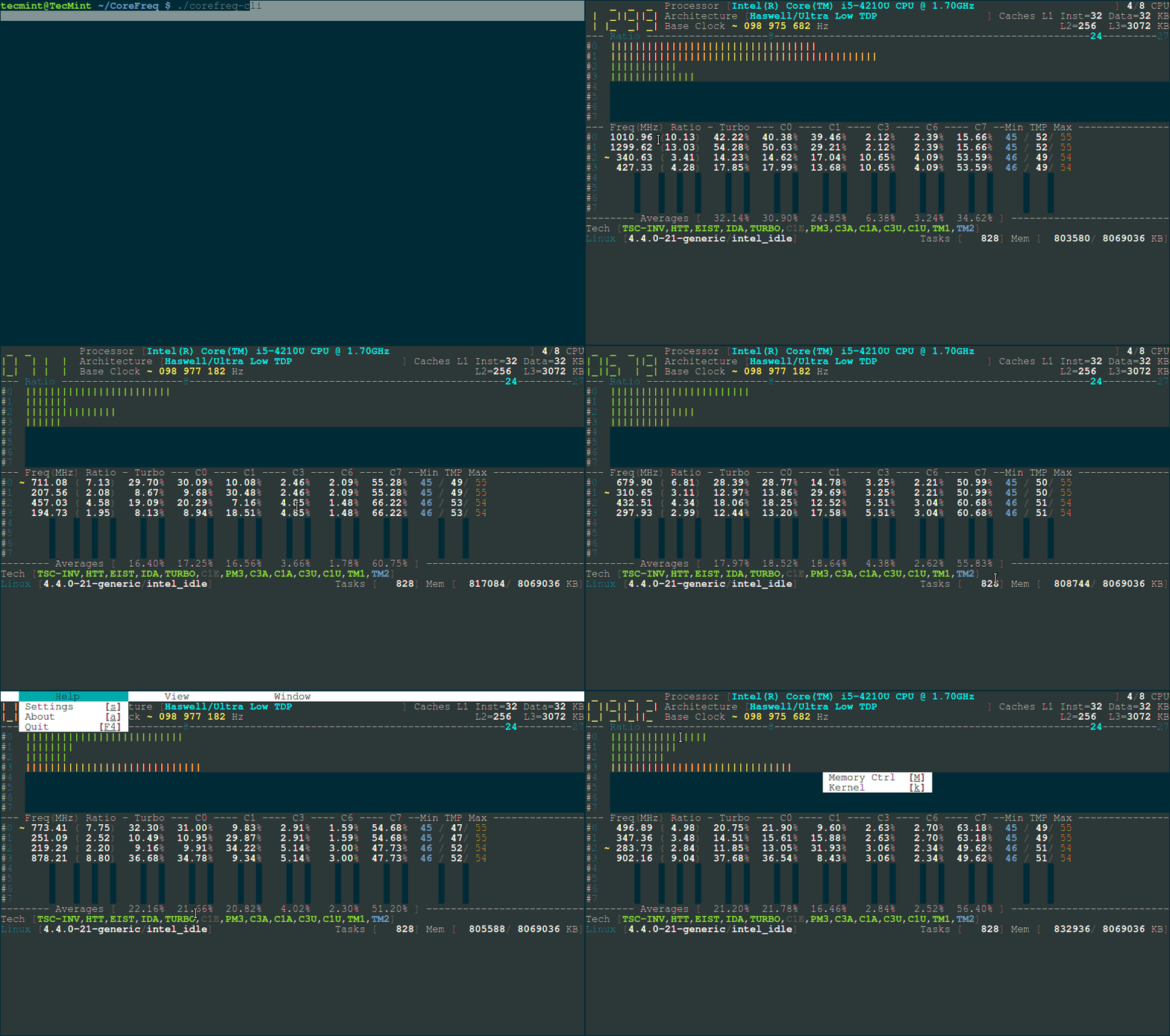
CoreFreq Linux CPU Monitoring
使用 F2 显示屏幕顶部显示的使用菜单。
使用 右 和 左 箭头移动菜单选项卡。
使用 上和 下 箭头选择菜单项,然后单击回车。
使用 F4 关闭程序。
使用 h 打开快速参考。
要查看所有的使用选项,请输入以下命令:
$ ./corefreq-cli -h
CoreFreq 选项:
    CoreFreq.  Copyright (C) 2015-2017 CYRIL INGENIERIE
    usage:  corefreq-cli [-option ]
    -t  Show Top (default)
    -d  Show Dashboard
    arguments:
    -c  Monitor Counters
    -i  Monitor Instructions
    -s  Print System Information
    -M  Print Memory Controller
    -m  Print Topology
    -u  Print CPUID
    -k  Print Kernel
    -h  Print out this message
    Exit status:
    0   if OK,
    1   if problems,
    >1  if serious trouble.
    Report bugs to labs[at]cyring.fr
要打印内核的信息,运行:
$ ./corefreq-cli -k
打印 CPU 细节信息:
$ ./corefreq-cli -u
你也可以实时监控 CPU 指令:
$ ./corefreq-cli -i
如下启用计数器追踪:
$ ./corefreq-cli -c
相关推荐:《Linux视频教程》
The above is the detailed content of What is CoreFreq in linux. For more information, please follow other related articles on the PHP Chinese website!

Hot AI Tools

Undress AI Tool
Undress images for free

Undresser.AI Undress
AI-powered app for creating realistic nude photos

AI Clothes Remover
Online AI tool for removing clothes from photos.

Clothoff.io
AI clothes remover

Video Face Swap
Swap faces in any video effortlessly with our completely free AI face swap tool!

Hot Article
Hot Tools

Notepad++7.3.1
Easy-to-use and free code editor

SublimeText3 Chinese version
Chinese version, very easy to use

Zend Studio 13.0.1
Powerful PHP integrated development environment

Dreamweaver CS6
Visual web development tools

SublimeText3 Mac version
God-level code editing software (SublimeText3)


 How to install software on Linux using the terminal?
Aug 02, 2025 pm 12:58 PM
How to install software on Linux using the terminal?
Aug 02, 2025 pm 12:58 PM
There are three main ways to install software on Linux: 1. Use a package manager, such as apt, dnf or pacman, and then execute the install command after updating the source, such as sudoaptininstallcurl; 2. For .deb or .rpm files, use dpkg or rpm commands to install, and repair dependencies when needed; 3. Use snap or flatpak to install applications across platforms, such as sudosnapinstall software name, which is suitable for users who are pursuing version updates. It is recommended to use the system's own package manager for better compatibility and performance.
 The Ultimate Guide to High-Performance Gaming on Linux
Aug 03, 2025 am 05:51 AM
The Ultimate Guide to High-Performance Gaming on Linux
Aug 03, 2025 am 05:51 AM
ChoosePop!_OS,Ubuntu,NobaraLinux,orArchLinuxforoptimalgamingperformancewithminimaloverhead.2.InstallofficialNVIDIAproprietarydriversforNVIDIAGPUs,ensureup-to-dateMesaandkernelversionsforAMDandIntelGPUs.3.EnabletheperformanceCPUgovernor,usealow-latenc
 What are the main pros and cons of Linux vs. Windows?
Aug 03, 2025 am 02:56 AM
What are the main pros and cons of Linux vs. Windows?
Aug 03, 2025 am 02:56 AM
Linux is suitable for old hardware, has high security and is customizable, but has weak software compatibility; Windows software is rich and easy to use, but has high resource utilization. 1. In terms of performance, Linux is lightweight and efficient, suitable for old devices; Windows has high hardware requirements. 2. In terms of software, Windows has wider compatibility, especially professional tools and games; Linux needs to use tools to run some software. 3. In terms of security, Linux permission management is stricter and updates are convenient; although Windows is protected, it is still vulnerable to attacks. 4. In terms of difficulty of use, the Linux learning curve is steep; Windows operation is intuitive. Choose according to requirements: choose Linux with performance and security, and choose Windows with compatibility and ease of use.
 Understanding RAID Configurations on a Linux Server
Aug 05, 2025 am 11:50 AM
Understanding RAID Configurations on a Linux Server
Aug 05, 2025 am 11:50 AM
RAIDimprovesstorageperformanceandreliabilityonLinuxserversthroughvariousconfigurations;RAID0offersspeedbutnoredundancy;RAID1providesmirroringforcriticaldatawith50�pacityloss;RAID5supportssingle-drivefailuretoleranceusingparityandrequiresatleastthre
 Linux how to enable and disable services at boot
Aug 08, 2025 am 10:23 AM
Linux how to enable and disable services at boot
Aug 08, 2025 am 10:23 AM
To manage the startup of Linux services, use the systemctl command. 1. Check the service status: systemctlstatus can check whether the service is running, enabled or disabled. 2. Enable the service startup: sudosystemctlenable, such as sudosystemctlenablenginx. If it is started at the same time, use sudosystemctlenable--nownginx. 3. Disable the service startup: sudosystemctldisable, such as sudosystemctldisablecups. If it is stopped at the same time, use sudosystemctldisabl
 Linux how to list all running processes
Aug 08, 2025 am 06:42 AM
Linux how to list all running processes
Aug 08, 2025 am 06:42 AM
Usepsauxforacompletesnapshotofallrunningprocesses,showingdetailedinformationlikeUSER,PID,CPU,andmemoryusage.2.Usetoporhtopforreal-timemonitoringofprocesseswithdynamicupdates,wherehtopoffersamoreintuitiveinterface.3.UsepgreporpidoftoquicklyfindthePIDs
 How to clean up your Linux system
Aug 22, 2025 am 07:42 AM
How to clean up your Linux system
Aug 22, 2025 am 07:42 AM
Removeunusedpackagesanddependencieswithsudoaptautoremove,cleanpackagecacheusingsudoaptcleanorautoclean,andremoveoldkernelsviasudoaptautoremove--purge.2.Clearsystemlogswithsudojournalctl--vacuum-time=7d,deletearchivedlogsin/var/log,andempty/tmpand/var
 Linux how to view the contents of a file
Aug 19, 2025 pm 06:44 PM
Linux how to view the contents of a file
Aug 19, 2025 pm 06:44 PM
ToviewfilecontentsinLinux,usedifferentcommandsbasedonyourneeds:1.Forsmallfiles,usecattodisplaytheentirecontentatonce,withcat-ntoshowlinenumbers.2.Forlargefiles,uselesstoscrollpagebypageorlinebyline,searchwith/search_term,andquitwithq.3.Usemoreforbasi
