


 Operation and Maintenance
Nginx
How to troubleshoot Nginx service startup failure in Kubernetes
Operation and Maintenance
Nginx
How to troubleshoot Nginx service startup failure in Kubernetes
How to troubleshoot Nginx service startup failure in Kubernetes

❌The pod node failed to start, the nginx service could not be accessed normally, and the service status was displayed as ImagePullBackOff.
[root@m1 ~]# kubectl get pods
NAME                    READY   STATUS             RESTARTS   AGE
nginx-f89759699-cgjgp   0/1     ImagePullBackOff   0          103m
View the Pod node details of the nginx service.
[root@m1 ~]# kubectl describe pod nginx-f89759699-cgjgp
Name:             nginx-f89759699-cgjgp
Namespace:        default
Priority:         0
Service Account:  default
Node:             n1/192.168.200.84
Start Time:       Fri, 10 Mar 2023 08:40:33 +0800
Labels:           app=nginx
                  pod-template-hash=f89759699
Annotations:      <none>
Status:           Pending
IP:               10.244.3.20
IPs:
  IP:           10.244.3.20
Controlled By:  ReplicaSet/nginx-f89759699
Containers:
  nginx:
    Container ID:
    Image:          nginx
    Image ID:
    Port:           <none>
    Host Port:      <none>
    State:          Waiting
      Reason:       ImagePullBackOff
    Ready:          False
    Restart Count:  0
    Environment:    <none>
    Mounts:
      /var/run/secrets/kubernetes.io/serviceaccount from default-token-zk8sj (ro)
Conditions:
  Type              Status
  Initialized       True
  Ready             False
  ContainersReady   False
  PodScheduled      True
Volumes:
  default-token-zk8sj:
    Type:        Secret (a volume populated by a Secret)
    SecretName:  default-token-zk8sj
    Optional:    false
QoS Class:       BestEffort
Node-Selectors:  <none>
Tolerations:     node.kubernetes.io/not-ready:NoExecute op=Exists for 300s
                 node.kubernetes.io/unreachable:NoExecute op=Exists for 300s
Events:
  Type     Reason   Age                     From     Message
  ----     ------   ----                    ----     -------
  Normal   BackOff  57m (x179 over 100m)    kubelet  Back-off pulling image "nginx"
  Normal   Pulling  7m33s (x22 over 100m)   kubelet  Pulling image "nginx"
  Warning  Failed   2m30s (x417 over 100m)  kubelet  Error: ImagePullBackOff
found that obtaining the nginx image failed. It may be caused by Docker service.
So, check whether Docker starts normally
systemctl status docker
Found that the docker service failed to start????, and tried to restart manually.
systemctl restart docker
However, restarting the docker service failed and the following error message appeared.
[root@m1 ~]# systemctl restart docker
Job for docker.service failed because the control process exited with error code.
See "systemctl status docker.service" and "journalctl -xe" for details.
The execution of the systemctl restart docker command fails.
Then, when executing the docker version command, it was found that it failed to connect to the Docker daemon
[root@m1 ~]# docker version
Client: Docker Engine - Community
 Version:           20.10.17
 API version:       1.41
 Go version:        go1.17.11
 Git commit:        100c701
 Built:             Mon Jun  6 23:03:11 2022
 OS/Arch:           linux/amd64
 Context:           default
 Experimental:      true
Cannot connect to the Docker daemon at unix:///var/run/docker.sock. Is the docker daemon running?
So, again executed the systemctl status docker command , check that the docker service failed to start, and read the output error message, as shown below.
[root@m1 ~]# systemctl status docker
● docker.service - Docker Application Container Engine
   Loaded: loaded (/usr/lib/systemd/system/docker.service; enabled; vendor preset: disabled)
   Active: failed (Result: exit-code) since Fri 2023-03-10 10:28:16 CST; 4min 35s ago
     Docs: https://docs.docker.com
 Main PID: 2221 (code=exited, status=1/FAILURE)

Mar 10 10:28:13 m1 systemd[1]: docker.service: Main process exited, code=exited, status=1/FAILURE
Mar 10 10:28:13 m1 systemd[1]: docker.service: Failed with result 'exit-code'.
Mar 10 10:28:13 m1 systemd[1]: Failed to start Docker Application Container Engine.
Mar 10 10:28:16 m1 systemd[1]: docker.service: Service RestartSec=2s expired, scheduling restart.
Mar 10 10:28:16 m1 systemd[1]: docker.service: Scheduled restart job, restart counter is at 3.
Mar 10 10:28:16 m1 systemd[1]: Stopped Docker Application Container Engine.
Mar 10 10:28:16 m1 systemd[1]: docker.service: Start request repeated too quickly.
Mar 10 10:28:16 m1 systemd[1]: docker.service: Failed with result 'exit-code'.
Mar 10 10:28:16 m1 systemd[1]: Failed to start Docker Application Container Engine.
[root@m1 ~]#
The above output shows that the startup of the Docker service process failed and the status is 1/FAILURE.
✅Next, try the following steps to troubleshoot and resolve the issue:
1️⃣View the Docker service log: Use the following command to view the Docker service log to understand the cause of the failure in more detail.
sudo journalctl -u docker.service
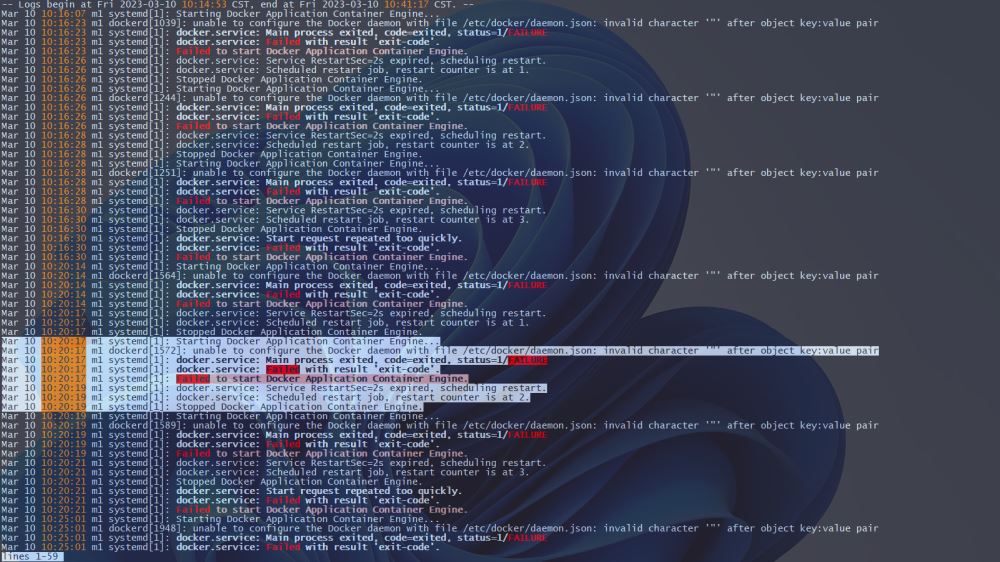
2️⃣ By outputting Ddocker log analysis, we extracted the relevant error message fragments and found that it was /etc/docker/daemon.json in the daemon configuration. Caused by an error in the configuration file.
Mar 10 10:20:17 m1 systemd[1]: Starting Docker Application Container Engine...
Mar 10 10:20:17 m1 dockerd[1572]: unable to configure the Docker daemon with file /etc/docker/daemon.json: invalid character '"' after object key:value pair
Mar 10 10:20:17 m1 systemd[1]: docker.service: Main process exited, code=exited, status=1/FAILURE
Mar 10 10:20:17 m1 systemd[1]: docker.service: Failed with result 'exit-code'.
Mar 10 10:20:17 m1 systemd[1]: Failed to start Docker Application Container Engine.
Mar 10 10:20:19 m1 systemd[1]: docker.service: Service RestartSec=2s expired, scheduling restart.
Mar 10 10:20:19 m1 systemd[1]: docker.service: Scheduled restart job, restart counter is at 2.
Mar 10 10:20:19 m1 systemd[1]: Stopped Docker Application Container Engine.
3️⃣At this point, check whether the daemon configuration file /etc/docker/daemon.json is configured correctly.
[root@m1 ~]# cat /etc/docker/daemon.json
{
  # 设置 Docker 镜像的注册表镜像源为阿里云镜像源。
  "registry-mirrors": ["https://w2kavmmf.mirror.aliyuncs.com"]
  # 指定 Docker 守护进程使用 systemd 作为 cgroup driver。
  "exec-opts": ["native.cgroupdriver=systemd"]
}
At first glance, there is nothing wrong with the configuration information and it is all correct, but if you look closely, you will find that a comma should be added at the end of the "registry-mirrors" option. I made a grammatical error caused by missing commas (,), and finally found the source of the problem.
After modification:
[root@m1 ~]# cat /etc/docker/daemon.json
{
  "registry-mirrors": ["https://w2kavmmf.mirror.aliyuncs.com"],
  "exec-opts": ["native.cgroupdriver=systemd"]
}

[root@m1 ~]# cat /etc/docker/daemon.json
{
  "registry-mirrors": ["https://w2kavmmf.mirror.aliyuncs.com"],
  "exec-opts": ["native.cgroupdriver=systemd"]
}
Press: wq to exit with an error.
4️⃣ Reload the system and restart the Docker service
systemctl daemon-reload
systemctl restart docker
systemctl status docker
5️⃣ Check whether the docker version information is output normally
[root@m1 ~]# docket version
-bash: docket: command not found
[root@m1 ~]# docker version
Client: Docker Engine - Community
 Version:           20.10.17
 API version:       1.41
 Go version:        go1.17.11
 Git commit:        100c701
 Built:             Mon Jun  6 23:03:11 2022
 OS/Arch:           linux/amd64
 Context:           default
 Experimental:      true

Server: Docker Engine - Community
 Engine:
  Version:          20.10.17
  API version:      1.41 (minimum version 1.12)
  Go version:       go1.17.11
  Git commit:       a89b842
  Built:            Mon Jun  6 23:01:29 2022
  OS/Arch:          linux/amd64
  Experimental:     false
 containerd:
  Version:          1.6.6
  GitCommit:        10c12954828e7c7c9b6e0ea9b0c02b01407d3ae1
 runc:
  Version:          1.1.2
  GitCommit:        v1.1.2-0-ga916309
 docker-init:
  Version:          0.19.0
  GitCommit:        de40ad0
[root@m1 ~]# docker info
Client:
 Context:    default
 Debug Mode: false
 Plugins:
  app: Docker App (Docker Inc., v0.9.1-beta3)
  buildx: Docker Buildx (Docker Inc., v0.8.2-docker)
  scan: Docker Scan (Docker Inc., v0.17.0)

Server:
 Containers: 20
  Running: 8
  Paused: 0
  Stopped: 12
 Images: 20
 Server Version: 20.10.17
 Storage Driver: overlay2
  Backing Filesystem: xfs
  Supports d_type: true
  Native Overlay Diff: true
  userxattr: false
 Logging Driver: json-file
 Cgroup Driver: systemd
 Cgroup Version: 1
 Plugins:
  Volume: local
  Network: bridge host ipvlan macvlan null overlay
  Log: awslogs fluentd gcplogs gelf journald json-file local logentries splunk syslog
 Swarm: inactive
 Runtimes: io.containerd.runc.v2 io.containerd.runtime.v1.linux runc
 Default Runtime: runc
 Init Binary: docker-init
 containerd version: 10c12954828e7c7c9b6e0ea9b0c02b01407d3ae1
 runc version: v1.1.2-0-ga916309
 init version: de40ad0
 Security Options:
  seccomp
   Profile: default
 Kernel Version: 4.18.0-372.9.1.el8.x86_64
 Operating System: Rocky Linux 8.6 (Green Obsidian)
 OSType: linux
 Architecture: x86_64
 CPUs: 2
 Total Memory: 9.711GiB
 Name: m1
 ID: 4YIS:FHSB:YXRI:CED5:PJSJ:EAS2:BCR3:GJJF:FDPK:EDJH:DVKU:AIYJ
 Docker Root Dir: /var/lib/docker
 Debug Mode: false
 Registry: https://index.docker.io/v1/
 Labels:
 Experimental: false
 Insecure Registries:
  127.0.0.0/8
 Registry Mirrors:
  https://w2kavmmf.mirror.aliyuncs.com/
 Live Restore Enabled: false
At this point, the Docker service restarts successfully, the pod node returns to normal, and Nginx The service can be accessed normally.
[root@m1 ~]# kubectl get pods
NAME                    READY   STATUS    RESTARTS   AGE
nginx-f89759699-cgjgp   1/1     Running   0          174m
Check the pod details and the display is normal.
[root@m1 ~]# kubectl describe pod nginx-f89759699-cgjgp
Name:             nginx-f89759699-cgjgp
Namespace:        default
Priority:         0
Service Account:  default
Node:             n1/192.168.200.84
Start Time:       Fri, 10 Mar 2023 08:40:33 +0800
Labels:           app=nginx
                  pod-template-hash=f89759699
Annotations:      <none>
Status:           Running
IP:               10.244.3.20
IPs:
  IP:           10.244.3.20
Controlled By:  ReplicaSet/nginx-f89759699
Containers:
  nginx:
    Container ID:   docker://88bdc2bfa592f60bf99bac2125b0adae005118ae8f2f271225245f20b7cfb3c8
    Image:          nginx
    Image ID:       docker-pullable://nginx@sha256:aa0afebbb3cfa473099a62c4b32e9b3fb73ed23f2a75a65ce1d4b4f55a5c2ef2
    Port:           <none>
    Host Port:      <none>
    State:          Running
      Started:      Fri, 10 Mar 2023 10:37:42 +0800
    Ready:          True
    Restart Count:  0
    Environment:    <none>
    Mounts:
      /var/run/secrets/kubernetes.io/serviceaccount from default-token-zk8sj (ro)
Conditions:
  Type              Status
  Initialized       True
  Ready             True
  ContainersReady   True
  PodScheduled      True
Volumes:
  default-token-zk8sj:
    Type:        Secret (a volume populated by a Secret)
    SecretName:  default-token-zk8sj
    Optional:    false
QoS Class:       BestEffort
Node-Selectors:  <none>
Tolerations:     node.kubernetes.io/not-ready:NoExecute op=Exists for 300s
                 node.kubernetes.io/unreachable:NoExecute op=Exists for 300s
Events:
  Type    Reason   Age                   From     Message
  ----    ------   ----                  ----     -------
  Normal  BackOff  58m (x480 over 171m)  kubelet  Back-off pulling image "nginx"
[root@m1 ~]#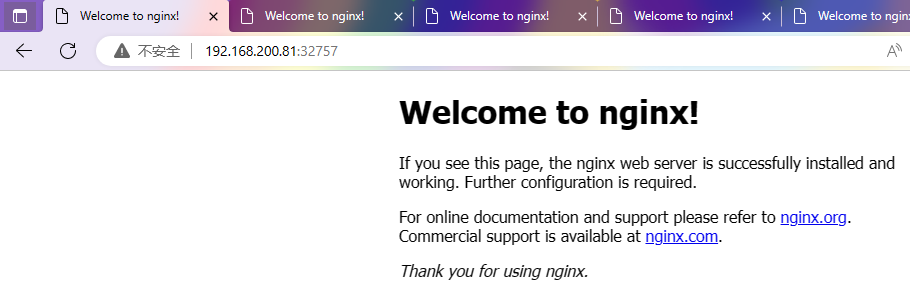
The above is the detailed content of How to troubleshoot Nginx service startup failure in Kubernetes. For more information, please follow other related articles on the PHP Chinese website!

Hot AI Tools

Undress AI Tool
Undress images for free

Undresser.AI Undress
AI-powered app for creating realistic nude photos

AI Clothes Remover
Online AI tool for removing clothes from photos.

Clothoff.io
AI clothes remover

Video Face Swap
Swap faces in any video effortlessly with our completely free AI face swap tool!

Hot Article
Hot Tools

Notepad++7.3.1
Easy-to-use and free code editor

SublimeText3 Chinese version
Chinese version, very easy to use

Zend Studio 13.0.1
Powerful PHP integrated development environment

Dreamweaver CS6
Visual web development tools

SublimeText3 Mac version
God-level code editing software (SublimeText3)


 How to execute php code after writing php code? Several common ways to execute php code
May 23, 2025 pm 08:33 PM
How to execute php code after writing php code? Several common ways to execute php code
May 23, 2025 pm 08:33 PM
PHP code can be executed in many ways: 1. Use the command line to directly enter the "php file name" to execute the script; 2. Put the file into the document root directory and access it through the browser through the web server; 3. Run it in the IDE and use the built-in debugging tool; 4. Use the online PHP sandbox or code execution platform for testing.
 After installing Nginx, the configuration file path and initial settings
May 16, 2025 pm 10:54 PM
After installing Nginx, the configuration file path and initial settings
May 16, 2025 pm 10:54 PM
Understanding Nginx's configuration file path and initial settings is very important because it is the first step in optimizing and managing a web server. 1) The configuration file path is usually /etc/nginx/nginx.conf. The syntax can be found and tested using the nginx-t command. 2) The initial settings include global settings (such as user, worker_processes) and HTTP settings (such as include, log_format). These settings allow customization and extension according to requirements. Incorrect configuration may lead to performance issues and security vulnerabilities.
 How to limit user resources in Linux? How to configure ulimit?
May 29, 2025 pm 11:09 PM
How to limit user resources in Linux? How to configure ulimit?
May 29, 2025 pm 11:09 PM
Linux system restricts user resources through the ulimit command to prevent excessive use of resources. 1.ulimit is a built-in shell command that can limit the number of file descriptors (-n), memory size (-v), thread count (-u), etc., which are divided into soft limit (current effective value) and hard limit (maximum upper limit). 2. Use the ulimit command directly for temporary modification, such as ulimit-n2048, but it is only valid for the current session. 3. For permanent effect, you need to modify /etc/security/limits.conf and PAM configuration files, and add sessionrequiredpam_limits.so. 4. The systemd service needs to set Lim in the unit file
 Specific steps to configure the self-start of Nginx service
May 16, 2025 pm 10:39 PM
Specific steps to configure the self-start of Nginx service
May 16, 2025 pm 10:39 PM
The steps for starting Nginx configuration are as follows: 1. Create a systemd service file: sudonano/etc/systemd/system/nginx.service, and add relevant configurations. 2. Reload the systemd configuration: sudosystemctldaemon-reload. 3. Enable Nginx to boot up automatically: sudosystemctlenablenginx. Through these steps, Nginx will automatically run when the system is started, ensuring the reliability and user experience of the website or application.
 What are the Debian Nginx configuration skills?
May 29, 2025 pm 11:06 PM
What are the Debian Nginx configuration skills?
May 29, 2025 pm 11:06 PM
When configuring Nginx on Debian system, the following are some practical tips: The basic structure of the configuration file global settings: Define behavioral parameters that affect the entire Nginx service, such as the number of worker threads and the permissions of running users. Event handling part: Deciding how Nginx deals with network connections is a key configuration for improving performance. HTTP service part: contains a large number of settings related to HTTP service, and can embed multiple servers and location blocks. Core configuration options worker_connections: Define the maximum number of connections that each worker thread can handle, usually set to 1024. multi_accept: Activate the multi-connection reception mode and enhance the ability of concurrent processing. s
 Configure PhpStorm and Docker containerized development environment
May 20, 2025 pm 07:54 PM
Configure PhpStorm and Docker containerized development environment
May 20, 2025 pm 07:54 PM
Through Docker containerization technology, PHP developers can use PhpStorm to improve development efficiency and environmental consistency. The specific steps include: 1. Create a Dockerfile to define the PHP environment; 2. Configure the Docker connection in PhpStorm; 3. Create a DockerCompose file to define the service; 4. Configure the remote PHP interpreter. The advantages are strong environmental consistency, and the disadvantages include long startup time and complex debugging.
 What are the SEO optimization techniques for Debian Apache2?
May 28, 2025 pm 05:03 PM
What are the SEO optimization techniques for Debian Apache2?
May 28, 2025 pm 05:03 PM
DebianApache2's SEO optimization skills cover multiple levels. Here are some key methods: Keyword research: Use tools (such as keyword magic tools) to mine the core and auxiliary keywords of the page. High-quality content creation: produce valuable and original content, and the content needs to be conducted in-depth research to ensure smooth language and clear format. Content layout and structure optimization: Use titles and subtitles to guide reading. Write concise and clear paragraphs and sentences. Use the list to display key information. Combining multimedia such as pictures and videos to enhance expression. The blank design improves the readability of text. Technical level SEO improvement: robots.txt file: Specifies the access rights of search engine crawlers. Accelerate web page loading: optimized with the help of caching mechanism and Apache configuration
 How to implement automated deployment of Docker on Debian
May 28, 2025 pm 04:33 PM
How to implement automated deployment of Docker on Debian
May 28, 2025 pm 04:33 PM
Implementing Docker's automated deployment on Debian system can be done in a variety of ways. Here are the detailed steps guide: 1. Install Docker First, make sure your Debian system remains up to date: sudoaptupdatesudoaptupgrade-y Next, install the necessary software packages to support APT access to the repository via HTTPS: sudoaptinstallapt-transport-httpsca-certificatecurlsoftware-properties-common-y Import the official GPG key of Docker: curl-
