


How to calculate π using formula in Python

Python uses formulas to calculate π: first import the math module and time module; then calculate Pi to a few digits after the decimal point, the code is [print('\n{:=^70}'.format ('Calculation starts'))]; Finally, the calculation is completed, the code is [print('\n{:=^70}'].

[Related Study recommendation: python tutorial】
How to calculate π using python formula:
1. Introduction to π
Introduction to π
Pi is represented by the Greek letter π (pronounced pài). It is a constant (approximately equal to 3.141592654) and represents the ratio of the circumference and diameter of a circle. It is an infinite Repeating decimals, in daily life, usually use 3.14 to represent pi for approximate calculations.
The solution process of π
In 1965, the British mathematician John Waugh John Wallis published a mathematical monograph in which he derived a formula and found that pi is equal to the product of infinite fractions multiplied.
In 2015, a professor at the University of Rochester Scientists discovered the same formula for pi in quantum mechanical calculations of the energy levels of hydrogen atoms.
On March 14, 2019, Google announced that pi has now reached 31.4 trillion decimal places.
Here I use a formula that I feel is 'good' to solve. It is good because the calculation results are relatively accurate, but the calculation process takes a long time. Let's do it together. Let’s study~~~
2. Approximate calculation of π
1. Calculation formula
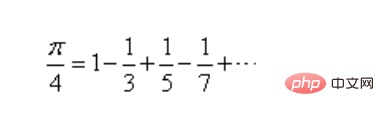
2. Method explanation
The numerators on the right side of the formulas and equations used are all 1, and the denominator is an increasing sequence. Starting from the first term, the odd term sign is positive, and the sign of the even term is negative. The larger and smaller the denominator on the right side of the equation is, the more accurate the calculated value of pi is. To put it another way, the more terms on the right side of the equation, the more accurate the calculated value.
3. Code implementation (python)
 1 from math import fabs           #导入数学模块
 2 from time import perf_counter   #导入时间模块
 3
 4 def Bar(i):         #动态文本条
 5     N = pow(10,level)
 6     a = int((i/N)*50)
 7     b = 50 - a
 8     Y , N = '*' * a , '.' * b
 9     print("\r计算中:{:3.0f}% [{}->{}] {:.2f}s"
10           .format(2*a,Y,N,perf_counter()),end='')
11
12 level = eval(input('计算Pi精确到小数点后几位数:'))
13 print('\n{:=^70}'.format('计算开始'))
14 a,b,pi,tmp = 1,1,0,1
15 i = 0
16 '''
17 a 分子  |  b 分母  |  pi 圆周率
18 tmp 存储a/b的值    |  i  执行进度
19 '''
20 perf_counter()      #开始计时
21 while (fabs(tmp) >= pow(10,-level)): #计算Pi
22     pi += tmp
23     b += 2
24     a = -a
25     tmp = a/b
26     i += 2
27     Bar(i)          #调用函数,实时显示计算进度
28
29 print('\n{:=^70}'.format('计算完成'))
30 print('\nPi的计算值为:{}'.format(round(pi*4,level))) #输出计算结果4. Picture example
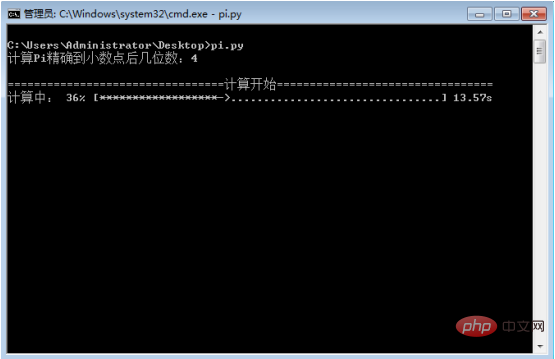
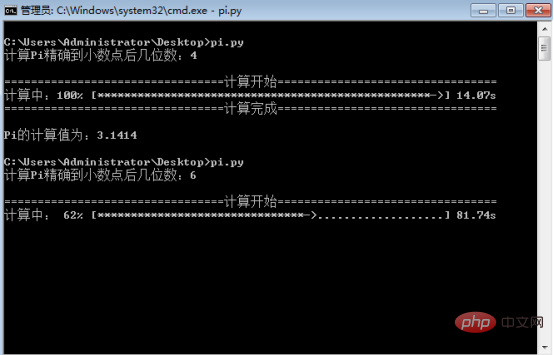
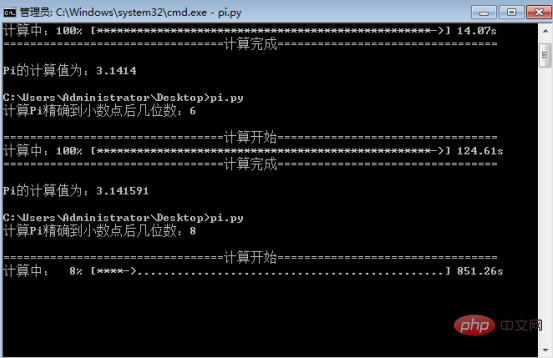
As can be seen from the above three pictures, it only takes 14.07 seconds to be accurate to 4 digits after the decimal point, and it also takes 6 seconds to be accurate to 6 digits after the decimal point. 124.61 seconds, and accurate to 8 decimal places requires 850 / 8% = 10625 seconds, which is about 177 minutes, or 2.95 hours. This method is good, but it still takes a long time to calculate.
The above is the detailed content of How to calculate π using formula in Python. For more information, please follow other related articles on the PHP Chinese website!

Hot AI Tools

Undresser.AI Undress
AI-powered app for creating realistic nude photos

AI Clothes Remover
Online AI tool for removing clothes from photos.

Undress AI Tool
Undress images for free

Clothoff.io
AI clothes remover

AI Hentai Generator
Generate AI Hentai for free.

Hot Article
Hot Tools

Notepad++7.3.1
Easy-to-use and free code editor

SublimeText3 Chinese version
Chinese version, very easy to use

Zend Studio 13.0.1
Powerful PHP integrated development environment

Dreamweaver CS6
Visual web development tools

SublimeText3 Mac version
God-level code editing software (SublimeText3)
Hot Topics
 1379
1379
 52
52

 PHP and Python: Code Examples and Comparison
Apr 15, 2025 am 12:07 AM
PHP and Python: Code Examples and Comparison
Apr 15, 2025 am 12:07 AM
PHP and Python have their own advantages and disadvantages, and the choice depends on project needs and personal preferences. 1.PHP is suitable for rapid development and maintenance of large-scale web applications. 2. Python dominates the field of data science and machine learning.
 How to train PyTorch model on CentOS
Apr 14, 2025 pm 03:03 PM
How to train PyTorch model on CentOS
Apr 14, 2025 pm 03:03 PM
Efficient training of PyTorch models on CentOS systems requires steps, and this article will provide detailed guides. 1. Environment preparation: Python and dependency installation: CentOS system usually preinstalls Python, but the version may be older. It is recommended to use yum or dnf to install Python 3 and upgrade pip: sudoyumupdatepython3 (or sudodnfupdatepython3), pip3install--upgradepip. CUDA and cuDNN (GPU acceleration): If you use NVIDIAGPU, you need to install CUDATool
 How is the GPU support for PyTorch on CentOS
Apr 14, 2025 pm 06:48 PM
How is the GPU support for PyTorch on CentOS
Apr 14, 2025 pm 06:48 PM
Enable PyTorch GPU acceleration on CentOS system requires the installation of CUDA, cuDNN and GPU versions of PyTorch. The following steps will guide you through the process: CUDA and cuDNN installation determine CUDA version compatibility: Use the nvidia-smi command to view the CUDA version supported by your NVIDIA graphics card. For example, your MX450 graphics card may support CUDA11.1 or higher. Download and install CUDAToolkit: Visit the official website of NVIDIACUDAToolkit and download and install the corresponding version according to the highest CUDA version supported by your graphics card. Install cuDNN library:
 Detailed explanation of docker principle
Apr 14, 2025 pm 11:57 PM
Detailed explanation of docker principle
Apr 14, 2025 pm 11:57 PM
Docker uses Linux kernel features to provide an efficient and isolated application running environment. Its working principle is as follows: 1. The mirror is used as a read-only template, which contains everything you need to run the application; 2. The Union File System (UnionFS) stacks multiple file systems, only storing the differences, saving space and speeding up; 3. The daemon manages the mirrors and containers, and the client uses them for interaction; 4. Namespaces and cgroups implement container isolation and resource limitations; 5. Multiple network modes support container interconnection. Only by understanding these core concepts can you better utilize Docker.
 Python vs. JavaScript: Community, Libraries, and Resources
Apr 15, 2025 am 12:16 AM
Python vs. JavaScript: Community, Libraries, and Resources
Apr 15, 2025 am 12:16 AM
Python and JavaScript have their own advantages and disadvantages in terms of community, libraries and resources. 1) The Python community is friendly and suitable for beginners, but the front-end development resources are not as rich as JavaScript. 2) Python is powerful in data science and machine learning libraries, while JavaScript is better in front-end development libraries and frameworks. 3) Both have rich learning resources, but Python is suitable for starting with official documents, while JavaScript is better with MDNWebDocs. The choice should be based on project needs and personal interests.
 How to choose the PyTorch version under CentOS
Apr 14, 2025 pm 02:51 PM
How to choose the PyTorch version under CentOS
Apr 14, 2025 pm 02:51 PM
When selecting a PyTorch version under CentOS, the following key factors need to be considered: 1. CUDA version compatibility GPU support: If you have NVIDIA GPU and want to utilize GPU acceleration, you need to choose PyTorch that supports the corresponding CUDA version. You can view the CUDA version supported by running the nvidia-smi command. CPU version: If you don't have a GPU or don't want to use a GPU, you can choose a CPU version of PyTorch. 2. Python version PyTorch
 How to operate distributed training of PyTorch on CentOS
Apr 14, 2025 pm 06:36 PM
How to operate distributed training of PyTorch on CentOS
Apr 14, 2025 pm 06:36 PM
PyTorch distributed training on CentOS system requires the following steps: PyTorch installation: The premise is that Python and pip are installed in CentOS system. Depending on your CUDA version, get the appropriate installation command from the PyTorch official website. For CPU-only training, you can use the following command: pipinstalltorchtorchvisiontorchaudio If you need GPU support, make sure that the corresponding version of CUDA and cuDNN are installed and use the corresponding PyTorch version for installation. Distributed environment configuration: Distributed training usually requires multiple machines or single-machine multiple GPUs. Place
 How to install nginx in centos
Apr 14, 2025 pm 08:06 PM
How to install nginx in centos
Apr 14, 2025 pm 08:06 PM
CentOS Installing Nginx requires following the following steps: Installing dependencies such as development tools, pcre-devel, and openssl-devel. Download the Nginx source code package, unzip it and compile and install it, and specify the installation path as /usr/local/nginx. Create Nginx users and user groups and set permissions. Modify the configuration file nginx.conf, and configure the listening port and domain name/IP address. Start the Nginx service. Common errors need to be paid attention to, such as dependency issues, port conflicts, and configuration file errors. Performance optimization needs to be adjusted according to the specific situation, such as turning on cache and adjusting the number of worker processes.
