


How to install phpmyadmin on the server


If you use php and mysql to develop a website, phpmyadmin is a very friendly mysql management tool, and it is free and open source. Many domestic virtual hosts come with such management tools, and the configuration is very simple. Next, configure phpmyadmin on the Linux server to manage the MySQL database.
First visit the homepage of the phpmyadmin official website, the URL is: http://www.phpmyadmin.net/. After entering, there is a download button. Do not download it yet, because the download is a zip package for windows. Click Download on the navigation bar. Link, enter the download interface, download the latest version 4.5.5.1 here, select the version shown in the picture to download:
Download and upload to the server, and then execute the following command Decompression:
tar -xvzf phpMyAdmin-4.5.5.1-all-languages.tar.gz
After decompression is completed, we put it in a directory that can be accessed by the web for subsequent management, such as /home/wwwroot
mv phpMyAdmin-4.5.5.1-all-languages /home/wwwroot/
and then execute cd /home/wwwroot/ Then rename the phpmyadmin directory, trying not to let others guess the entrance, for example:
mv phpMyAdmin-4.5.5.1-all-languages phpmyAdmina4689f
Then execute cd phpmyAdmina4689f to enter the installation directory. The latest version of phpmyadmin supports quick configuration without executing the installation script. The official Chinese quick installation Document: http://docs.phpmyadmin.net/zh_CN/latest/setup.html#quick-install
At this time you can see a configuration file in the directory: config.sample.inc.php
Copy this file:
cp config.sample.inc.php config.inc.php
Then execute the edit:
vim config.inc.php
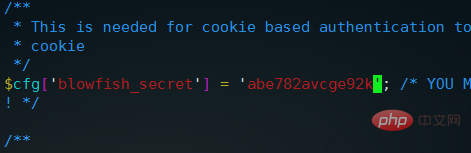
Find the $cfg['blowfish_secret'] configuration item, which is empty by default. We can set it as we like here. A complex string used for encryption:
Then $cfg['Servers'][$i]['auth_type'] defaults to cookie, It means that you need to log in every time. We don’t need to modify it. This is safer. Then $cfg['Servers'][$i]['host'] = '127.0.0.1'; it is recommended to set it to the IP address, whether it is local Or remotely, as long as mysql authorization is used, there will be no problem. The default localhost may cause an error like #2002 - Permission denied — The server is not responding. Be sure to pay attention. It is recommended to use the IP address
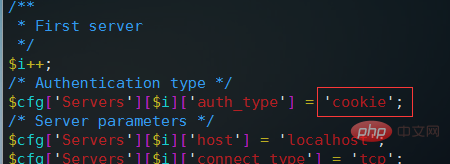
If you are debugging locally, then set it here to config, and then fill in the user name and password here. It will automatically enter every time, and debugging is more convenient.
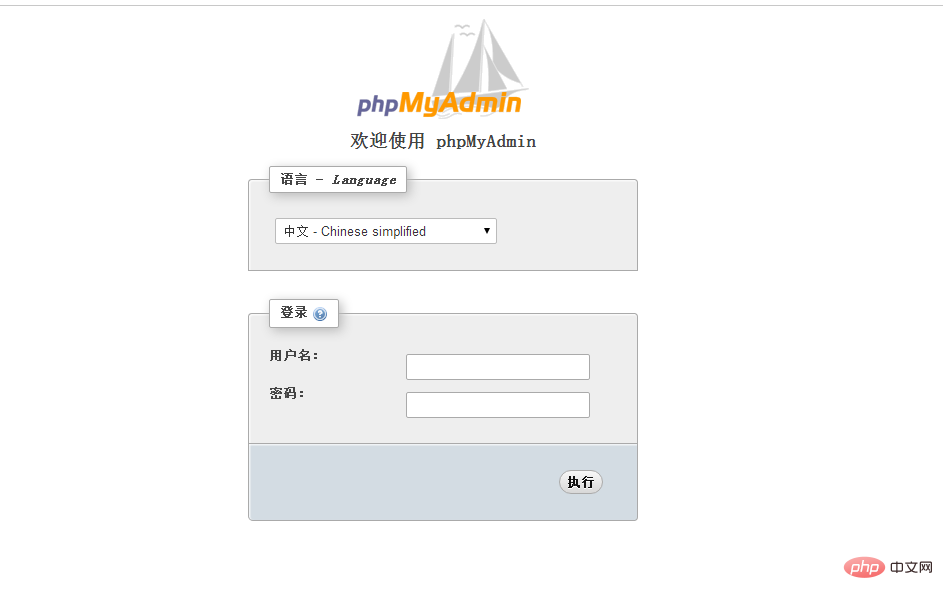
The overall thing is to set the above login authentication type and IP address There are two items in total. After setting, save and exit, then access our phpmyadmin directory address through the web. For example, if it is placed under www.xxxx.com, then at this time we need to visit: http://www.xxxx.com/phpmyAdmina4689f , note that the Linux server is strictly case-sensitive. When you see the login interface, phpmyadmin is configured
Recommended learning: phpmyadmin tutorial
The above is the detailed content of How to install phpmyadmin on the server. For more information, please follow other related articles on the PHP Chinese website!

Hot AI Tools

Undress AI Tool
Undress images for free

Undresser.AI Undress
AI-powered app for creating realistic nude photos

AI Clothes Remover
Online AI tool for removing clothes from photos.

Clothoff.io
AI clothes remover

Video Face Swap
Swap faces in any video effortlessly with our completely free AI face swap tool!

Hot Article
Hot Tools

Notepad++7.3.1
Easy-to-use and free code editor

SublimeText3 Chinese version
Chinese version, very easy to use

Zend Studio 13.0.1
Powerful PHP integrated development environment

Dreamweaver CS6
Visual web development tools

SublimeText3 Mac version
God-level code editing software (SublimeText3)
Hot Topics
 1793
1793
 16
1736
56
1588
29
267
587
16
1736
56
1588
29
267
587

 How to set primary key in phpmyadmin
Apr 07, 2024 pm 02:54 PM
How to set primary key in phpmyadmin
Apr 07, 2024 pm 02:54 PM
The primary key of a table is one or more columns that uniquely identify each record in the table. Here are the steps to set a primary key: Log in to phpMyAdmin. Select database and table. Check the column you want to use as the primary key. Click "Save Changes". Primary keys provide data integrity, lookup speed, and relationship modeling benefits.
 How to add foreign keys in phpmyadmin
Apr 07, 2024 pm 02:36 PM
How to add foreign keys in phpmyadmin
Apr 07, 2024 pm 02:36 PM
Adding a foreign key in phpMyAdmin can be achieved by following these steps: Select the parent table that contains the foreign key. Edit the parent table structure and add new columns in "Columns". Enable foreign key constraints and select the referencing table and key. Set update/delete operations. save Changes.
 How to delete data table in phpmyadmin
Apr 07, 2024 pm 03:00 PM
How to delete data table in phpmyadmin
Apr 07, 2024 pm 03:00 PM
Steps to delete a data table in phpMyAdmin: Select the database and data table; click the "Action" tab; select the "Delete" option; confirm and perform the deletion operation.
 Where does the wordpress database exist?
Apr 15, 2024 pm 10:39 PM
Where does the wordpress database exist?
Apr 15, 2024 pm 10:39 PM
The WordPress database is housed in a MySQL database that stores all website data and can be accessed through your hosting provider’s dashboard, FTP, or phpMyAdmin. The database name is related to the website URL or username, and access requires the use of database credentials, including name, username, password, and hostname, which are typically stored in the "wp-config.php" file.
 What should I do if navicat cannot connect?
Apr 23, 2024 am 10:00 AM
What should I do if navicat cannot connect?
Apr 23, 2024 am 10:00 AM
When Navicat cannot connect, you can try the following solutions in order: Check whether the connection information is correct, such as database name, host name, port number, user name and password. Make sure the database is up and running. Check the firewall rules to confirm that Navicat and related services are not blocked. Try using the ping command to test your network connection. Update Navicat client software to the latest version. Check the server logs for error messages related to failed connections. Try connecting using other database tools to troubleshoot Navicat-specific issues.
 How to set foreign keys in phpmyadmin
Apr 07, 2024 pm 03:03 PM
How to set foreign keys in phpmyadmin
Apr 07, 2024 pm 03:03 PM
How to set up foreign keys? Create main table and sub-table. Open the phpMyAdmin dashboard. Select the main table. Open the "Structure" tab. Add a foreign key column and select the related column in the child table. Select the foreign key type (such as "CASCADE"). save Changes.
 What to do if the installation of phpmyadmin fails
Apr 07, 2024 pm 03:15 PM
What to do if the installation of phpmyadmin fails
Apr 07, 2024 pm 03:15 PM
Troubleshooting steps for failed phpMyAdmin installation: Check system requirements (PHP version, MySQL version, web server); enable PHP extensions (mysqli, pdo_mysql, mbstring, token_get_all); check configuration file settings (host, port, username, password); Check file permissions (directory ownership, file permissions); check firewall settings (whitelist web server ports); view error logs (/var/log/apache2/error.log or /var/log/nginx/error.log); seek Technical support (phpMyAdmin
 How to change the default password of Empire CMS
Apr 16, 2024 pm 03:21 PM
How to change the default password of Empire CMS
Apr 16, 2024 pm 03:21 PM
Reset the Empire CMS default password through the following steps: Log in to the database and find the user table. Edit the administrator user (username is admin). Modify the value in the password field. Save the changes and use the new password to log in to the management backend.
