


 Web Front-end
CSS Tutorial
How to set background image with css? background attribute adds background image
Web Front-end
CSS Tutorial
How to set background image with css? background attribute adds background image
How to set background image with css? background attribute adds background image

During the front-end development process, background images are often added to HTML pages for the sake of page beauty. So how to use css to set the image as the background in html? This chapter will introduce to you how to set a background image with css. It has certain reference value. Friends in need can refer to it. I hope it will be helpful to you.
Recommended Manual: CSS Online Manual
##How to set the background image in css?
css background attribute is a property that specifically sets the background. You can set the background color or background image.Let’s take a look at the attributes that can be set for background:
- background-color: Specifies the background color to be used.
- background-position: Specifies the position of the background image.
- background-size: Specifies the size of the background image.
- background-repeat: Specifies how to repeat the background image.
- background-origin: Specifies the positioning area of the background image.
- background-clip: Specifies the drawing area of the background.
- background-attachment: Specifies whether the background image is fixed or scrolls with the rest of the page.
- background-image: Specifies the background image to be used.
background-image:url(How to set background image with css? background attribute adds background image);This is given in url() By specifying the path of the image, you can set a background image for the div box; it seems simple, but one thing to note is that the box for setting the background image must have substantial width and height, so that the background image can be displayed on the display.
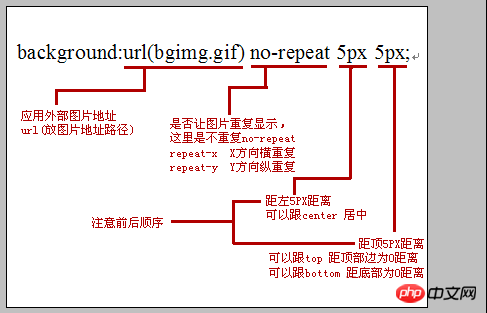
background:url(bgimg.gif) no-repeat 5px 5px;Explanation as shown below:
Recommended related articles: 1.
How to make the background image tiled in css? Introduction to four ways of tiling css background images 2.
How to add a background image and make the image tile the entire page? (code example) 3.
How to achieve a fixed background image in css
Related video recommendations: 1.
CSS Video Tutorial-Jade Girl Heart Sutra Edition
css code example for setting background image
1.css set the background image to adaptive full screen
<!DOCTYPE html>
<html>
	<head>
		<meta charset="UTF-8">
		<title>背景图片设置</title>
		<style>
			.demo{
				position:fixed;
				top: 0;
				left: 0;
				width:100%;
				height:100%;
				min-width: 1000px;
				z-index:-10;
				zoom: 1;
				background-color: #fff;
				background: url(2.png);
				background-repeat: no-repeat;
				background-size: cover;
				-webkit-background-size: cover;
				-o-background-size: cover;
				background-position: center 0;
			}
		</style>
	</head>
	<body>
		<div class="demo"></div>
	</body>
</html>
Rendering: 
position:fixed;
top: 0;
left: 0;
These three sentences fix the entire div.demo box at the top and left of the screen.
width:100%;
height:100%;
This is to make the entire div the same size as the screen, thereby achieving a full-screen effect.
min-width: 1000px;min-width is to keep the size of the div unchanged when the screen width is within 1000px. That is to say, in this case, when scaling the screen width, the image should not be scaled (only within 1000px is effective).
z-index:-10;This is to place the entire div below each level in the HTML page. Under normal circumstances, the z-index value of the first created level is 0, so if we write -1 here, it is OK. Implementation, but writing -10 here is to ensure that the entire div is at the bottom, because if there are too many levels in the page, sometimes -1 is not necessarily at the bottom, but it does not make sense if it is written as a large number like -100. Use index:-10 to achieve what looks like a background image. It is actually the most ordinary div, but the hierarchical relationship has changed, making it look like a background image.
background-repeat: no-repeat;This css style is to set the background image not to repeat; the example is a large image. If it is a solid color (or with dots/stripes) image, the image can be tiled (repeated) ) to the entire screen to achieve a full-screen effect. (repeat-x is to set horizontal tiling, repeat-y is to set vertical tiling) 2.css sets the background image to be transparent Original image:

<!DOCTYPE html>
<html>
	<head>
		<meta charset="UTF-8">
		<title>背景图片设置</title>
		<style>
			.demo{
				width: 600px;
				height: 200px;
				background:url(How to set background image with css? background attribute adds background image) no-repeat;

			}
			.demo1{
				width: 100%;
				height: 100%;
				background-color: rgba(255,255,255,0.5);
			}
		</style>
	</head>
	<body>
		<div class="demo">
			<div class="demo1"></div>
		</div>
	</body>
</html>
Rendering:

This method has good browser compatibility, and you can add text in a transparent div box to achieve the effect of transparent pictures but opaque text.
Related recommendations:
3. Summary and sharing of background (properties, colors, images) settings in css
4.CSS realizes web page background image adaptive full-screen detailed explanation
5.How to set the css background image to stretch to 100% full screen display
The above is the detailed content of How to set background image with css? background attribute adds background image. For more information, please follow other related articles on the PHP Chinese website!

Hot AI Tools

Undress AI Tool
Undress images for free

Undresser.AI Undress
AI-powered app for creating realistic nude photos

AI Clothes Remover
Online AI tool for removing clothes from photos.

Clothoff.io
AI clothes remover

Video Face Swap
Swap faces in any video effortlessly with our completely free AI face swap tool!

Hot Article
Hot Tools

Notepad++7.3.1
Easy-to-use and free code editor

SublimeText3 Chinese version
Chinese version, very easy to use

Zend Studio 13.0.1
Powerful PHP integrated development environment

Dreamweaver CS6
Visual web development tools

SublimeText3 Mac version
God-level code editing software (SublimeText3)
Hot Topics


 What is Autoprefixer and how does it work?
Jul 02, 2025 am 01:15 AM
What is Autoprefixer and how does it work?
Jul 02, 2025 am 01:15 AM
Autoprefixer is a tool that automatically adds vendor prefixes to CSS attributes based on the target browser scope. 1. It solves the problem of manually maintaining prefixes with errors; 2. Work through the PostCSS plug-in form, parse CSS, analyze attributes that need to be prefixed, and generate code according to configuration; 3. The usage steps include installing plug-ins, setting browserslist, and enabling them in the build process; 4. Notes include not manually adding prefixes, keeping configuration updates, prefixes not all attributes, and it is recommended to use them with the preprocessor.
 How can you animate an SVG with CSS?
Jun 30, 2025 am 02:06 AM
How can you animate an SVG with CSS?
Jun 30, 2025 am 02:06 AM
AnimatingSVGwithCSSispossibleusingkeyframesforbasicanimationsandtransitionsforinteractiveeffects.1.Use@keyframestodefineanimationstagesforpropertieslikescale,opacity,andcolor.2.ApplytheanimationtoSVGelementssuchas,,orviaCSSclasses.3.Forhoverorstate-b
 What is the conic-gradient() function?
Jul 01, 2025 am 01:16 AM
What is the conic-gradient() function?
Jul 01, 2025 am 01:16 AM
Theconic-gradient()functioninCSScreatescirculargradientsthatrotatecolorstopsaroundacentralpoint.1.Itisidealforpiecharts,progressindicators,colorwheels,anddecorativebackgrounds.2.Itworksbydefiningcolorstopsatspecificangles,optionallystartingfromadefin
 CSS tutorial focusing on mobile-first design
Jul 02, 2025 am 12:52 AM
CSS tutorial focusing on mobile-first design
Jul 02, 2025 am 12:52 AM
Mobile-firstCSSdesignrequiressettingtheviewportmetatag,usingrelativeunits,stylingfromsmallscreensup,optimizingtypographyandtouchtargets.First,addtocontrolscaling.Second,use%,em,orreminsteadofpixelsforflexiblelayouts.Third,writebasestylesformobile,the
 CSS tutorial for creating loading spinners and animations
Jul 07, 2025 am 12:07 AM
CSS tutorial for creating loading spinners and animations
Jul 07, 2025 am 12:07 AM
There are three ways to create a CSS loading rotator: 1. Use the basic rotator of borders to achieve simple animation through HTML and CSS; 2. Use a custom rotator of multiple points to achieve the jump effect through different delay times; 3. Add a rotator in the button and switch classes through JavaScript to display the loading status. Each approach emphasizes the importance of design details such as color, size, accessibility and performance optimization to enhance the user experience.
 What is feature detection in CSS using @supports?
Jul 02, 2025 am 01:14 AM
What is feature detection in CSS using @supports?
Jul 02, 2025 am 01:14 AM
FeaturedetectioninCSSusing@supportschecksifabrowsersupportsaspecificfeaturebeforeapplyingrelatedstyles.1.ItusesconditionalCSSblocksbasedonproperty-valuepairs,suchas@supports(display:grid).2.Thismethodensuresfuturecompatibilityandavoidsrelianceonunrel
 European virtual currency trading platform ranking list 2025 latest list TOP10 inventory (recently updated)
Jul 11, 2025 pm 08:57 PM
European virtual currency trading platform ranking list 2025 latest list TOP10 inventory (recently updated)
Jul 11, 2025 pm 08:57 PM
The top ten virtual currency trading platforms in Europe in 2025 include Binance, OKX, Coinbase, etc., and are selected based on compliance, security, expenses, asset types and user experience. 1. Binance: The world has the largest transaction volume, low fees, and has obtained a license in multiple countries; 2. OKX: Comprehensive products, strong technology, registered in France; 3. Coinbase: Compliance and safety, suitable for beginners, licensed in many countries; 4. Gate.io: Has a long history, high security, registered in many European countries; 5. Bitstamp: Founded early, has strong compliance, regulated by Luxembourg; 6. eToro: Supports social transactions, diversified investment, regulated by CySEC; 7. Bitpanda: World
 Integrating CSS and JavaScript effectively with HTML5 structure.
Jul 12, 2025 am 03:01 AM
Integrating CSS and JavaScript effectively with HTML5 structure.
Jul 12, 2025 am 03:01 AM
HTML5, CSS and JavaScript should be efficiently combined with semantic tags, reasonable loading order and decoupling design. 1. Use HTML5 semantic tags, such as improving structural clarity and maintainability, which is conducive to SEO and barrier-free access; 2. CSS should be placed in, use external files and split by module to avoid inline styles and delayed loading problems; 3. JavaScript is recommended to be introduced in front, and use defer or async to load asynchronously to avoid blocking rendering; 4. Reduce strong dependence between the three, drive behavior through data-* attributes and class name control status, and improve collaboration efficiency through unified naming specifications. These methods can effectively optimize page performance and collaborate with teams.
