


How to deploy a SpringBoot API on AWS ECS using CDKTF?

When a Java developer asked me how to deploy their Spring Boot API on AWS ECS, I saw it as the perfect chance to dive into the latest updates on the CDKTF (Cloud Development Kit for Terraform) project.
In a previous article, I introduced CDKTF, a framework that allows you to write Infrastructure as Code (IaC) using general-purpose programming languages such as Python. Since then, CDKTF has reached its first GA release, making it the perfect time to revisit it. In this article, we’ll walk through deploying a Spring Boot API on AWS ECS using CDKTF.
Find the code of this article on my github repo.
How to deploy a SpringBoot API on AWS ECS using CDKTF? Overview
Before diving into the implementation, let’s review the architecture we aim to deploy:
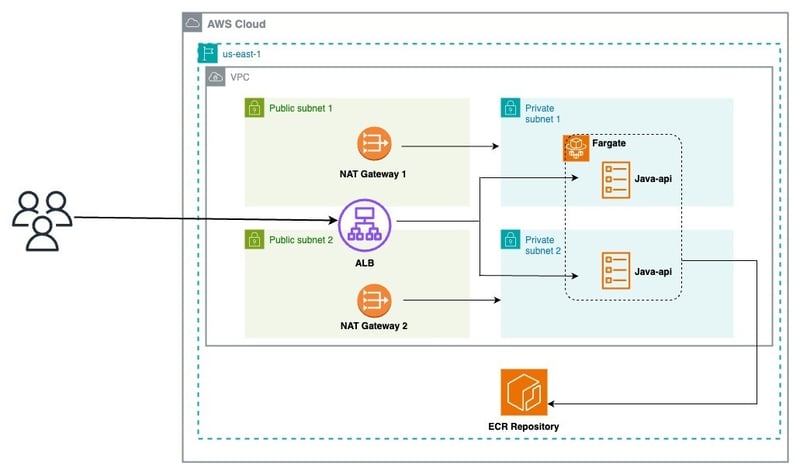
From this diagram, we can break down the architecture into 03 layers:
-
Network:
- VPC
- Public and private subnets
- Internet Gateway
- NAT Gateways
-
Infrastructure:
- Application Load Balancer (ALB)
- Listeners
- ECS Cluster
-
Service Stack:
- Target Groups
- ECS Service
- Task Definitions
Step 1: Containerize your Spring Boot Application
The Java API we’re deploying is available on GitHub.
It defines a simple REST API with three endpoints:
- /ping: Returns the string "pong". This endpoint is useful for testing the API's responsiveness. It also increments a Prometheus counter metric for monitoring.
- /healthcheck: Returns "ok", serving as a health check endpoint to ensure the application is running correctly. Like /ping, it updates a Prometheus counter for observability.
- /hello: Accepts a name query parameter (defaults to "World") and returns a personalized greeting, e.g., "Hello, [name]!". This endpoint also integrates with the Prometheus counter.
Let’s add the Dockerfile:
FROM maven:3.9-amazoncorretto-21 AS builder

WORKDIR /app

COPY pom.xml .

COPY src src

RUN mvn clean package

# amazon java distribution
FROM amazoncorretto:21-alpine

COPY --from=builder /app/target/*.jar /app/java-api.jar

EXPOSE 8080

ENTRYPOINT ["java","-jar","/app/java-api.jar"]
Our application is ready to be deployed!
Step 2: Set up AWS CDKTF
AWS CDKTF allows you to define and manage AWS resources using Python.
1. Prerequisites
- [**python (3.13)**](https://www.python.org/)
- [**pipenv**](https://pipenv.pypa.io/en/latest/)
- [**npm**](https://nodejs.org/en/)
2. Install CDKTF and Dependencies
Ensure you have the necessary tools by installing CDKTF and its dependencies:
$ npm install -g cdktf-cli@latest
This installs the cdktf CLI that allows to spin up new projects for various languages.
3. Initialize Your CDKTF Application
We can scaffold a new python project by running:
FROM maven:3.9-amazoncorretto-21 AS builder

WORKDIR /app

COPY pom.xml .

COPY src src

RUN mvn clean package

# amazon java distribution
FROM amazoncorretto:21-alpine

COPY --from=builder /app/target/*.jar /app/java-api.jar

EXPOSE 8080

ENTRYPOINT ["java","-jar","/app/java-api.jar"]
There are many files created by default and all the dependencies are installed.
Below is the initial main.pyfile:
- [**python (3.13)**](https://www.python.org/)
- [**pipenv**](https://pipenv.pypa.io/en/latest/)
- [**npm**](https://nodejs.org/en/)
Step 3: Building Layers
A stack represents a group of infrastructure resources that CDK for Terraform (CDKTF) compiles into a distinct Terraform configuration. Stacks enable separate state management for different environments within an application. To share resources across layers, we will utilize Cross-Stack references.
1. Network Layer
Add the network_stack.py file to your project
$ npm install -g cdktf-cli@latest
Add the following code to create all the network resources:
# init the project using aws provider
$ mkdir samples-fargate

$ cd samples-fargate && cdktf init --template=python --providers=aws
Then, edit the main.py file:
#!/usr/bin/env python
from constructs import Construct
from cdktf import App, TerraformStack

class MyStack(TerraformStack):
    def __init__(self, scope: Construct, id: str):
        super().__init__(scope, id)

        # define resources here

app = App()
MyStack(app, "aws-cdktf-samples-fargate")

app.synth()
Generate the terraform configuration files by running the following command:
$ mkdir infra

$ cd infra && touch network_stack.py
Deploy the network stack with this:
from constructs import Construct
from cdktf import S3Backend, TerraformStack
from cdktf_cdktf_provider_aws.provider import AwsProvider
from cdktf_cdktf_provider_aws.vpc import Vpc
from cdktf_cdktf_provider_aws.subnet import Subnet
from cdktf_cdktf_provider_aws.eip import Eip
from cdktf_cdktf_provider_aws.nat_gateway import NatGateway
from cdktf_cdktf_provider_aws.route import Route
from cdktf_cdktf_provider_aws.route_table import RouteTable
from cdktf_cdktf_provider_aws.route_table_association import RouteTableAssociation
from cdktf_cdktf_provider_aws.internet_gateway import InternetGateway

class NetworkStack(TerraformStack):
    def __init__(self, scope: Construct, ns: str, params: dict):
        super().__init__(scope, ns)

        self.region = params["region"]

        # configure the AWS provider to use the us-east-1 region
        AwsProvider(self, "AWS", region=self.region)

        # use S3 as backend
        S3Backend(
            self,
            bucket=params["backend_bucket"],
            key=params["backend_key_prefix"] + "/network.tfstate",
            region=self.region,
        )

        # create the vpc
        vpc_demo = Vpc(self, "vpc-demo", cidr_block="192.168.0.0/16")

        # create two public subnets
        public_subnet1 = Subnet(
            self,
            "public-subnet-1",
            vpc_id=vpc_demo.id,
            availability_zone=f"{self.region}a",
            cidr_block="192.168.1.0/24",
        )

        public_subnet2 = Subnet(
            self,
            "public-subnet-2",
            vpc_id=vpc_demo.id,
            availability_zone=f"{self.region}b",
            cidr_block="192.168.2.0/24",
        )

        # create. the internet gateway
        igw = InternetGateway(self, "igw", vpc_id=vpc_demo.id)

        # create the public route table
        public_rt = Route(
            self,
            "public-rt",
            route_table_id=vpc_demo.main_route_table_id,
            destination_cidr_block="0.0.0.0/0",
            gateway_id=igw.id,
        )

        # create the private subnets
        private_subnet1 = Subnet(
            self,
            "private-subnet-1",
            vpc_id=vpc_demo.id,
            availability_zone=f"{self.region}a",
            cidr_block="192.168.10.0/24",
        )

        private_subnet2 = Subnet(
            self,
            "private-subnet-2",
            vpc_id=vpc_demo.id,
            availability_zone=f"{self.region}b",
            cidr_block="192.168.20.0/24",
        )

        # create the Elastic IPs
        eip1 = Eip(self, "nat-eip-1", depends_on=[igw])
        eip2 = Eip(self, "nat-eip-2", depends_on=[igw])

        # create the NAT Gateways
        private_nat_gw1 = NatGateway(
            self,
            "private-nat-1",
            subnet_id=public_subnet1.id,
            allocation_id=eip1.id,
        )

        private_nat_gw2 = NatGateway(
            self,
            "private-nat-2",
            subnet_id=public_subnet2.id,
            allocation_id=eip2.id,
        )

        # create Route Tables
        private_rt1 = RouteTable(self, "private-rt1", vpc_id=vpc_demo.id)
        private_rt2 = RouteTable(self, "private-rt2", vpc_id=vpc_demo.id)

        # add default routes to tables
        Route(
            self,
            "private-rt1-default-route",
            route_table_id=private_rt1.id,
            destination_cidr_block="0.0.0.0/0",
            nat_gateway_id=private_nat_gw1.id,
        )

        Route(
            self,
            "private-rt2-default-route",
            route_table_id=private_rt2.id,
            destination_cidr_block="0.0.0.0/0",
            nat_gateway_id=private_nat_gw2.id,
        )

        # associate routes with subnets
        RouteTableAssociation(
            self,
            "public-rt-association",
            subnet_id=private_subnet2.id,
            route_table_id=private_rt2.id,
        )

        RouteTableAssociation(
            self,
            "private-rt1-association",
            subnet_id=private_subnet1.id,
            route_table_id=private_rt1.id,
        )

        RouteTableAssociation(
            self,
            "private-rt2-association",
            subnet_id=private_subnet2.id,
            route_table_id=private_rt2.id,
        )

        # terraform outputs
        self.vpc_id = vpc_demo.id
        self.public_subnets = [public_subnet1.id, public_subnet2.id]
        self.private_subnets = [private_subnet1.id, private_subnet2.id]

Our VPC is ready as shown in the image below:

2. Infrastructure Layer
Add the infra_stack.py file to your project
#!/usr/bin/env python
from constructs import Construct
from cdktf import App, TerraformStack
from infra.network_stack import NetworkStack

ENV = "dev"
AWS_REGION = "us-east-1"
BACKEND_S3_BUCKET = "blog.abdelfare.me"
BACKEND_S3_KEY = f"{ENV}/cdktf-samples"

class MyStack(TerraformStack):
    def __init__(self, scope: Construct, id: str):
        super().__init__(scope, id)

        # define resources here

app = App()
MyStack(app, "aws-cdktf-samples-fargate")

network = NetworkStack(
    app,
    "network",
    {
        "region": AWS_REGION,
        "backend_bucket": BACKEND_S3_BUCKET,
        "backend_key_prefix": BACKEND_S3_KEY,
    },
)

app.synth()
Add the following code to create all the infrastructure resources:
$ cdktf synth
Edit the main.py file:
$ cdktf deploy network
Deploy the infra stack with this:
$ cd infra && touch infra_stack.py
Note the DNS name of the ALB, we will use it later.

3. Service Layer
Add the service_stack.py file to your project
from constructs import Construct
from cdktf import S3Backend, TerraformStack
from cdktf_cdktf_provider_aws.provider import AwsProvider
from cdktf_cdktf_provider_aws.ecs_cluster import EcsCluster
from cdktf_cdktf_provider_aws.lb import Lb
from cdktf_cdktf_provider_aws.lb_listener import (
    LbListener,
    LbListenerDefaultAction,
    LbListenerDefaultActionFixedResponse,
)
from cdktf_cdktf_provider_aws.security_group import (
    SecurityGroup,
    SecurityGroupIngress,
    SecurityGroupEgress,
)

class InfraStack(TerraformStack):
    def __init__(self, scope: Construct, ns: str, network: dict, params: dict):
        super().__init__(scope, ns)

        self.region = params["region"]

        # Configure the AWS provider to use the us-east-1 region
        AwsProvider(self, "AWS", region=self.region)

        # use S3 as backend
        S3Backend(
            self,
            bucket=params["backend_bucket"],
            key=params["backend_key_prefix"] + "/load_balancer.tfstate",
            region=self.region,
        )

        # create the ALB security group
        alb_sg = SecurityGroup(
            self,
            "alb-sg",
            vpc_id=network["vpc_id"],
            ingress=[
                SecurityGroupIngress(
                    protocol="tcp", from_port=80, to_port=80, cidr_blocks=["0.0.0.0/0"]
                )
            ],
            egress=[
                SecurityGroupEgress(
                    protocol="-1", from_port=0, to_port=0, cidr_blocks=["0.0.0.0/0"]
                )
            ],
        )

        # create the ALB
        alb = Lb(
            self,
            "alb",
            internal=False,
            load_balancer_type="application",
            security_groups=[alb_sg.id],
            subnets=network["public_subnets"],
        )

        # create the LB Listener
        alb_listener = LbListener(
            self,
            "alb-listener",
            load_balancer_arn=alb.arn,
            port=80,
            protocol="HTTP",
            default_action=[
                LbListenerDefaultAction(
                    type="fixed-response",
                    fixed_response=LbListenerDefaultActionFixedResponse(
                        content_type="text/plain",
                        status_code="404",
                        message_body="Could not find the resource you are looking for",
                    ),
                )
            ],
        )

        # create the ECS cluster
        cluster = EcsCluster(self, "cluster", name=params["cluster_name"])

        self.alb_arn = alb.arn
        self.alb_listener = alb_listener.arn
        self.alb_sg = alb_sg.id
        self.cluster_id = cluster.id
Add the following code to create all the ECS Service resources:
...

CLUSTER_NAME = "cdktf-samples"
...

infra = InfraStack(
    app,
    "infra",
    {
        "vpc_id": network.vpc_id,
        "public_subnets": network.public_subnets,
    },
    {
        "region": AWS_REGION,
        "backend_bucket": BACKEND_S3_BUCKET,
        "backend_key_prefix": BACKEND_S3_KEY,
        "cluster_name": CLUSTER_NAME,
    },
)
...
Update the main.py (for the last time ?):
$ cdktf deploy network infra
Deploy the service stack with this:
$ mkdir apps

$ cd apps && touch service_stack.py
Here we go!
We successfully created all the resources to deploy a new service on AWS ECS Fargate.
Run the following to get the list of your stacks
from constructs import Construct
import json
from cdktf import S3Backend, TerraformStack, Token, TerraformOutput
from cdktf_cdktf_provider_aws.provider import AwsProvider
from cdktf_cdktf_provider_aws.ecs_service import (
    EcsService,
    EcsServiceLoadBalancer,
    EcsServiceNetworkConfiguration,
)
from cdktf_cdktf_provider_aws.ecr_repository import (
    EcrRepository,
    EcrRepositoryImageScanningConfiguration,
)
from cdktf_cdktf_provider_aws.ecr_lifecycle_policy import EcrLifecyclePolicy
from cdktf_cdktf_provider_aws.ecs_task_definition import (
    EcsTaskDefinition,
)
from cdktf_cdktf_provider_aws.lb_listener_rule import (
    LbListenerRule,
    LbListenerRuleAction,
    LbListenerRuleCondition,
    LbListenerRuleConditionPathPattern,
)
from cdktf_cdktf_provider_aws.lb_target_group import (
    LbTargetGroup,
    LbTargetGroupHealthCheck,
)
from cdktf_cdktf_provider_aws.security_group import (
    SecurityGroup,
    SecurityGroupIngress,
    SecurityGroupEgress,
)
from cdktf_cdktf_provider_aws.cloudwatch_log_group import CloudwatchLogGroup
from cdktf_cdktf_provider_aws.data_aws_iam_policy_document import (
    DataAwsIamPolicyDocument,
)
from cdktf_cdktf_provider_aws.iam_role import IamRole
from cdktf_cdktf_provider_aws.iam_role_policy_attachment import IamRolePolicyAttachment

class ServiceStack(TerraformStack):
    def __init__(
        self, scope: Construct, ns: str, network: dict, infra: dict, params: dict
    ):
        super().__init__(scope, ns)

        self.region = params["region"]

        # Configure the AWS provider to use the us-east-1 region
        AwsProvider(self, "AWS", region=self.region)

        # use S3 as backend
        S3Backend(
            self,
            bucket=params["backend_bucket"],
            key=params["backend_key_prefix"] + "/" + params["app_name"] + ".tfstate",
            region=self.region,
        )

        # create the service security group
        svc_sg = SecurityGroup(
            self,
            "svc-sg",
            vpc_id=network["vpc_id"],
            ingress=[
                SecurityGroupIngress(
                    protocol="tcp",
                    from_port=params["app_port"],
                    to_port=params["app_port"],
                    security_groups=[infra["alb_sg"]],
                )
            ],
            egress=[
                SecurityGroupEgress(
                    protocol="-1", from_port=0, to_port=0, cidr_blocks=["0.0.0.0/0"]
                )
            ],
        )

        # create the service target group
        svc_tg = LbTargetGroup(
            self,
            "svc-target-group",
            name="svc-tg",
            port=params["app_port"],
            protocol="HTTP",
            vpc_id=network["vpc_id"],
            target_type="ip",
            health_check=LbTargetGroupHealthCheck(path="/ping", matcher="200"),
        )

        # create the service listener rule
        LbListenerRule(
            self,
            "alb-rule",
            listener_arn=infra["alb_listener"],
            action=[LbListenerRuleAction(type="forward", target_group_arn=svc_tg.arn)],
            condition=[
                LbListenerRuleCondition(
                    path_pattern=LbListenerRuleConditionPathPattern(values=["/*"])
                )
            ],
        )

        # create the ECR repository
        repo = EcrRepository(
            self,
            params["app_name"],
            image_scanning_configuration=EcrRepositoryImageScanningConfiguration(
                scan_on_push=True
            ),
            image_tag_mutability="MUTABLE",
            name=params["app_name"],
        )

        EcrLifecyclePolicy(
            self,
            "this",
            repository=repo.name,
            policy=json.dumps(
                {
                    "rules": [
                        {
                            "rulePriority": 1,
                            "description": "Keep last 10 images",
                            "selection": {
                                "tagStatus": "tagged",
                                "tagPrefixList": ["v"],
                                "countType": "imageCountMoreThan",
                                "countNumber": 10,
                            },
                            "action": {"type": "expire"},
                        },
                        {
                            "rulePriority": 2,
                            "description": "Expire images older than 3 days",
                            "selection": {
                                "tagStatus": "untagged",
                                "countType": "sinceImagePushed",
                                "countUnit": "days",
                                "countNumber": 3,
                            },
                            "action": {"type": "expire"},
                        },
                    ]
                }
            ),
        )

        # create the service log group
        service_log_group = CloudwatchLogGroup(
            self,
            "svc_log_group",
            name=params["app_name"],
            retention_in_days=1,
        )

        ecs_assume_role = DataAwsIamPolicyDocument(
            self,
            "assume_role",
            statement=[
                {
                    "actions": ["sts:AssumeRole"],
                    "principals": [
                        {
                            "identifiers": ["ecs-tasks.amazonaws.com"],
                            "type": "Service",
                        },
                    ],
                },
            ],
        )

        # create the service execution role
        service_execution_role = IamRole(
            self,
            "service_execution_role",
            assume_role_policy=ecs_assume_role.json,
            name=params["app_name"] + "-exec-role",
        )

        IamRolePolicyAttachment(
            self,
            "ecs_role_policy",
            policy_arn="arn:aws:iam::aws:policy/service-role/AmazonECSTaskExecutionRolePolicy",
            role=service_execution_role.name,
        )

        # create the service task role
        service_task_role = IamRole(
            self,
            "service_task_role",
            assume_role_policy=ecs_assume_role.json,
            name=params["app_name"] + "-task-role",
        )

        # create the service task definition
        task = EcsTaskDefinition(
            self,
            "svc-task",
            family="service",
            network_mode="awsvpc",
            requires_compatibilities=["FARGATE"],
            cpu="256",
            memory="512",
            task_role_arn=service_task_role.arn,
            execution_role_arn=service_execution_role.arn,
            container_definitions=json.dumps(
                [
                    {
                        "name": "svc",
                        "image": f"{repo.repository_url}:latest",
                        "networkMode": "awsvpc",
                        "healthCheck": {
                            "Command": ["CMD-SHELL", "echo hello"],
                            "Interval": 5,
                            "Timeout": 2,
                            "Retries": 3,
                        },
                        "portMappings": [
                            {
                                "containerPort": params["app_port"],
                                "hostPort": params["app_port"],
                            }
                        ],
                        "logConfiguration": {
                            "logDriver": "awslogs",
                            "options": {
                                "awslogs-group": service_log_group.name,
                                "awslogs-region": params["region"],
                                "awslogs-stream-prefix": params["app_name"],
                            },
                        },
                    }
                ]
            ),
        )

        # create the ECS service
        EcsService(
            self,
            "ecs_service",
            name=params["app_name"] + "-service",
            cluster=infra["cluster_id"],
            task_definition=task.arn,
            desired_count=params["desired_count"],
            launch_type="FARGATE",
            force_new_deployment=True,
            network_configuration=EcsServiceNetworkConfiguration(
                subnets=network["private_subnets"],
                security_groups=[svc_sg.id],
            ),
            load_balancer=[
                EcsServiceLoadBalancer(
                    target_group_arn=svc_tg.id,
                    container_name="svc",
                    container_port=params["app_port"],
                )
            ],
        )

        TerraformOutput(
            self,
            "ecr_repository_url",
            description="url of the ecr repo",
            value=repo.repository_url,
        )

Step 4: Github Actions Workflow
To automate deployments, let’s integrate a GitHub Actions workflow to our java-api. After enabling Github Actions, setting the secrets and variables for your repository, create the .github/workflows/deploy.yml file and add the content below:
FROM maven:3.9-amazoncorretto-21 AS builder

WORKDIR /app

COPY pom.xml .

COPY src src

RUN mvn clean package

# amazon java distribution
FROM amazoncorretto:21-alpine

COPY --from=builder /app/target/*.jar /app/java-api.jar

EXPOSE 8080

ENTRYPOINT ["java","-jar","/app/java-api.jar"]
Our workflow is working well:

The service was successfully deployed as shown in the image below:

Step 5: Validate the Deployment
Test your deployment using the following script (replace the ALB URL with yours):
- [**python (3.13)**](https://www.python.org/)
- [**pipenv**](https://pipenv.pypa.io/en/latest/)
- [**npm**](https://nodejs.org/en/)
The ALB is now ready to serve traffic!
Final Thoughts
By leveraging AWS CDKTF, we can write clean, maintainable IaC code using Python. This approach simplifies deploying containerized applications like a Spring Boot API on AWS ECS Fargate.
CDKTF’s flexibility, combined with Terraform’s robust capabilities, makes it an excellent choice for modern cloud deployments.
While the CDKTF project offers many interesting features for infrastructure management, I have to admit that I find it somewhat too verbose at times.
Do you have any experience with CDKTF? Have you used it in production?
Feel free to share your experience with us.
The above is the detailed content of How to deploy a SpringBoot API on AWS ECS using CDKTF?. For more information, please follow other related articles on the PHP Chinese website!

Hot AI Tools

Undress AI Tool
Undress images for free

Undresser.AI Undress
AI-powered app for creating realistic nude photos

AI Clothes Remover
Online AI tool for removing clothes from photos.

Clothoff.io
AI clothes remover

Video Face Swap
Swap faces in any video effortlessly with our completely free AI face swap tool!

Hot Article
Hot Tools

Notepad++7.3.1
Easy-to-use and free code editor

SublimeText3 Chinese version
Chinese version, very easy to use

Zend Studio 13.0.1
Powerful PHP integrated development environment

Dreamweaver CS6
Visual web development tools

SublimeText3 Mac version
God-level code editing software (SublimeText3)


 SQLAlchemy 2.0 Deprecation Warning and Connection Close Problem Resolving Guide
Aug 05, 2025 pm 07:57 PM
SQLAlchemy 2.0 Deprecation Warning and Connection Close Problem Resolving Guide
Aug 05, 2025 pm 07:57 PM
This article aims to help SQLAlchemy beginners resolve the "RemovedIn20Warning" warning encountered when using create_engine and the subsequent "ResourceClosedError" connection closing error. The article will explain the cause of this warning in detail and provide specific steps and code examples to eliminate the warning and fix connection issues to ensure that you can query and operate the database smoothly.
 How to automate data entry from Excel to a web form with Python?
Aug 12, 2025 am 02:39 AM
How to automate data entry from Excel to a web form with Python?
Aug 12, 2025 am 02:39 AM
The method of filling Excel data into web forms using Python is: first use pandas to read Excel data, and then use Selenium to control the browser to automatically fill and submit the form; the specific steps include installing pandas, openpyxl and Selenium libraries, downloading the corresponding browser driver, using pandas to read Name, Email, Phone and other fields in the data.xlsx file, launching the browser through Selenium to open the target web page, locate the form elements and fill in the data line by line, using WebDriverWait to process dynamic loading content, add exception processing and delay to ensure stability, and finally submit the form and process all data lines in a loop.
 python pandas styling dataframe example
Aug 04, 2025 pm 01:43 PM
python pandas styling dataframe example
Aug 04, 2025 pm 01:43 PM
Using PandasStyling in JupyterNotebook can achieve the beautiful display of DataFrame. 1. Use highlight_max and highlight_min to highlight the maximum value (green) and minimum value (red) of each column; 2. Add gradient background color (such as Blues or Reds) to the numeric column through background_gradient to visually display the data size; 3. Custom function color_score combined with applymap to set text colors for different fractional intervals (≥90 green, 80~89 orange, 60~79 red,
 How to create a virtual environment in Python
Aug 05, 2025 pm 01:05 PM
How to create a virtual environment in Python
Aug 05, 2025 pm 01:05 PM
To create a Python virtual environment, you can use the venv module. The steps are: 1. Enter the project directory to execute the python-mvenvenv environment to create the environment; 2. Use sourceenv/bin/activate to Mac/Linux and env\Scripts\activate to Windows; 3. Use the pipinstall installation package, pipfreeze>requirements.txt to export dependencies; 4. Be careful to avoid submitting the virtual environment to Git, and confirm that it is in the correct environment during installation. Virtual environments can isolate project dependencies to prevent conflicts, especially suitable for multi-project development, and editors such as PyCharm or VSCode are also
 python schedule library example
Aug 04, 2025 am 10:33 AM
python schedule library example
Aug 04, 2025 am 10:33 AM
Use the Pythonschedule library to easily implement timing tasks. First, install the library through pipinstallschedule, then import the schedule and time modules, define the functions that need to be executed regularly, then use schedule.every() to set the time interval and bind the task function. Finally, call schedule.run_pending() and time.sleep(1) in a while loop to continuously run the task; for example, if you execute a task every 10 seconds, you can write it as schedule.every(10).seconds.do(job), which supports scheduling by minutes, hours, days, weeks, etc., and you can also specify specific tasks.
 How to handle large datasets in Python that don't fit into memory?
Aug 14, 2025 pm 01:00 PM
How to handle large datasets in Python that don't fit into memory?
Aug 14, 2025 pm 01:00 PM
When processing large data sets that exceed memory in Python, they cannot be loaded into RAM at one time. Instead, strategies such as chunking processing, disk storage or streaming should be adopted; CSV files can be read in chunks through Pandas' chunksize parameters and processed block by block. Dask can be used to realize parallelization and task scheduling similar to Pandas syntax to support large memory data operations. Write generator functions to read text files line by line to reduce memory usage. Use Parquet columnar storage format combined with PyArrow to efficiently read specific columns or row groups. Use NumPy's memmap to memory map large numerical arrays to access data fragments on demand, or store data in lightweight data such as SQLite or DuckDB.
 python logging to file example
Aug 04, 2025 pm 01:37 PM
python logging to file example
Aug 04, 2025 pm 01:37 PM
Python's logging module can write logs to files through FileHandler. First, call the basicConfig configuration file processor and format, such as setting the level to INFO, using FileHandler to write app.log; secondly, add StreamHandler to achieve output to the console at the same time; Advanced scenarios can use TimedRotatingFileHandler to divide logs by time, for example, setting when='midnight' to generate new files every day and keep 7 days of backup, and make sure that the log directory exists; it is recommended to use getLogger(__name__) to create named loggers, and produce
 HDF5 Dataset Name Conflicts and Group Names: Solutions and Best Practices
Aug 23, 2025 pm 01:15 PM
HDF5 Dataset Name Conflicts and Group Names: Solutions and Best Practices
Aug 23, 2025 pm 01:15 PM
This article provides detailed solutions and best practices for the problem that dataset names conflict with group names when operating HDF5 files using the h5py library. The article will analyze the causes of conflicts in depth and provide code examples to show how to effectively avoid and resolve such problems to ensure proper reading and writing of HDF5 files. Through this article, readers will be able to better understand the HDF5 file structure and write more robust h5py code.
