


Python module: logging

Many programs have the need to record logs, and the information contained in the logs includes normal program access logs, and may also include errors, warnings and other information output. Python's logging module provides a standard log interface through which you can store Various formats of logs. The recorded logs can be divided into 5 levels: debug, info, warning, error, and critical. Let’s take a look at how to use it.
First introduction to the module:
#logging初识

import logging

logging.warning("user [James] attempted wrong password more than 3 times")
logging.critical("server is down")

# WARNING:root:user [James] attempted wrong password more than 3 times
# CRITICAL:root:server is downThe above code is the simplest way, brackets The content inside is the printed information, and the method after logging. is the log level. Let’s take a look at the detailed information of the five levels of logging. If you want to write the log to a file, it is also very simple:
#日志打印到文件中

import  logging

logging.basicConfig(filename="example.log",level=logging.INFO,
                    format="%(asctime)s %(message)s", datefmt="%m/%d/%Y %H:%M:%S [%A]")
                                                                # H 24小时格式  I 12小时格式  A 周几完整  a 周几简写  p AM/PM


logging.debug("This message should go to the log file")
logging.info("So should this")
logging.warning("And this ,too")logging .basicConfig defines the input file path, input log information level, input format, and the format can be customized; after executing the code, the example.log file will generate the following information: 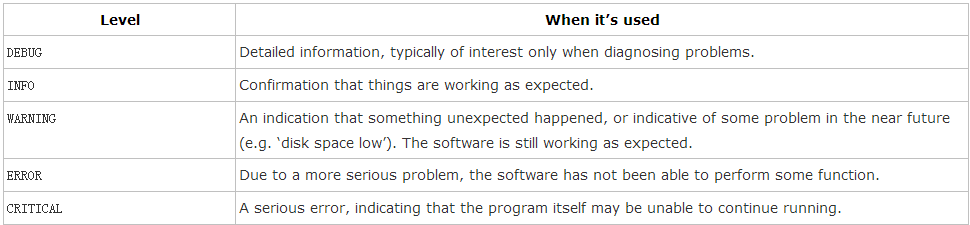
10/31/2016 17:16:17 [Monday] So should this
10/31/2016 17:16:17 [Monday] And this ,too
#!/usr/bin/env python
# -*- coding:utf-8 -*-
#-Author-Lian

import  logging

#创建logger
logger = logging.getLogger("test_log")  #创建logger对象   括号内容随便写
logger.setLevel(logging.INFO)       #全局日志级别


ch = logging.StreamHandler()        #日志打印到屏幕上
ch.setLevel(logging.DEBUG)          #指定ch日志打印级别

fh = logging.FileHandler("access.log")      #日志存进文件
fh.setLevel(logging.WARNING)            #指定fh日志输入级别

formatter = logging.Formatter("%(asctime)s - %(name)s - %(levelname)s - %(message)s")   #定义日志格式,可写多个

#添加日志格式到ch,fh
ch.setFormatter(formatter)
fh.setFormatter(formatter)

#添加ch,fh到logger中
logger.addHandler(ch)
logger.addHandler(fh)


logger.debug('debug message')
logger.info('info message')
logger.warn('warn message')
logger.error('error message')
logger.critical('critical message')2016-10-31 17:23:42,988 - test_log - INFO - info message 2016-10-31 17:23:42,988 - test_log - WARNING - warn message 2016-10-31 17:23:42,988 - test_log - ERROR - error message 2016-10-31 17:23:42,988 - test_log - CRITICAL - critical message
2016-10-31 17:02:06,223 - test_log - WARNING - warn message
2016-10-31 17:02:06,224 - test_log - ERROR - error message
2016-10-31 17:02:06,224 - test_log - CRITICAL - critical message
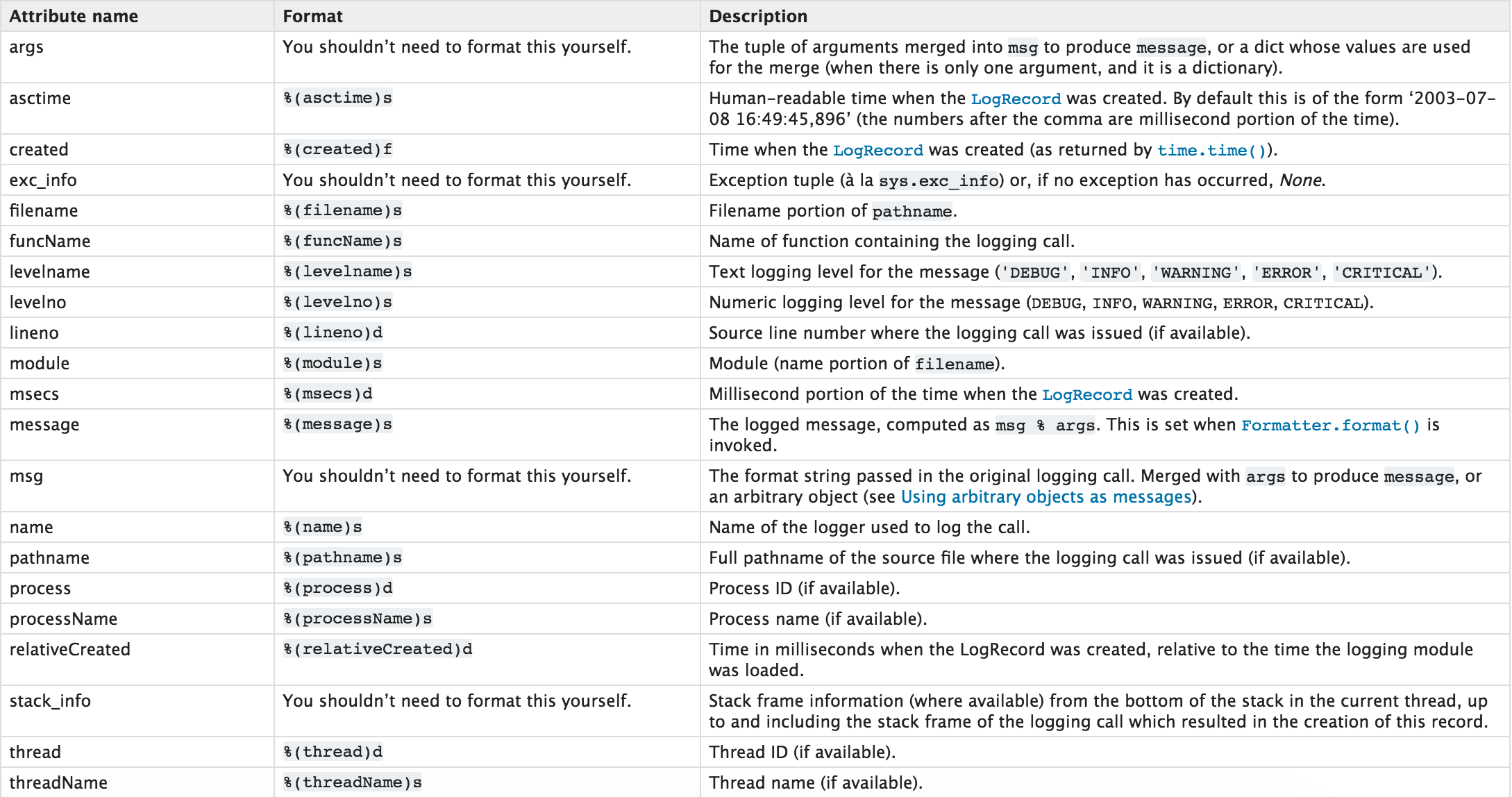
Several important formats: %(lineno)d Output print log code line, %(process) d outputs the process ID of the printing log, %(thread)d outputs the thread ID of the printing log

Hot AI Tools

Undresser.AI Undress
AI-powered app for creating realistic nude photos

AI Clothes Remover
Online AI tool for removing clothes from photos.

Undress AI Tool
Undress images for free

Clothoff.io
AI clothes remover

AI Hentai Generator
Generate AI Hentai for free.

Hot Article
Hot Tools

Notepad++7.3.1
Easy-to-use and free code editor

SublimeText3 Chinese version
Chinese version, very easy to use

Zend Studio 13.0.1
Powerful PHP integrated development environment

Dreamweaver CS6
Visual web development tools

SublimeText3 Mac version
God-level code editing software (SublimeText3)
Hot Topics
 1381
1381
 52
52

 PHP and Python: Code Examples and Comparison
Apr 15, 2025 am 12:07 AM
PHP and Python: Code Examples and Comparison
Apr 15, 2025 am 12:07 AM
PHP and Python have their own advantages and disadvantages, and the choice depends on project needs and personal preferences. 1.PHP is suitable for rapid development and maintenance of large-scale web applications. 2. Python dominates the field of data science and machine learning.
 How to train PyTorch model on CentOS
Apr 14, 2025 pm 03:03 PM
How to train PyTorch model on CentOS
Apr 14, 2025 pm 03:03 PM
Efficient training of PyTorch models on CentOS systems requires steps, and this article will provide detailed guides. 1. Environment preparation: Python and dependency installation: CentOS system usually preinstalls Python, but the version may be older. It is recommended to use yum or dnf to install Python 3 and upgrade pip: sudoyumupdatepython3 (or sudodnfupdatepython3), pip3install--upgradepip. CUDA and cuDNN (GPU acceleration): If you use NVIDIAGPU, you need to install CUDATool
 How is the GPU support for PyTorch on CentOS
Apr 14, 2025 pm 06:48 PM
How is the GPU support for PyTorch on CentOS
Apr 14, 2025 pm 06:48 PM
Enable PyTorch GPU acceleration on CentOS system requires the installation of CUDA, cuDNN and GPU versions of PyTorch. The following steps will guide you through the process: CUDA and cuDNN installation determine CUDA version compatibility: Use the nvidia-smi command to view the CUDA version supported by your NVIDIA graphics card. For example, your MX450 graphics card may support CUDA11.1 or higher. Download and install CUDAToolkit: Visit the official website of NVIDIACUDAToolkit and download and install the corresponding version according to the highest CUDA version supported by your graphics card. Install cuDNN library:
 Detailed explanation of docker principle
Apr 14, 2025 pm 11:57 PM
Detailed explanation of docker principle
Apr 14, 2025 pm 11:57 PM
Docker uses Linux kernel features to provide an efficient and isolated application running environment. Its working principle is as follows: 1. The mirror is used as a read-only template, which contains everything you need to run the application; 2. The Union File System (UnionFS) stacks multiple file systems, only storing the differences, saving space and speeding up; 3. The daemon manages the mirrors and containers, and the client uses them for interaction; 4. Namespaces and cgroups implement container isolation and resource limitations; 5. Multiple network modes support container interconnection. Only by understanding these core concepts can you better utilize Docker.
 Python vs. JavaScript: Community, Libraries, and Resources
Apr 15, 2025 am 12:16 AM
Python vs. JavaScript: Community, Libraries, and Resources
Apr 15, 2025 am 12:16 AM
Python and JavaScript have their own advantages and disadvantages in terms of community, libraries and resources. 1) The Python community is friendly and suitable for beginners, but the front-end development resources are not as rich as JavaScript. 2) Python is powerful in data science and machine learning libraries, while JavaScript is better in front-end development libraries and frameworks. 3) Both have rich learning resources, but Python is suitable for starting with official documents, while JavaScript is better with MDNWebDocs. The choice should be based on project needs and personal interests.
 How to choose the PyTorch version under CentOS
Apr 14, 2025 pm 02:51 PM
How to choose the PyTorch version under CentOS
Apr 14, 2025 pm 02:51 PM
When selecting a PyTorch version under CentOS, the following key factors need to be considered: 1. CUDA version compatibility GPU support: If you have NVIDIA GPU and want to utilize GPU acceleration, you need to choose PyTorch that supports the corresponding CUDA version. You can view the CUDA version supported by running the nvidia-smi command. CPU version: If you don't have a GPU or don't want to use a GPU, you can choose a CPU version of PyTorch. 2. Python version PyTorch
 MiniOpen Centos compatibility
Apr 14, 2025 pm 05:45 PM
MiniOpen Centos compatibility
Apr 14, 2025 pm 05:45 PM
MinIO Object Storage: High-performance deployment under CentOS system MinIO is a high-performance, distributed object storage system developed based on the Go language, compatible with AmazonS3. It supports a variety of client languages, including Java, Python, JavaScript, and Go. This article will briefly introduce the installation and compatibility of MinIO on CentOS systems. CentOS version compatibility MinIO has been verified on multiple CentOS versions, including but not limited to: CentOS7.9: Provides a complete installation guide covering cluster configuration, environment preparation, configuration file settings, disk partitioning, and MinI
 How to operate distributed training of PyTorch on CentOS
Apr 14, 2025 pm 06:36 PM
How to operate distributed training of PyTorch on CentOS
Apr 14, 2025 pm 06:36 PM
PyTorch distributed training on CentOS system requires the following steps: PyTorch installation: The premise is that Python and pip are installed in CentOS system. Depending on your CUDA version, get the appropriate installation command from the PyTorch official website. For CPU-only training, you can use the following command: pipinstalltorchtorchvisiontorchaudio If you need GPU support, make sure that the corresponding version of CUDA and cuDNN are installed and use the corresponding PyTorch version for installation. Distributed environment configuration: Distributed training usually requires multiple machines or single-machine multiple GPUs. Place
