


 Technology peripherals
AI
Entity relationship representation issues in knowledge graph construction
Technology peripherals
AI
Entity relationship representation issues in knowledge graph construction
Entity relationship representation issues in knowledge graph construction


Entity relationship representation issues in the construction of knowledge graphs require specific code examples
Introduction:
With the development of artificial intelligence and big data technology, knowledge graphs As an effective knowledge organization and representation method, it has received more and more attention. Knowledge graphs represent entities in the real world and the relationships between them in the form of graphs, and can be used for tasks such as natural language processing, machine learning, and reasoning. Entity relationship representation is an important issue in the construction of knowledge graphs. By mapping entities and relationships into vector space, semantic understanding and reasoning of entity relationships can be achieved. This article will introduce common problems in entity relationship representation and give corresponding code examples.
1. Problems with entity relationship representation
- Data preparation
In the task of entity relationship representation, data preparation is an important step. First, entity and relationship information needs to be extracted from the existing knowledge graph. Secondly, these entities and relationships need to be deduplicated, cleaned and annotated for use in subsequent entity relationship representation models. - Representation of entities and relationships
The representation of entities and relationships is the core issue in the task of entity relationship representation. Typically, deep learning models can be leveraged to map entities and relationships into low-dimensional vector spaces. Commonly used methods include models based on Graph Convolutional Network (GCN) and attention mechanism (Attention). - Alignment of entities and relationships
In the task of entity relationship representation, entities and relationships in different knowledge graphs often have different representation methods and naming conventions. Therefore, entities and relationships need to be aligned to facilitate knowledge sharing and interaction between different knowledge graphs. Alignment methods can be rule-based methods, machine learning-based methods, or deep learning-based methods.
2. Code Example
The following is a simple code example for representing entities and relationships in the entity relationship representation task:
'''
import numpy as np
import torch
import torch.nn as nn
import torch.optim as optim
Define the representation model of entities and relationships
class EntityRelationEmbedding( nn.Module):
def __init__(self, num_entities, num_relations, embedding_dim):
    super(EntityRelationEmbedding, self).__init__()
    self.entity_embedding = nn.Embedding(num_entities, embedding_dim)
    self.relation_embedding = nn.Embedding(num_relations, embedding_dim)
    self.fc = nn.Linear(embedding_dim, 1)
    self.sigmoid = nn.Sigmoid()

def forward(self, entities, relations):
    entity_embed = self.entity_embedding(entities)
    relation_embed = self.relation_embedding(relations)
    x = torch.cat((entity_embed, relation_embed), dim=1)
    x = self.fc(x)
    x = self.sigmoid(x)
    return x
Define training function
def train(entity_relation_model, entities, relations, labels, epochs, learning_rate):
criterion = nn.BCELoss()
optimizer = optim.Adam(entity_relation_model.parameters(), lr=learning_rate)

for epoch in range(epochs):
    entity_relation_model.zero_grad()
    outputs = entity_relation_model(entities, relations)
    loss = criterion(outputs, labels)
    loss.backward()
    optimizer.step()

print('Training finished.')
Simulated data
entities = torch.tensor([0, 1, 2, 3])
relations = torch.tensor([0, 1, 0, 1])
labels = torch.tensor([1, 0 , 1, 0])
Instantiate the model and train
embedding_dim = 2
num_entities = max(entities) 1
num_relations = max(relations) 1
entity_relation_model = EntityRelationEmbedding(num_entities, num_relations, embedding_dim)
epochs = 100
learning_rate = 0.1
train(entity_relation_model, entities, relations, labels, epochs, learning_rate)
Output entity Representation vector of sum relationship
entity_embed = entity_relation_model.entity_embedding(entities)
relation_embed = entity_relation_model.relation_embedding(relations)
print('Entity embeddings:', entity_embed)
print('Relation embeddings:', relation_embed)
'''
3. Summary
Entity relationship representation is an important issue in the construction of knowledge graphs. By mapping entities and relationships into vector space, we can achieve Semantic understanding and reasoning of entity relationships. This article introduces some common problems of entity relationship representation and gives a simple code example for the representation of entities and relationships. It is hoped that readers can better understand the issues and methods of entity relationship representation through the introduction and sample code of this article, and further in-depth study and application of tasks related to knowledge graph construction.
The above is the detailed content of Entity relationship representation issues in knowledge graph construction. For more information, please follow other related articles on the PHP Chinese website!

Hot AI Tools

Undresser.AI Undress
AI-powered app for creating realistic nude photos

AI Clothes Remover
Online AI tool for removing clothes from photos.

Undress AI Tool
Undress images for free

Clothoff.io
AI clothes remover

AI Hentai Generator
Generate AI Hentai for free.

Hot Article
Hot Tools

Notepad++7.3.1
Easy-to-use and free code editor

SublimeText3 Chinese version
Chinese version, very easy to use

Zend Studio 13.0.1
Powerful PHP integrated development environment

Dreamweaver CS6
Visual web development tools

SublimeText3 Mac version
God-level code editing software (SublimeText3)
Hot Topics
 1378
1378
 52
52

 Advanced practice of industrial knowledge graph
Jun 13, 2024 am 11:59 AM
Advanced practice of industrial knowledge graph
Jun 13, 2024 am 11:59 AM
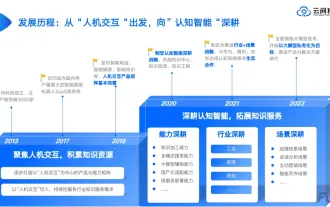
1. Background Introduction First, let’s introduce the development history of Yunwen Technology. Yunwen Technology Company...2023 is the period when large models are prevalent. Many companies believe that the importance of graphs has been greatly reduced after large models, and the preset information systems studied previously are no longer important. However, with the promotion of RAG and the prevalence of data governance, we have found that more efficient data governance and high-quality data are important prerequisites for improving the effectiveness of privatized large models. Therefore, more and more companies are beginning to pay attention to knowledge construction related content. This also promotes the construction and processing of knowledge to a higher level, where there are many techniques and methods that can be explored. It can be seen that the emergence of a new technology does not necessarily defeat all old technologies. It is also possible that the new technology and the old technology will be integrated with each other.
 Jia Qianghuai: Construction and application of large-scale knowledge graph of ants
Sep 10, 2023 pm 03:05 PM
Jia Qianghuai: Construction and application of large-scale knowledge graph of ants
Sep 10, 2023 pm 03:05 PM
1. Graph Overview First introduce some basic concepts of knowledge graph. 1. What is knowledge graph? Knowledge graph aims to use graph structures to model, identify and infer complex relationships between things and precipitate domain knowledge. It is an important cornerstone of realizing cognitive intelligence and has been widely used in search engines and intelligent question answering. , language semantic understanding, big data decision analysis and many other fields. The knowledge graph models both the semantic relationship and the structural relationship between data. Combined with deep learning technology, the two relationships can be better integrated and represented. 2. Why should we build a knowledge graph? We want to build a knowledge graph mainly from the following two points: on the one hand, the characteristics of the data source background of ants themselves, and on the other hand, the benefits that the knowledge graph can bring. [1] The data sources themselves are diverse and heterogeneous.
 Selected Java JPA interview questions: Test your mastery of the persistence framework
Feb 19, 2024 pm 09:12 PM
Selected Java JPA interview questions: Test your mastery of the persistence framework
Feb 19, 2024 pm 09:12 PM
What is JPA? How is it different from JDBC? JPA (JavaPersistence API) is a standard interface for object-relational mapping (ORM), which allows Java developers to use familiar Java objects to operate databases without writing SQL queries directly against the database. JDBC (JavaDatabaseConnectivity) is Java's standard API for connecting to databases. It requires developers to use SQL statements to operate the database. JPA encapsulates JDBC, provides a more convenient and higher-level API for object-relational mapping, and simplifies data access operations. In JPA, what is an entity? entity
 Construction of automotive knowledge graph for recommendation
Apr 14, 2023 am 10:01 AM
Construction of automotive knowledge graph for recommendation
Apr 14, 2023 am 10:01 AM
Background 1. Introduction The concept of knowledge graph was first proposed by Google in 2012, aiming to achieve a more intelligent search engine, and began to be popularized in academia and industry after 2013. At present, with the rapid development of artificial intelligence technology, knowledge graphs have been widely used in search, recommendation, advertising, risk control, intelligent scheduling, speech recognition, robots and other fields. 2. Development status Knowledge graph, as the core technology driving force of artificial intelligence, can alleviate the problem of deep learning relying on massive training data and large-scale computing power. It can be widely adapted to different downstream tasks and has good interpretability. Therefore, Large Internet companies around the world are actively deploying their own knowledge graphs. For example, in 2013 Facebook released Op
 Explore the relationship between the Android system and the Linux kernel
Mar 14, 2024 pm 12:48 PM
Explore the relationship between the Android system and the Linux kernel
Mar 14, 2024 pm 12:48 PM
The Android system and the Linux kernel are two closely related entities, and the relationship between them is close and complex. In the Android system, the Linux kernel plays an important role, providing underlying hardware drivers and system call support for the Android system. This article will explore the relationship between the Android system and the Linux kernel, how they interact and work together, and provide some specific code examples. Android is a mobile operating system developed based on the Linux kernel and is mainly used for mobile devices such as smartphones and tablets. L
 Research on the relationship between Huawei Hongmeng system and Android
Mar 23, 2024 am 11:54 AM
Research on the relationship between Huawei Hongmeng system and Android
Mar 23, 2024 am 11:54 AM
Research on the relationship between Huawei Hongmeng system and Android With the continuous development of technology, smartphones have become an indispensable part of people's lives. As one of the world's leading mobile phone manufacturers, Huawei has been constantly innovating and is committed to providing better mobile operating systems and user experiences. In recent years, with the United States' suppression of Huawei, Huawei has begun to accelerate the development of its own operating system, and HarmonyOS came into being. In this context, people have begun to pay attention to the relationship between Hongmeng System and Android. First, we need to understand
 How to use C++ for efficient knowledge graph construction and reasoning?
Aug 26, 2023 pm 01:57 PM
How to use C++ for efficient knowledge graph construction and reasoning?
Aug 26, 2023 pm 01:57 PM
How to use C++ for efficient knowledge graph construction and reasoning? Knowledge graphs play an important role in the fields of artificial intelligence and natural language processing. Building and reasoning about knowledge graphs has complex algorithms and huge data processing tasks, so it is very important to use efficient programming languages and algorithms to implement them. This article will introduce how to use C++ language for efficient knowledge graph construction and reasoning, and provide some code examples. Knowledge graph is a graphical model used to represent entities, concepts, and relationships. It is mainly composed of nodes and edges. node representation
 Knowledge extraction issues in knowledge graph construction
Oct 09, 2023 pm 12:45 PM
Knowledge extraction issues in knowledge graph construction
Oct 09, 2023 pm 12:45 PM
Knowledge extraction problems in knowledge graph construction require specific code examples. With the advent of the information age, the growth of data has shown an explosive growth trend. This brings challenges to the construction of knowledge graphs, because useful knowledge needs to be extracted and organized from large amounts of unstructured data. Knowledge extraction is an important link in the process of building knowledge graphs. It involves extracting information such as entities, relationships, and attributes from text. In the process of knowledge extraction, the most commonly used methods are rule-based methods and machine learning-based methods. Rule-based approaches rely on
