


Java interview HTTP and HTTPS protocols

First of all, let’s take a look at the interview questions of Alibaba and SF Express.
Alibaba interview questions: How much do you know about the HTTP protocol? What is the difference between HTTP and HTTPS? How is the security of HTTPS implemented?
SF Express Interview question: http explain
(Learning video sharing: java video tutorial)
The detailed answer is as follows:
1. Introduction to HTTP
HTTP protocol is the abbreviation of Hyper Text Transfer Protocol. The HTTP protocol works on a client-server architecture. As an HTTP client, the browser sends all requests to the HTTP server, that is, the WEB server, through the URL. The web server sends response information to the client based on the received request.
2. HTTP protocol characteristics
No connection: The meaning of no connection is to limit each connection to process only one request. After the server processes the client's request and receives the client's response, it disconnects. This method saves transmission time.
Stateless: The HTTP protocol is a stateless protocol. Stateless means that the protocol has no memory ability for transaction processing. The lack of status means that if subsequent processing requires the previous information, it must be retransmitted, which may result in an increase in the amount of data transferred per connection. On the other hand, the server responds faster when it does not need previous information.
3. HTTP status code
1xx: Instruction information – indicates that the request has been received, continue processing
2xx: Success – indicates that the request has been successfully received, Understand, accept
3xx: Redirect – further action must be taken to complete the request
4xx: Client error – the request has a syntax error or the request cannot be fulfilled
5xx: Server side error – the server failed to fulfill it Legal request
Common status codes:
200 OK //客户端请求成功400 Bad Request //客户端请求有语法错误,不能被服务器所理解401 Unauthorized //请求未经授权,这个状态代码必须和WWW-Authenticate报头域一起使用 403 Forbidden //服务器收到请求,但是拒绝提供服务404 Not Found //请求资源不存在,eg:输入了错误的URL500 Internal Server Error //服务器发生不可预期的错误503 Server Unavailable //服务器当前不能处理客户端的请求,一段时间后可能恢复正常
4. How HTTP works
The HTTP protocol defines how a Web client requests a Web page from a Web server, and how the server transmits the Web page to the client. The HTTP protocol uses a request/response model. The client sends a request message to the server. The request message contains the request method, URL, protocol version, request header and request data. The server responds with a status line that includes the protocol version, success or error code, server information, response headers, and response data.
The following are the steps for HTTP request/response:
1. Client connects to the Web server
An HTTP client, usually a browser, communicates with the Web server Establish a TCP socket connection to the server's HTTP port (80 by default). For example, http://www.baidu.con.
2. Send HTTP request
Through the TCP socket, the client sends a text request message to the Web server. A request message consists of the request line, It consists of 4 parts: request header, blank line and request data.
3. The server accepts the request and returns an HTTP response
The web server parses the request and locates the requested resource. The server writes a copy of the resource to the TCP socket, which is read by the client. A response consists of four parts: status line, response header, blank line and response data.
4. Release the connection TCP connection
If the connection mode is close, the server actively closes the TCP connection, and the client passively closes the connection and releases the TCP connection; if the connection mode is close If it is keepalive, the connection will be maintained for a period of time, and requests can continue to be received during this time;
5. The client browser parses the HTML content
Client browsing The server first parses the status line for a status code indicating whether the request was successful. Then each response header is parsed, and the response header tells the following HTML document of several bytes and the character set of the document. The client browser reads the response data HTML, formats it according to the syntax of HTML, and displays it in the browser window.
For example: type the URL in the browser address bar and press Enter, you will go through the following process:
1. The browser requests the DNS server to resolve the IP address corresponding to the domain name in the URL;
2 , after parsing the IP address, establish a TCP connection with the server based on the IP address and the default port 80;
3. The browser issues an HTTP request to read the file (the file corresponding to the part after the domain name in the URL), and the request reports The text is sent to the server as the data of the third message of the TCP three-way handshake;
4. The server responds to the browser request and sends the corresponding html text to the browser;
5. Release the TCP connection;
6. The browser will convert the html text and display the content;
(For more related interview questions, please visit: java interview questions and answers)
5. What is the difference between HTTP and HTTPS
HTTPS: It is an HTTP channel aimed at security. Simply put, it is a secure version of HTTP, that is, HTTP The SSL layer is added below. The security foundation of HTTPS is SSL, so the details of encryption require SSL.
The main functions of the HTTPS protocol can be divided into two types: one is to establish an information security channel to ensure the security of data transmission; the other is to confirm the authenticity of the website.
The main differences between HTTPS and HTTP are as follows:
1. The https protocol requires applying for a certificate from ca. Generally, there are fewer free certificates, so a certain fee is required.
2. http is a hypertext transfer protocol, and information is transmitted in plain text, while https is a secure SSL encrypted transmission protocol.
3. http and https use completely different connection methods and use different ports. The former is 80 and the latter is 443.
4. The http connection is very simple and stateless; the HTTPS protocol is a network protocol built from the SSL HTTP protocol that can perform encrypted transmission and identity authentication, and is more secure than the http protocol.
6. How is the security of HTTPS implemented?

(1) Customers use https URLs to access the web server. Requirements Establish an SSL connection with the web server.
(2) After receiving the client's request, the web server will transmit a copy of the website's certificate information (the certificate contains the public key) to the client.
(3) The client's browser and the Web server begin to negotiate the security level of the SSL connection, which is the level of information encryption.
(4) The client's browser establishes a session key based on the security level agreed by both parties, then uses the website's public key to encrypt the session key and transmits it to the website.
(5) The Web server uses its own private key to decrypt the session key.
(6) The web server uses the session key to encrypt the communication with the client. 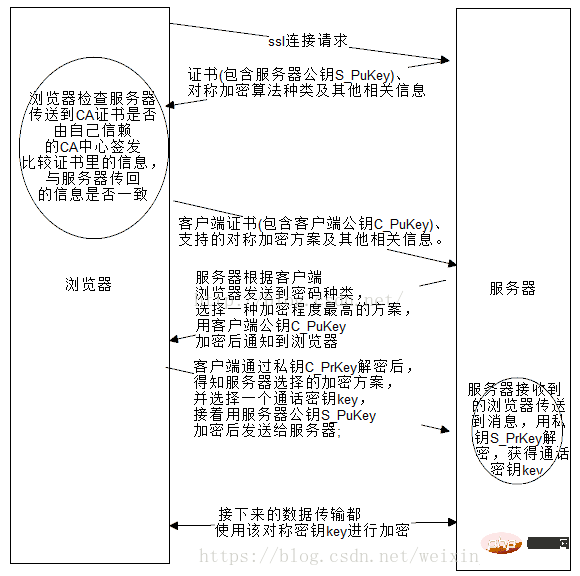
Related recommendations: java introductory tutorial
The above is the detailed content of Java interview HTTP and HTTPS protocols. For more information, please follow other related articles on the PHP Chinese website!

Hot AI Tools

Undress AI Tool
Undress images for free

Undresser.AI Undress
AI-powered app for creating realistic nude photos

AI Clothes Remover
Online AI tool for removing clothes from photos.

Clothoff.io
AI clothes remover

Video Face Swap
Swap faces in any video effortlessly with our completely free AI face swap tool!

Hot Article
Hot Tools

Notepad++7.3.1
Easy-to-use and free code editor

SublimeText3 Chinese version
Chinese version, very easy to use

Zend Studio 13.0.1
Powerful PHP integrated development environment

Dreamweaver CS6
Visual web development tools

SublimeText3 Mac version
God-level code editing software (SublimeText3)


 What is a deadlock in Java and how can you prevent it?
Aug 23, 2025 pm 12:55 PM
What is a deadlock in Java and how can you prevent it?
Aug 23, 2025 pm 12:55 PM
AdeadlockinJavaoccurswhentwoormorethreadsareblockedforever,eachwaitingforaresourceheldbytheother,typicallyduetocircularwaitcausedbyinconsistentlockordering;thiscanbepreventedbybreakingoneofthefournecessaryconditions—mutualexclusion,holdandwait,nopree
 How to use Optional in Java?
Aug 22, 2025 am 10:27 AM
How to use Optional in Java?
Aug 22, 2025 am 10:27 AM
UseOptional.empty(),Optional.of(),andOptional.ofNullable()tocreateOptionalinstancesdependingonwhetherthevalueisabsent,non-null,orpossiblynull.2.CheckforvaluessafelyusingisPresent()orpreferablyifPresent()toavoiddirectnullchecks.3.Providedefaultswithor
 Java Persistence with Spring Data JPA and Hibernate
Aug 22, 2025 am 07:52 AM
Java Persistence with Spring Data JPA and Hibernate
Aug 22, 2025 am 07:52 AM
The core of SpringDataJPA and Hibernate working together is: 1. JPA is the specification and Hibernate is the implementation, SpringDataJPA encapsulation simplifies DAO development; 2. Entity classes map database structures through @Entity, @Id, @Column, etc.; 3. Repository interface inherits JpaRepository to automatically implement CRUD and named query methods; 4. Complex queries use @Query annotation to support JPQL or native SQL; 5. In SpringBoot, integration is completed by adding starter dependencies and configuring data sources and JPA attributes; 6. Transactions are made by @Transactiona
 Java Cryptography Architecture (JCA) for Secure Coding
Aug 23, 2025 pm 01:20 PM
Java Cryptography Architecture (JCA) for Secure Coding
Aug 23, 2025 pm 01:20 PM
Understand JCA core components such as MessageDigest, Cipher, KeyGenerator, SecureRandom, Signature, KeyStore, etc., which implement algorithms through the provider mechanism; 2. Use strong algorithms and parameters such as SHA-256/SHA-512, AES (256-bit key, GCM mode), RSA (2048-bit or above) and SecureRandom; 3. Avoid hard-coded keys, use KeyStore to manage keys, and generate keys through securely derived passwords such as PBKDF2; 4. Disable ECB mode, adopt authentication encryption modes such as GCM, use unique random IVs for each encryption, and clear sensitive ones in time
![LOL Game Settings Not Saving After Closing [FIXED]](https://img.php.cn/upload/article/001/431/639/175597664176545.jpg?x-oss-process=image/resize,m_fill,h_207,w_330) LOL Game Settings Not Saving After Closing [FIXED]
Aug 24, 2025 am 03:17 AM
LOL Game Settings Not Saving After Closing [FIXED]
Aug 24, 2025 am 03:17 AM
IfLeagueofLegendssettingsaren’tsaving,trythesesteps:1.Runthegameasadministrator.2.GrantfullfolderpermissionstotheLeagueofLegendsdirectory.3.Editandensuregame.cfgisn’tread-only.4.Disablecloudsyncforthegamefolder.5.RepairthegameviatheRiotClient.
 How to use the Pattern and Matcher classes in Java?
Aug 22, 2025 am 09:57 AM
How to use the Pattern and Matcher classes in Java?
Aug 22, 2025 am 09:57 AM
The Pattern class is used to compile regular expressions, and the Matcher class is used to perform matching operations on strings. The combination of the two can realize text search, matching and replacement; first create a pattern object through Pattern.compile(), and then call its matcher() method to generate a Matcher instance. Then use matches() to judge the full string matching, find() to find subsequences, replaceAll() or replaceFirst() for replacement. If the regular contains a capture group, the nth group content can be obtained through group(n). In actual applications, you should avoid repeated compilation patterns, pay attention to special character escapes, and use the matching pattern flag as needed, and ultimately achieve efficient
 Edit bookmarks in chrome
Aug 27, 2025 am 12:03 AM
Edit bookmarks in chrome
Aug 27, 2025 am 12:03 AM
Chrome bookmark editing is simple and practical. Users can enter the bookmark manager through the shortcut keys Ctrl Shift O (Windows) or Cmd Shift O (Mac), or enter through the browser menu; 1. When editing a single bookmark, right-click to select "Edit", modify the title or URL and click "Finish" to save; 2. When organizing bookmarks in batches, you can hold Ctrl (or Cmd) to multiple-choice bookmarks in the bookmark manager, right-click to select "Move to" or "Copy to" the target folder; 3. When exporting and importing bookmarks, click the "Solve" button to select "Export Bookmark" to save as HTML file, and then restore it through the "Import Bookmark" function if necessary.
!['Java is not recognized' Error in CMD [3 Simple Steps]](https://img.php.cn/upload/article/001/431/639/175588500160220.jpg?x-oss-process=image/resize,m_fill,h_207,w_330) 'Java is not recognized' Error in CMD [3 Simple Steps]
Aug 23, 2025 am 01:50 AM
'Java is not recognized' Error in CMD [3 Simple Steps]
Aug 23, 2025 am 01:50 AM
IfJavaisnotrecognizedinCMD,ensureJavaisinstalled,settheJAVA_HOMEvariabletotheJDKpath,andaddtheJDK'sbinfoldertothesystemPATH.RestartCMDandrunjava-versiontoconfirm.
