


What are the ways to enter the docker container?


There are many ways to enter a Docker container. Here we focus on several commonly used methods of entering a Docker container.
(Learning video sharing: php video tutorial)
Some of the more common ways to enter a Docker container are as follows:
Use docker attach
Use SSH
Use nsenter
Use exec
1. Use docker attach to enter the Docker container
Docker provides the attach command to enter the Docker container.
Next we create a daemon Docker container, and then use the docker attach command to enter the container.
$ sudo docker run -itd ubuntu:14.04 /bin/bash
Then we use docker ps to view the container information, and then use docker attach to enter the container
$ sudo docker attach 44fc0f0582d9
We can see that we have entered the container.
But there is a problem with using this command. When multiple windows use this command to enter the container at the same time, all windows will be displayed simultaneously. If one window is blocked, other windows will no longer be able to operate.
For this reason, the docker attach command is not suitable for production environments. You can use this command when developing your own applications.
2. Use SSH to enter the Docker container
After excluding using the docker attach command to enter the container in the production environment, I believe the first thing that everyone thinks of is ssh. Install SSH Server in the image (or container), so that multiple people can enter the container without interfering with each other. I believe everyone does this in the current production environment (without using Docker). However, it is not recommended to use ssh to enter the Docker container after using it.
3. Use nsenter to enter the Docker container
If the above two methods are not suitable, there is a more convenient method, which is to use nsenter to enter the Docker container.
After understanding what nsenter is, the system will install the nsenter we need into the host by default.
If it is not installed, just follow the steps below to install it (note that it is the host and not the container or Mirror)
The specific installation command is as follows:
$ wget https://www.kernel.org/pub/linux/utils/util-linux/v2.24/util-linux-2.24.tar.gz
$ tar -xzvf util-linux-2.24.tar.gz
$ cd util-linux-2.24/
$ ./configure --without-ncurses
$ make nsenter
$ sudo cp nsenter /usr/local/bin
After installing nsenter, you can check the use of this command.
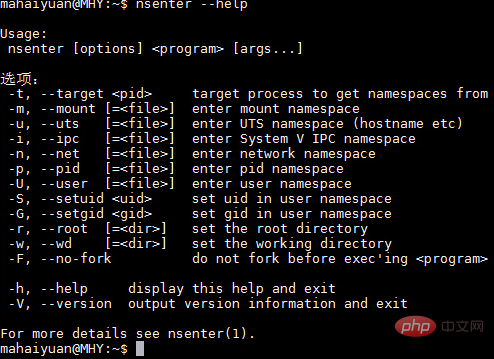
#nsenter can access the namespace of another process. So in order to connect to a container we also need to get the PID of the first process of the container. You can use the docker inspect command to get the PID.
The docker inspect command is used as follows:
$ sudo docker inspect --help
The inspect command can display information about an image or container hierarchically. For example, we currently have a running container.

You can use docker inspect to view the details of the container.
$ sudo docker inspect 44fc0f0582d9
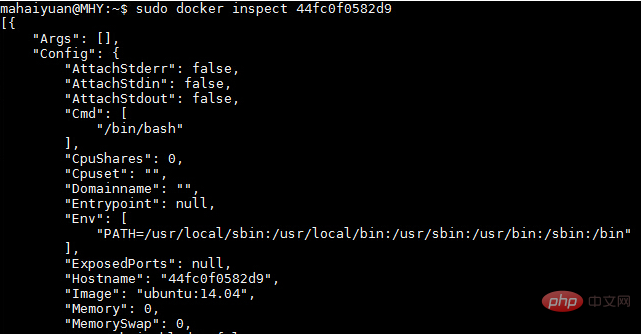
Since there is a lot of information, only part of it is captured here for display. If you want to display the first PID of the container, you can use the following method
$ sudo docker inspect -f {{.State.Pid}} 44fc0f0582d9
After getting the PID of the process, we can use the nsenter command to access the container.
$ sudo nsenter --target 3326 --mount --uts --ipc --net --pid
$ sudo nsenter --target 3326 --mount --uts --ipc --net --pid
The 3326 is the PID of the process just obtained.
4. Use docker exec to enter the Docker container
In addition to the above methods, docker also provides a new command exec after version 1.3.X for entering the container. This The method is relatively simpler. Let’s take a look at the use of this command:
$ sudo docker exec --help
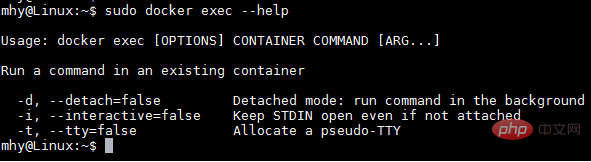
Next we use this command to enter an already running container
$ sudo docker ps
$ sudo docker exec -it 775c7c9ee1e1 /bin/bash
Related recommendations: docker tutorial
The above is the detailed content of What are the ways to enter the docker container?. For more information, please follow other related articles on the PHP Chinese website!

Hot AI Tools

Undress AI Tool
Undress images for free

Undresser.AI Undress
AI-powered app for creating realistic nude photos

AI Clothes Remover
Online AI tool for removing clothes from photos.

Clothoff.io
AI clothes remover

Video Face Swap
Swap faces in any video effortlessly with our completely free AI face swap tool!

Hot Article
Hot Tools

Notepad++7.3.1
Easy-to-use and free code editor

SublimeText3 Chinese version
Chinese version, very easy to use

Zend Studio 13.0.1
Powerful PHP integrated development environment

Dreamweaver CS6
Visual web development tools

SublimeText3 Mac version
God-level code editing software (SublimeText3)


 How to deploy a PyTorch app on Ubuntu
May 29, 2025 pm 11:18 PM
How to deploy a PyTorch app on Ubuntu
May 29, 2025 pm 11:18 PM
Deploying a PyTorch application on Ubuntu can be done by following the steps: 1. Install Python and pip First, make sure that Python and pip are already installed on your system. You can install them using the following command: sudoaptupdatesudoaptinstallpython3python3-pip2. Create a virtual environment (optional) To isolate your project environment, it is recommended to create a virtual environment: python3-mvenvmyenvsourcemyenv/bin/activatet
 What is Docker BuildKit, and how does it improve build performance?
Jun 19, 2025 am 12:20 AM
What is Docker BuildKit, and how does it improve build performance?
Jun 19, 2025 am 12:20 AM
DockerBuildKit is a modern image building backend. It can improve construction efficiency and maintainability by 1) parallel processing of independent construction steps, 2) more advanced caching mechanisms (such as remote cache reuse), and 3) structured output improves construction efficiency and maintainability, significantly optimizing the speed and flexibility of Docker image building. Users only need to enable the DOCKER_BUILDKIT environment variable or use the buildx command to activate this function.
 How does Docker work with Docker Desktop?
Jun 15, 2025 pm 12:54 PM
How does Docker work with Docker Desktop?
Jun 15, 2025 pm 12:54 PM
DockerworkswithDockerDesktopbyprovidingauser-friendlyinterfaceandenvironmenttomanagecontainers,images,andresourcesonlocalmachines.1.DockerDesktopbundlesDockerEngine,CLI,Compose,andothertoolsintoonepackage.2.Itusesvirtualization(likeWSL2onWindowsorHyp
 How can you monitor the resource usage of a Docker container?
Jun 13, 2025 am 12:10 AM
How can you monitor the resource usage of a Docker container?
Jun 13, 2025 am 12:10 AM
To monitor Docker container resource usage, built-in commands, third-party tools, or system-level tools can be used. 1. Use dockerstats to monitor real-time: Run dockerstats to view CPU, memory, network and disk IO indicators, support filtering specific containers and recording regularly with watch commands. 2. Get container insights through cAdvisor: Deploy cAdvisor containers to obtain detailed performance data and view historical trends and visual information through WebUI. 3. In-depth analysis with system-level tools: use top/htop, iostat, iftop and other Linux tools to monitor resource consumption at the system level, and integrate Prometheu
 What is Kubernetes, and how does it relate to Docker?
Jun 21, 2025 am 12:01 AM
What is Kubernetes, and how does it relate to Docker?
Jun 21, 2025 am 12:01 AM
Kubernetes is not a replacement for Docker, but the next step in managing large-scale containers. Docker is used to build and run containers, while Kubernetes is used to orchestrate these containers across multiple machines. Specifically: 1. Docker packages applications and Kubernetes manages its operations; 2. Kubernetes automatically deploys, expands and manages containerized applications; 3. It realizes container orchestration through components such as nodes, pods and control planes; 4. Kubernetes works in collaboration with Docker to automatically restart failed containers, expand on demand, load balancing and no downtime updates; 5. Applicable to application scenarios that require rapid expansion, running microservices, high availability and multi-environment deployment.
 How does Docker differ from traditional virtualization?
Jul 08, 2025 am 12:03 AM
How does Docker differ from traditional virtualization?
Jul 08, 2025 am 12:03 AM
The main difference between Docker and traditional virtualization lies in the processing and resource usage of the operating system layer. 1. Docker containers share the host OS kernel, which is lighter, faster startup, and more resource efficiency; 2. Each instance of a traditional VM runs a full OS, occupying more space and resources; 3. The container usually starts in a few seconds, and the VM may take several minutes; 4. The container depends on namespace and cgroups to achieve isolation, while the VM obtains stronger isolation through hypervisor simulation hardware; 5. Docker has better portability, ensuring that applications run consistently in different environments, suitable for microservices and cloud environment deployment.
 How to troubleshoot Docker issues
Jul 07, 2025 am 12:29 AM
How to troubleshoot Docker issues
Jul 07, 2025 am 12:29 AM
When encountering Docker problems, you should first locate the problem, which is problems such as image construction, container operation or network configuration, and then follow the steps to check. 1. Check the container log (dockerlogs or docker-composelogs) to obtain error information; 2. Check the container status (dockerps) and resource usage (dockerstats) to determine whether there is an exception due to insufficient memory or port problems; 3. Enter the inside of the container (dockerexec) to verify the path, permissions and dependencies; 4. Review whether there are configuration errors in the Dockerfile and compose files, such as environment variable spelling or volume mount path problems, and recommend that cleanbuild avoid cache dryness
 How do you specify environment variables in a Docker container?
Jun 28, 2025 am 12:22 AM
How do you specify environment variables in a Docker container?
Jun 28, 2025 am 12:22 AM
There are three common ways to set environment variables in a Docker container: use the -e flag, define ENV instructions in a Dockerfile, or manage them through DockerCompose. 1. Adding the -e flag when using dockerrun can directly pass variables, which is suitable for temporary testing or CI/CD integration; 2. Using ENV in Dockerfile to set default values, which is suitable for fixed variables that are not often changed, but is not suitable for distinguishing different environment configurations; 3. DockerCompose can define variables through environment blocks or .env files, which is more conducive to development collaboration and configuration separation, and supports variable replacement. Choose the right method according to project needs or use multiple methods in combination
