


Common interview questions about java containers

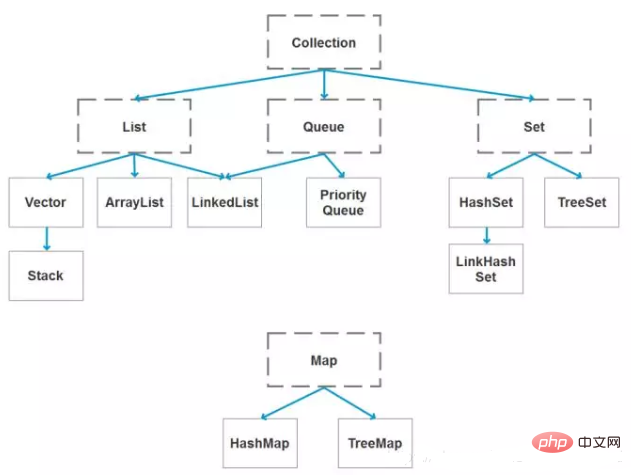
#What are the Java containers? (Recommended learning: java Frequently see test questions )
# What is the difference between?
java.util.Collection is a collection interface (a top-level interface for collection classes). It provides common interface methods for basic operations on collection objects. The Collection interface has many specific implementations in the Java class library.
The significance of the Collection interface is to provide a maximized unified operation method for various specific collections. Its directly inherited interfaces include List and Set.
Collections is a tool class/helper class of the collection class, which provides a series of static methods for various operations such as sorting, searching, and thread safety of elements in the collection
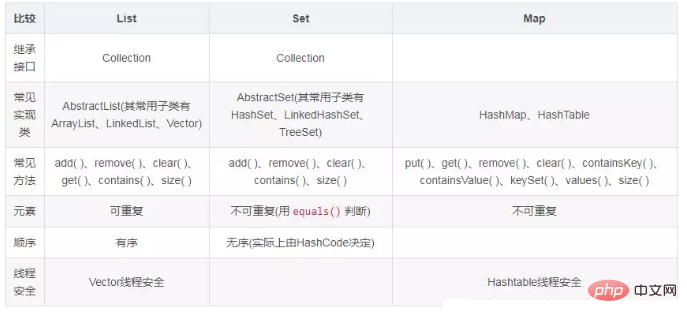
What is the difference between List, Set and Map?
What is the difference between HashMap and Hashtable?
hashMap removes the contains method of HashTable, but adds containsValue() and containsKey() methods.
HashTable is synchronous, while HashMap is asynchronous, and is more efficient than hashTable.
HashMap allows empty key values, but hashTable does not.
How to decide whether to use HashMap or TreeMap?
HashMap is the best choice for operations such as inserting, deleting and positioning elements in Map. However, if you need to iterate over an ordered collection of keys, TreeMap is a better choice. Depending on the size of your collection, it may be faster to add elements to a HashMap and replace the map with a TreeMap for ordered key traversal.
Tell me about the implementation principle of HashMap?
HashMap Overview: HashMap is an asynchronous implementation of the Map interface based on hash tables. This implementation provides all optional mapping operations and allows null values and null keys. This class does not guarantee the order of the mapping, and in particular it does not guarantee that the order is immutable.
HashMap data structure: In the Java programming language, there are two most basic structures, one is an array, and the other is a simulated pointer (reference). All data structures can use these two basic structures. To construct, HashMap is no exception. HashMap is actually a "linked list hash" data structure, which is a combination of an array and a linked list.
When we put an element into the Hashmap, we first recalculate the hash value based on the hashcode of the key, and get the position (subscript) of the element in the array based on the hash value. If the array is already stored at that position If other elements are added, the elements at this position will be stored in the form of a linked list, with the newly added ones placed at the head of the chain, and the first added elements placed at the end of the chain. If there is no element at this position in the array, the element will be placed directly into the linked list. at that position in the array.
It should be noted that the implementation of HashMap has been optimized in Jdk 1.8. When the node data in the linked list exceeds eight, the linked list will be converted into a red-black tree to improve query efficiency, from the original O(n) To O(logn)
, talk about the implementation principle of HashSet?
The bottom layer of HashSet is implemented by HashMap
The value of HashSet is stored in the key of HashMap
The value of HashMap is unified as PRESENT
What is the difference between ArrayList and LinkedList?
The most obvious difference is that the underlying data structure of ArrrayList is an array and supports random access, while the underlying data structure of LinkedList is a two-way circular linked list and does not support random access. To access an element using a subscript, the time complexity of ArrayList is O(1), while that of LinkedList is O(n).
How to convert between array and List?
Convert List to array: call the toArray method of ArrayList.
Convert an array into a List: call the asList method of Arrays.
What is the difference between ArrayList and Vector?
Vector is synchronized, but ArrayList is not. However, if you seek to make changes to the list while iterating, you should use CopyOnWriteArrayList.
ArrayList is faster than Vector. It will not be overloaded because of synchronization.
ArrayList is more versatile because we can easily obtain synchronized lists and read-only lists using the Collections tool class.
What is the difference between Array and ArrayList?
Array can hold basic types and objects, while ArrayList can only hold objects.
Array is immutable after specifying the size, while the size of ArrayList is variable.
Array does not provide as many functions as ArrayList, such as addAll, removeAll and iterator.
What is the difference between poll() and remove() in Queue?
poll() and remove() both take out an element from the queue, but poll() will return null when it fails to obtain the element, but remove() will throw an exception when it fails. .
Which collection classes are thread-safe?
vector: It has one more synchronization mechanism (thread safety) than arraylist. Because of its low efficiency, its use is no longer recommended. In web applications, especially front-end pages, efficiency (page response speed) is often a priority.
statck: stack class, first in, last out.
hashtable: It is more thread-safe than hashmap.
enumeration: Enumeration, equivalent to iterator.
Iterator What is Iterator?
An iterator is a design pattern that is an object that can be traversed and selected in a sequence without the developer needing to know the underlying structure of the sequence. Iterators are often called "lightweight" objects because they are cheap to create.
How to use Iterator? What are the characteristics?
The Iterator function in Java is relatively simple and can only move in one direction:
(1) Use the iterator() method to require the container to return an Iterator. The first time the Iterator's next() method is called, it returns the first element of the sequence. Note: the iterator() method is the java.lang.Iterable interface and is inherited by Collection.
(2) Use next() to get the next element in the sequence.
(3) Use hasNext() to check whether there are still elements in the sequence.
(4) Use remove() to delete the element newly returned by the iterator.
Iterator is the simplest implementation of Java iterator. ListIterator designed for List has more functions. It can traverse List in two directions and can also insert and delete elements from List.
What is the difference between Iterator and ListIterator?
Iterator can be used to traverse Set and List collections, but ListIterator can only be used to traverse List.
Iterator can only traverse a collection forward, while ListIterator can traverse both forward and backward.
ListIterator implements the Iterator interface and includes other functions, such as: adding elements, replacing elements, getting the index of the previous and next elements, etc.
The above is the detailed content of Common interview questions about java containers. For more information, please follow other related articles on the PHP Chinese website!

Hot AI Tools

Undress AI Tool
Undress images for free

Undresser.AI Undress
AI-powered app for creating realistic nude photos

AI Clothes Remover
Online AI tool for removing clothes from photos.

Clothoff.io
AI clothes remover

Video Face Swap
Swap faces in any video effortlessly with our completely free AI face swap tool!

Hot Article
Hot Tools

Notepad++7.3.1
Easy-to-use and free code editor

SublimeText3 Chinese version
Chinese version, very easy to use

Zend Studio 13.0.1
Powerful PHP integrated development environment

Dreamweaver CS6
Visual web development tools

SublimeText3 Mac version
God-level code editing software (SublimeText3)


 What is a deadlock in Java and how can you prevent it?
Aug 23, 2025 pm 12:55 PM
What is a deadlock in Java and how can you prevent it?
Aug 23, 2025 pm 12:55 PM
AdeadlockinJavaoccurswhentwoormorethreadsareblockedforever,eachwaitingforaresourceheldbytheother,typicallyduetocircularwaitcausedbyinconsistentlockordering;thiscanbepreventedbybreakingoneofthefournecessaryconditions—mutualexclusion,holdandwait,nopree
 How to use Optional in Java?
Aug 22, 2025 am 10:27 AM
How to use Optional in Java?
Aug 22, 2025 am 10:27 AM
UseOptional.empty(),Optional.of(),andOptional.ofNullable()tocreateOptionalinstancesdependingonwhetherthevalueisabsent,non-null,orpossiblynull.2.CheckforvaluessafelyusingisPresent()orpreferablyifPresent()toavoiddirectnullchecks.3.Providedefaultswithor
 Java Persistence with Spring Data JPA and Hibernate
Aug 22, 2025 am 07:52 AM
Java Persistence with Spring Data JPA and Hibernate
Aug 22, 2025 am 07:52 AM
The core of SpringDataJPA and Hibernate working together is: 1. JPA is the specification and Hibernate is the implementation, SpringDataJPA encapsulation simplifies DAO development; 2. Entity classes map database structures through @Entity, @Id, @Column, etc.; 3. Repository interface inherits JpaRepository to automatically implement CRUD and named query methods; 4. Complex queries use @Query annotation to support JPQL or native SQL; 5. In SpringBoot, integration is completed by adding starter dependencies and configuring data sources and JPA attributes; 6. Transactions are made by @Transactiona
 Java Cryptography Architecture (JCA) for Secure Coding
Aug 23, 2025 pm 01:20 PM
Java Cryptography Architecture (JCA) for Secure Coding
Aug 23, 2025 pm 01:20 PM
Understand JCA core components such as MessageDigest, Cipher, KeyGenerator, SecureRandom, Signature, KeyStore, etc., which implement algorithms through the provider mechanism; 2. Use strong algorithms and parameters such as SHA-256/SHA-512, AES (256-bit key, GCM mode), RSA (2048-bit or above) and SecureRandom; 3. Avoid hard-coded keys, use KeyStore to manage keys, and generate keys through securely derived passwords such as PBKDF2; 4. Disable ECB mode, adopt authentication encryption modes such as GCM, use unique random IVs for each encryption, and clear sensitive ones in time
![LOL Game Settings Not Saving After Closing [FIXED]](https://img.php.cn/upload/article/001/431/639/175597664176545.jpg?x-oss-process=image/resize,m_fill,h_207,w_330) LOL Game Settings Not Saving After Closing [FIXED]
Aug 24, 2025 am 03:17 AM
LOL Game Settings Not Saving After Closing [FIXED]
Aug 24, 2025 am 03:17 AM
IfLeagueofLegendssettingsaren’tsaving,trythesesteps:1.Runthegameasadministrator.2.GrantfullfolderpermissionstotheLeagueofLegendsdirectory.3.Editandensuregame.cfgisn’tread-only.4.Disablecloudsyncforthegamefolder.5.RepairthegameviatheRiotClient.
 How to use the Pattern and Matcher classes in Java?
Aug 22, 2025 am 09:57 AM
How to use the Pattern and Matcher classes in Java?
Aug 22, 2025 am 09:57 AM
The Pattern class is used to compile regular expressions, and the Matcher class is used to perform matching operations on strings. The combination of the two can realize text search, matching and replacement; first create a pattern object through Pattern.compile(), and then call its matcher() method to generate a Matcher instance. Then use matches() to judge the full string matching, find() to find subsequences, replaceAll() or replaceFirst() for replacement. If the regular contains a capture group, the nth group content can be obtained through group(n). In actual applications, you should avoid repeated compilation patterns, pay attention to special character escapes, and use the matching pattern flag as needed, and ultimately achieve efficient
 Edit bookmarks in chrome
Aug 27, 2025 am 12:03 AM
Edit bookmarks in chrome
Aug 27, 2025 am 12:03 AM
Chrome bookmark editing is simple and practical. Users can enter the bookmark manager through the shortcut keys Ctrl Shift O (Windows) or Cmd Shift O (Mac), or enter through the browser menu; 1. When editing a single bookmark, right-click to select "Edit", modify the title or URL and click "Finish" to save; 2. When organizing bookmarks in batches, you can hold Ctrl (or Cmd) to multiple-choice bookmarks in the bookmark manager, right-click to select "Move to" or "Copy to" the target folder; 3. When exporting and importing bookmarks, click the "Solve" button to select "Export Bookmark" to save as HTML file, and then restore it through the "Import Bookmark" function if necessary.
!['Java is not recognized' Error in CMD [3 Simple Steps]](https://img.php.cn/upload/article/001/431/639/175588500160220.jpg?x-oss-process=image/resize,m_fill,h_207,w_330) 'Java is not recognized' Error in CMD [3 Simple Steps]
Aug 23, 2025 am 01:50 AM
'Java is not recognized' Error in CMD [3 Simple Steps]
Aug 23, 2025 am 01:50 AM
IfJavaisnotrecognizedinCMD,ensureJavaisinstalled,settheJAVA_HOMEvariabletotheJDKpath,andaddtheJDK'sbinfoldertothesystemPATH.RestartCMDandrunjava-versiontoconfirm.
