


How to output without line breaks in Python

How to output without line breaks in Python? This article will introduce to you how to achieve output without line breaks in Python2 and Python3. It has certain reference value. Friends in need can refer to it. I hope it will be helpful to you.
Generally speaking, people who have just switched from C/C++ to Python want to know how to output two or more variables or statements without entering a new line in python. Since python's print() function ends with a newline character by default, it will automatically wrap by default. In Python there is a predefined format and if you use print(variable) then it will automatically go to the next line. [Recommended related video tutorials: python tutorial]
Give some examples:
print("Hello World!")
print("My name is Karim")
will be displayed like this:

But sometimes we may not want to go to the next line, we just want to output on the same line and display them together on the same line. So what can we do?
For example, the output is displayed like this:
Input: print ("Hello World!") print ("My name is Karim")
Output: Hello World! My name is Karim
Input: a = [1,2,3,4]
Output: 1 2 3 4
Here we will use different python versions to Discuss solutions to achieve output without line breaks.
Output without line breaks in Python 2.x
In Python 2, the easiest way to avoid or terminate line breaks isUse comma at the end of the print statement, example:
# 虽然没有新行,但换行符存在的空间将会被输出显示
print "Hello World!",
print "My name is Karim"

# 数组
a = [1, 2, 3, 4]

# 输出数组的元素
for i in range(4):
    print(a[i]),
Run:
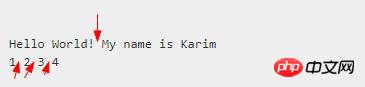
As we can see, although There is no newline character, but there is still a space character between the two output statements.
If you really need to have a little space, then this is the easiest and most straightforward method.
But what if you want the output to be displayed without spaces or newlines?
In this case, you can use the powerful sys.stdout.write function in the sys module.
This function only outputs what we have explicitly instructed to print.
No terminating string.
Let’s give an example
import sys  #声明使用sys模块

sys.stdout.write("Hello World!")
sys.stdout.write("My name is Karim")
Run:

No line breaks in Python 3.x For output
In Python 3, the simplest solution is provided, all you have to do is provide an extra parameter to the print function. Example:
# 使用命名参数“end”指定行尾显式的字符串
print("Hello World!", end ="") #end里没有空格
print("My name is Karim")

# 数组
a = [1, 2, 3, 4]

# 输出数组的元素
for i in range(4):
    print(a[i], end =" ")  #end里添加空格
Run:

We can use the optional named parameter end to explicitly mention the string that should be added at the end of the line .
Whatever you provide as the end argument will be the terminating string.
So if you provide an empty string, there will be no newlines and no spaces will be appended to the input.
Summary: The above is the entire content of this article. I introduce to you the method of outputting without line breaks in Python 2 and Python 3. I hope it will be helpful to your learning. .
The above is the detailed content of How to output without line breaks in Python. For more information, please follow other related articles on the PHP Chinese website!

Hot AI Tools

Undress AI Tool
Undress images for free

Undresser.AI Undress
AI-powered app for creating realistic nude photos

AI Clothes Remover
Online AI tool for removing clothes from photos.

Clothoff.io
AI clothes remover

Video Face Swap
Swap faces in any video effortlessly with our completely free AI face swap tool!

Hot Article
Hot Tools

Notepad++7.3.1
Easy-to-use and free code editor

SublimeText3 Chinese version
Chinese version, very easy to use

Zend Studio 13.0.1
Powerful PHP integrated development environment

Dreamweaver CS6
Visual web development tools

SublimeText3 Mac version
God-level code editing software (SublimeText3)


 What are class methods in Python
Aug 21, 2025 am 04:12 AM
What are class methods in Python
Aug 21, 2025 am 04:12 AM
ClassmethodsinPythonareboundtotheclassandnottoinstances,allowingthemtobecalledwithoutcreatinganobject.1.Theyaredefinedusingthe@classmethoddecoratorandtakeclsasthefirstparameter,referringtotheclassitself.2.Theycanaccessclassvariablesandarecommonlyused
 python asyncio queue example
Aug 21, 2025 am 02:13 AM
python asyncio queue example
Aug 21, 2025 am 02:13 AM
asyncio.Queue is a queue tool for secure communication between asynchronous tasks. 1. The producer adds data through awaitqueue.put(item), and the consumer uses awaitqueue.get() to obtain data; 2. For each item you process, you need to call queue.task_done() to wait for queue.join() to complete all tasks; 3. Use None as the end signal to notify the consumer to stop; 4. When multiple consumers, multiple end signals need to be sent or all tasks have been processed before canceling the task; 5. The queue supports setting maxsize limit capacity, put and get operations automatically suspend and do not block the event loop, and the program finally passes Canc
 How to run a Python script and see the output in a separate panel in Sublime Text?
Aug 17, 2025 am 06:06 AM
How to run a Python script and see the output in a separate panel in Sublime Text?
Aug 17, 2025 am 06:06 AM
ToseePythonoutputinaseparatepanelinSublimeText,usethebuilt-inbuildsystembysavingyourfilewitha.pyextensionandpressingCtrl B(orCmd B).2.EnsurethecorrectbuildsystemisselectedbygoingtoTools→BuildSystem→Pythonandconfirming"Python"ischecked.3.Ifn
 How to use regular expressions with the re module in Python?
Aug 22, 2025 am 07:07 AM
How to use regular expressions with the re module in Python?
Aug 22, 2025 am 07:07 AM
Regular expressions are implemented in Python through the re module for searching, matching and manipulating strings. 1. Use re.search() to find the first match in the entire string, re.match() only matches at the beginning of the string; 2. Use brackets() to capture the matching subgroups, which can be named to improve readability; 3. re.findall() returns all non-overlapping matches, and re.finditer() returns the iterator of the matching object; 4. re.sub() replaces the matching text and supports dynamic function replacement; 5. Common patterns include \d, \w, \s, etc., you can use re.IGNORECASE, re.MULTILINE, re.DOTALL, re
 How to build and run Python in Sublime Text?
Aug 22, 2025 pm 03:37 PM
How to build and run Python in Sublime Text?
Aug 22, 2025 pm 03:37 PM
EnsurePythonisinstalledbyrunningpython--versionorpython3--versionintheterminal;ifnotinstalled,downloadfrompython.organdaddtoPATH.2.InSublimeText,gotoTools>BuildSystem>NewBuildSystem,replacecontentwith{"cmd":["python","-
 How to use variables and data types in Python
Aug 20, 2025 am 02:07 AM
How to use variables and data types in Python
Aug 20, 2025 am 02:07 AM
VariablesinPythonarecreatedbyassigningavalueusingthe=operator,anddatatypessuchasint,float,str,bool,andNoneTypedefinethekindofdatabeingstored,withPythonbeingdynamicallytypedsotypecheckingoccursatruntimeusingtype(),andwhilevariablescanbereassignedtodif
 How to pass command-line arguments to a script in Python
Aug 20, 2025 pm 01:50 PM
How to pass command-line arguments to a script in Python
Aug 20, 2025 pm 01:50 PM
Usesys.argvforsimpleargumentaccess,whereargumentsaremanuallyhandledandnoautomaticvalidationorhelpisprovided.2.Useargparseforrobustinterfaces,asitsupportsautomatichelp,typechecking,optionalarguments,anddefaultvalues.3.argparseisrecommendedforcomplexsc
 How to debug a remote Python application in VSCode
Aug 30, 2025 am 06:17 AM
How to debug a remote Python application in VSCode
Aug 30, 2025 am 06:17 AM
To debug a remote Python application, you need to use debugpy and configure port forwarding and path mapping: First, install debugpy on the remote machine and modify the code to listen to port 5678, forward the remote port to the local area through the SSH tunnel, then configure "AttachtoRemotePython" in VSCode's launch.json and correctly set the localRoot and remoteRoot path mappings. Finally, start the application and connect to the debugger to realize remote breakpoint debugging, variable checking and code stepping. The entire process depends on debugpy, secure port forwarding and precise path matching.
