本篇文章中的内容是ThinkPHP5中行为的使用 ,现在分享给大家,有需要的朋友可以参考一下这篇文章的内容
目录结构: 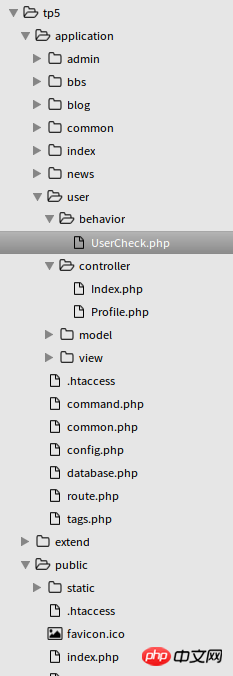
1.在user\behavior目录下建UserCheck.php(名称随便取)
<?phpnamespace app\user\behavior;use think\Controller;/**
*
*/class UserCheck {
use \traits\controller\Jump;//类里面引入jump;类
//绑定到CheckAuth标签,可以用于检测Session以用来判断用户是否登录
public function run(&$params){
return $this->error('请登录!','index/login');
}
}1
2
3
4
5
6
7
8
9
10
11
12
13
14
15
16
17
18
这里run函数中添加自己检测用户权限的逻辑,可以使用session或者别的…
2.在application目录下tags.php(没有就新建一个,名字固定不能改)把行为与某个标签绑定,这里绑定到了“CheckAuth”
<?phpreturn [ 'CheckAuth' => [ 'app\\user\\behavior\\UserCheck',
],
];1
2
3
4
5
6
7
3 . 在控制器里需要监听的地方写下监听标签代码
user\controller\Index.php
<?phpnamespace app\user\controller;use think\Hook;class Index{
public function index(){
//判断用户是否登录
Hook::listen('CheckAuth',$params); //
echo 'index_end';
}
}
转载:http://blog.csdn.net/u012995856相关推荐:
The above is the detailed content of The use of behaviors in ThinkPHP5. For more information, please follow other related articles on the PHP Chinese website!











![[Web front-end] Node.js quick start](https://img.php.cn/upload/course/000/000/067/662b5d34ba7c0227.png)