


Laravel Vue.js single page application (SPA) tutorial

Single-page applications (SPAs) can be built using Laravel and Vue.js. 1) Define API routing and controller in Laravel to process data logic. 2) Create a componentized front-end in Vue.js to realize user interface and data interaction. 3) Configure CORS and use axios for data interaction. 4) Use Vue Router to implement routing management and improve user experience.

introduction
In modern web development, single page applications (SPA) have become the mainstream choice. They provide a smooth user experience and an efficient development process. Today, we will dive into how to build a SPA using Laravel and Vue.js. Through this article, you will learn how to use Laravel as a backend API, combined with the Vue.js front-end framework to create a modern single-page application.
Review of basic knowledge
Before we get started, let's quickly review the basics of Laravel and Vue.js. Laravel is a PHP-based framework that provides powerful features and elegant syntax, which is perfect for building RESTful APIs. Vue.js is a progressive JavaScript framework that focuses on building user interfaces, especially suitable for developing SPAs.
If you are not familiar with these two frameworks, it is recommended to learn the basics of them first. The core concepts of Laravel include routing, controllers, models, and migration, while the core concepts of Vue.js include components, templates, and state management.
Core concept or function analysis
Laravel as a backend API
Laravel's main function as a backend API is to process data logic and provide data interfaces. With Laravel, we can easily create RESTful APIs to interact with the front-end data.
 // routes/api.php
Route::get('/users', 'UserController@index');
Route::post('/users', 'UserController@store');

// app/Http/Controllers/UserController.php
namespace App\Http\Controllers;

use App\User;
use Illuminate\Http\Request;

class UserController extends Controller
{
    public function index()
    {
        return User::all();
    }

    public function store(Request $request)
    {
        $user = new User();
        $user->name = $request->input('name');
        $user->email = $request->input('email');
        $user->save();
        return $user;
    }
}
This example shows how to define API routing and controller in Laravel. In this way, we can easily manage data and provide it to the front-end.
Vue.js as front-end framework
The main function of Vue.js is to build a user interface and manage front-end logic. Through Vue.js, we can create componentized front-end applications to realize dynamic data updates and user interaction.
// src/components/UserList.vue
<template>
<div>
<h1>User List</h1>
<ul>
<li v-for="user in users" :key="user.id">{{ user.name }} - {{ user.email }}</li>
</ul>
<form @submit.prevent="addUser">
<input v-model="newUser.name" placeholder="Name" />
<input v-model="newUser.email" placeholder="Email" />
<button type="submit">Add User</button>
</form>
</div>
</template>
<script>
export default {
data() {
return {
users: [],
newUser: {
name: '',
email: ''
}
};
},
mounted() {
this.fetchUsers();
},
methods: {
fetchUsers() {
fetch('/api/users')
.then(response => response.json())
.then(data => {
this.users = data;
});
},
addUser() {
fetch('/api/users', {
method: 'POST',
headers: {
'Content-Type': 'application/json'
},
body: JSON.stringify(this.newUser)
})
.then(response => response.json())
.then(data => {
this.users.push(data);
this.newUser.name = '';
this.newUser.email = '';
});
}
}
};
</script>This example shows how to create a user list component in Vue.js and interact with the backend through the API.
Example of usage
Basic usage
In the basic usage, we need to make sure Laravel and Vue.js can interact correctly. First, we need to configure CORS in Laravel so that the front-end can access the API.
 // app/Http/Middleware/Cors.php
namespace App\Http\Middleware;

use Closure;

class Cors
{
    public function handle($request, Closure $next)
    {
        return $next($request)
            ->header('Access-Control-Allow-Origin', '*')
            ->header('Access-Control-Allow-Methods', 'GET, POST, PUT, DELETE, OPTIONS')
            ->header('Access-Control-Allow-Headers', 'Content-Type, Authorization');
    }
}
Then we need to use axios in Vue.js to send HTTP requests.
 // src/main.js
import Vue from 'vue';
import App from './App.vue';
import axios from 'axios';
import VueAxios from 'vue-axios';

Vue.use(VueAxios, axios);

new Vue({
  render: h => h(App)
}).$mount('#app');
In this way, we can easily interact with data between the front and back ends.
Advanced Usage
In advanced usage, we can use Vue Router to implement routing management to create a more complex SPA.
 // src/router/index.js
import Vue from 'vue';
import VueRouter from 'vue-router';
import UserList from '../components/UserList.vue';

Vue.use(VueRouter);

const routes = [
  {
    path: '/',
    name: 'UserList',
    component: UserList
  }
];

const router = new VueRouter({
  mode: 'history',
  base: process.env.BASE_URL,
  routes
});

export default router;
Through Vue Router, we can realize navigation between pages and improve user experience.
Common Errors and Debugging Tips
During the development process, you may encounter some common problems, such as CORS errors, data binding problems, etc. Here are some debugging tips:
- CORS error : Make sure the CORS middleware is correctly configured in Laravel and the domain name requested by the front-end is the same as the back-end.
- Data binding problem : Check whether the data in the Vue.js component is correctly bound to ensure smooth data flow.
- API request failed : Use the browser's developer tools to view the network request and check whether the request is sent and received correctly.
Performance optimization and best practices
Performance optimization and best practices are very important in practical applications. Here are some suggestions:
- API optimization : In Laravel, you can use the query optimization function of Eloquent ORM to reduce the number of database queries and improve the API response speed.
- Front-end optimization : In Vue.js, virtual scrolling technology can be used to process large amounts of data to avoid performance problems caused by loading all data at once.
- Code readability : Maintain the readability and maintenance of the code, and use comments and documents reasonably to facilitate team collaboration and post-maintenance.
Through these optimizations and best practices, we can build an efficient and maintainable SPA.
Summarize
Through this article, we explore in detail how to use Laravel and Vue.js to develop a single page application. From basics to advanced usage, to performance optimization and best practices, we hope these contents will help you better understand and apply these two powerful frameworks. I wish you all the best on the road to development!
The above is the detailed content of Laravel Vue.js single page application (SPA) tutorial. For more information, please follow other related articles on the PHP Chinese website!

Hot AI Tools

Undress AI Tool
Undress images for free

Undresser.AI Undress
AI-powered app for creating realistic nude photos

AI Clothes Remover
Online AI tool for removing clothes from photos.

Clothoff.io
AI clothes remover

Video Face Swap
Swap faces in any video effortlessly with our completely free AI face swap tool!

Hot Article
Hot Tools

Notepad++7.3.1
Easy-to-use and free code editor

SublimeText3 Chinese version
Chinese version, very easy to use

Zend Studio 13.0.1
Powerful PHP integrated development environment

Dreamweaver CS6
Visual web development tools

SublimeText3 Mac version
God-level code editing software (SublimeText3)
Hot Topics
 1793
1793
 16
1736
56
1587
29
267
587
16
1736
56
1587
29
267
587

 What is the blockchain confirmation time? How to query the confirmation status of transactions on the blockchain?
Jul 23, 2025 pm 11:48 PM
What is the blockchain confirmation time? How to query the confirmation status of transactions on the blockchain?
Jul 23, 2025 pm 11:48 PM
Blockchain confirmation time refers to the time it takes for a transaction to be broadcasted to be packaged by a block and written to the chain. The confirmation speeds of different chains vary. 1. Bitcoin produces blocks on average in 10 minutes, and it is recommended to confirm 6 times to ensure security; 2. Ethereum produces blocks in about 12 seconds, and 1-3 times can be confirmed, and most transactions are completed within 1 minute; 3. The BSC chain block time is about 3 seconds, suitable for high-frequency trading; 4. The TRON tide block time is 1-3 seconds, suitable for real-time transfer; 5. The Polygon block time is about 2 seconds, with low fees, and is widely used in DeFi and NFT. Trading hash (TxID) is required for query and confirmation status. Recommended platforms include: 1. Ouyi OKX, which supports multi-chain transaction query; 2. Binance, suitable for BSC chain; 3. Huobi HT
 What is a blockchain browser? How to use it to track on-chain transaction data?
Jul 23, 2025 pm 11:54 PM
What is a blockchain browser? How to use it to track on-chain transaction data?
Jul 23, 2025 pm 11:54 PM
Blockchain browser is a must-have on-chain query tool for Web3 users. 1. It serves as a "search engine" in the decentralized world, allowing users to openly and transparently verify all records on the blockchain; 2. The core functions include querying transaction details, viewing account information, exploring block data and tracking smart contracts; 3. When tracking transactions, you need to obtain the transaction hash, select the browser corresponding to the public chain, and enter the hash to view the status, address, amount and fee details; 4. Confirm whether the transaction is successful through the browser is a key step to ensure the security of digital assets. Proficient use can help users better understand and participate in the blockchain ecosystem, thereby operating more safely and stably in the decentralized world.
 What is a more common digital currency
Jul 23, 2025 pm 09:53 PM
What is a more common digital currency
Jul 23, 2025 pm 09:53 PM
Digital currency is a decentralized electronic currency based on blockchain technology. Its value is determined by market supply and demand. It is globally universal, transparent in transactions and has certain anonymity. 1. Binance is the largest platform in the world with transaction volume, providing rich currencies and a strong ecosystem. 2. OkX has a comprehensive product line, supporting derivatives trading and Web3 accounts, suitable for advanced users; 3. Huobi (Huobi/HTX) has a long history, is safe and stable, and is deeply trusted by old users; 4. Gat
 2025 Cryptocurrency Market Outlook: How do policies, institutions and technological innovations affect trends?
Jul 23, 2025 pm 10:15 PM
2025 Cryptocurrency Market Outlook: How do policies, institutions and technological innovations affect trends?
Jul 23, 2025 pm 10:15 PM
In 2025, the cryptocurrency market will be driven by three major factors: clear policy supervision, in-depth institutional participation and technological innovation. 1. The United States may introduce a comprehensive crypto bill, and global regulatory coordination (such as the EU MiCA) will enhance the legitimacy of the industry; 2. Institutional funds will enter large-scale through compliant products such as Bitcoin and Ethereum ETFs, and exchanges such as Binance, OKX, Huobi, Gate.io and Coinbase will serve as core infrastructure to undertake institutional traffic; 3. The popularization of Layer 2 network will promote the scale of applications, and the tokenization of real-world assets (RWA) is expected to inject trillion-dollar liquidity into DeFi. The integration of AI and crypto will give birth to a new paradigm, jointly driving the growth of the industry's intrinsic value.
 The stablecoin market ushers in major changes, and the US dollar stablecoin becomes the biggest winner
Jul 23, 2025 pm 10:27 PM
The stablecoin market ushers in major changes, and the US dollar stablecoin becomes the biggest winner
Jul 23, 2025 pm 10:27 PM
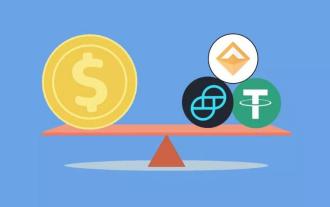
After experiencing the collapse of algorithmic stablecoins and stricter regulation, the US dollar stablecoin supported by fiat currency reserves has become the biggest winner in the market due to its high transparency and strong compliance, and its dominance has been consolidated. 1. Tether (USDT) has become the core trading pair of mainstream exchanges around the world such as Binance, Ouyi and Huobi with its maximum market value and extensive liquidity; 2. USD Coin (USDC) has won the favor of institutions for its high transparency and regular audits, and has widely supported it on platforms such as Binance, Ouyi and Coinbase; 3. First Digital USD (FDUSD) is an emerging compliant stablecoin, which has developed rapidly under the promotion of Binance and has gradually entered platforms such as Gate.io; 4. Dai (DA
 What are public and private keys? How to manage key security in blockchain?
Jul 23, 2025 pm 11:51 PM
What are public and private keys? How to manage key security in blockchain?
Jul 23, 2025 pm 11:51 PM
Public keys are used to receive assets and identity identification, private keys are used to sign and control assets. The two are based on asymmetric encryption technologies such as ECDSA. Private keys can be derived from public keys but vice versa. mainstream platforms such as Ouyi OKX adopts multiple signatures and cold storage, Binance uses hardware isolation and layered permissions, Huobi HTX implements hot and cold separation and whitelisting mechanisms, and Gate.io gate combines multiple signatures and distributed storage; public keys and private keys are used in blockchain for identity authentication, asset control and decentralized login; key security management suggestions include offline backup, anti-phishing, enabling multi-factor authentication and using multi-signature or MPC; among different management methods, single keys are at high risk, multiple signatures are suitable for teams, and hardware equipment is highly secure but costly.
 Free market website app software collection Download the official version of currency circle market website
Jul 23, 2025 pm 09:28 PM
Free market website app software collection Download the official version of currency circle market website
Jul 23, 2025 pm 09:28 PM
Binance provides comprehensive market and trading, with fast official website and app data and wide coverage; 2. OkX market tools are powerful, supporting spot and futures and other multi-product data; 3. Huobi (HTX) has stable data and simple interface, suitable for novices; 4. Gate.io has rich currency, which is conducive to tracking niche projects; 5. CoinMarketCap is an authoritative data aggregation platform, providing market value ranking and macro analysis; 6. CoinGecko is neutral and comprehensive, and includes fast new coins and provides community and developer indicators; 7. TradingView is a benchmark for technical analysis, integrating multi-exchange data, powerful chart functions, and all have free web pages and app versions for use.
 Ranking of the top ten legal virtual currencies in the world in 2025 (digital currency rankings)
Jul 23, 2025 pm 09:20 PM
Ranking of the top ten legal virtual currencies in the world in 2025 (digital currency rankings)
Jul 23, 2025 pm 09:20 PM
The top ten virtual currency exchanges in the world in 2025 are: 1. Binance, which ranks first with its leading trading volume, rich currency and complete ecosystem; 2. OKX, which ranks second with strong derivatives trading and Web3 account technology; 3. Coinbase, as a Nasdaq listed platform, is known for its high compliance and novice friendly; 4. Kraken, has a long history, high security, and has complete fiat currency support; 5. Gate.io, which is famous for its massive altcoins and fast new projects; 6. KuCoin, which is active in the community, focuses on the functions of new currency initial public offerings and trading robots; 7. Huobi (HTX), which has a deep user base, continuously optimizes services and revitalizes market position; 8. By
