


 Java
javaTutorial
TechEazy Consulting Launches Comprehensive Java, Spring Boot & AWS Training Program with onth Free Internship
Java
javaTutorial
TechEazy Consulting Launches Comprehensive Java, Spring Boot & AWS Training Program with onth Free Internship
TechEazy Consulting Launches Comprehensive Java, Spring Boot & AWS Training Program with onth Free Internship

TechEazy Consulting is excited to announce the launch of our comprehensive training program designed for beginners, freshers, and professionals looking to switch to backend development with Java, Spring Boot, and AWS.
This 4-month paid training program is followed by a 2-month unpaid internship, where you can apply your new skills in real-world projects—without any additional training charges. This is the perfect opportunity for those looking to fill employment gaps, switch careers, or gain hands-on experience with industry-relevant technologies.
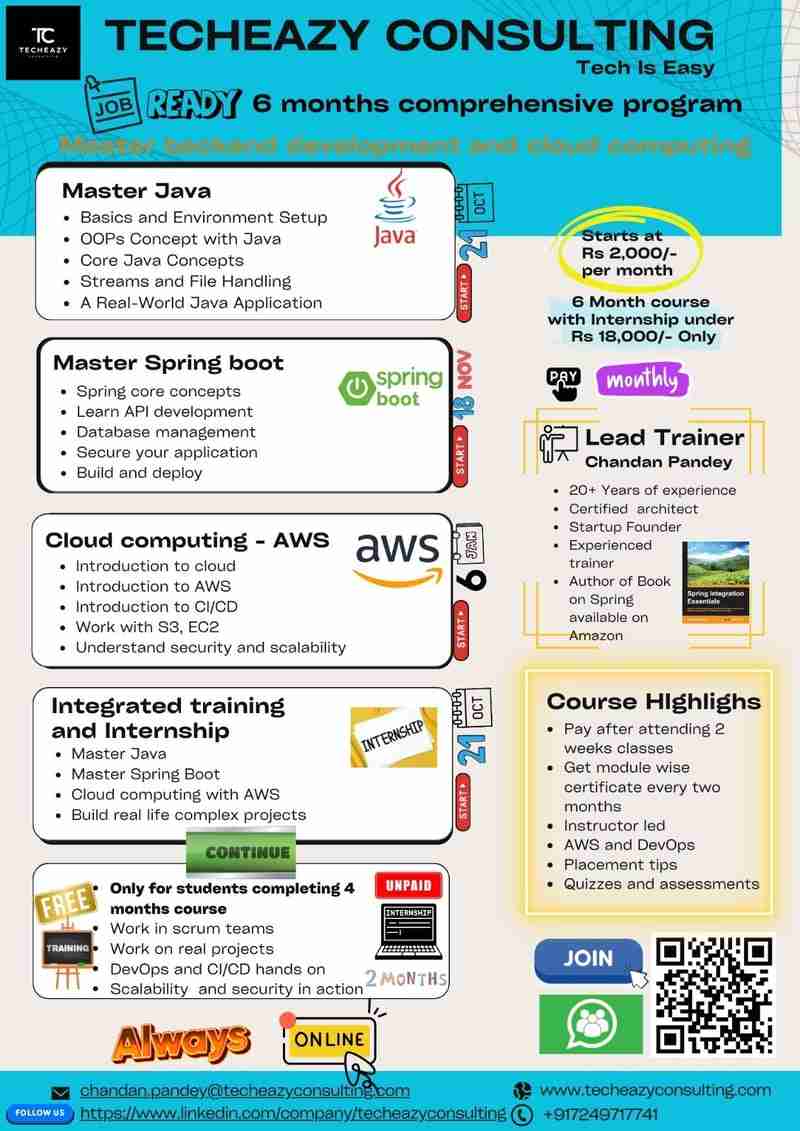
Program Overview:
**Phase 1: 4-Month Paid Training
**Learn the ins and outs of Java, Spring Boot, and AWS with a project-driven approach. You’ll gain practical knowledge in building and deploying applications, database management, and cloud computing. The training is designed to be affordable, with a ₹999 registration fee (adjusted in the first month’s payment), and the first month is FREE.**Phase 2: 2-Month Unpaid Internship
**After completing the 4-month training, candidates will enter a 2-month unpaid internship where they can apply their skills to real-world projects. There are no additional fees for this internship, and high performers may even get opportunities for paid internships or jobs with our clients.
Who Should Join?
Freshers looking for internship certificates.
Career switchers moving from frontend or other tech stacks.
Professionals looking to upgrade their Java and AWS skills and become market-ready.
Why Choose Techeazy Consulting?
Hands-on learning with real-world projects.
2-month internship to gain practical experience with no additional charges.
Certification for 4-6 months to enhance your resume and increase job prospects.
Affordable pricing: ₹999 registration (adjusted in the first month), and the first month is FREE.
How to Apply:
Interested in leveling up your career? Apply now and join our WhatsApp group for more details:
? Apply here: https://forms.gle/nTB9YDzKcYCWSpRf8
? Join WhatsApp Group: https://chat.whatsapp.com/HKTOC4WxLkqITrEr1XmBAn
TechEazy Consulting is committed to providing quality training and real-world experience to help you become market-ready. Start your tech journey with us today!
The above is the detailed content of TechEazy Consulting Launches Comprehensive Java, Spring Boot & AWS Training Program with onth Free Internship. For more information, please follow other related articles on the PHP Chinese website!

Hot AI Tools

Undress AI Tool
Undress images for free

Undresser.AI Undress
AI-powered app for creating realistic nude photos

AI Clothes Remover
Online AI tool for removing clothes from photos.

Clothoff.io
AI clothes remover

Video Face Swap
Swap faces in any video effortlessly with our completely free AI face swap tool!

Hot Article
Hot Tools

Notepad++7.3.1
Easy-to-use and free code editor

SublimeText3 Chinese version
Chinese version, very easy to use

Zend Studio 13.0.1
Powerful PHP integrated development environment

Dreamweaver CS6
Visual web development tools

SublimeText3 Mac version
God-level code editing software (SublimeText3)


 Comparing Java Frameworks: Spring Boot vs Quarkus vs Micronaut
Aug 04, 2025 pm 12:48 PM
Comparing Java Frameworks: Spring Boot vs Quarkus vs Micronaut
Aug 04, 2025 pm 12:48 PM
Pre-formanceTartuptimeMoryusage, Quarkusandmicronautleadduetocompile-Timeprocessingandgraalvsupport, Withquarkusoftenperforminglightbetterine ServerLess scenarios.2.Thyvelopecosyste,
 What is a deadlock in Java and how can you prevent it?
Aug 23, 2025 pm 12:55 PM
What is a deadlock in Java and how can you prevent it?
Aug 23, 2025 pm 12:55 PM
AdeadlockinJavaoccurswhentwoormorethreadsareblockedforever,eachwaitingforaresourceheldbytheother,typicallyduetocircularwaitcausedbyinconsistentlockordering;thiscanbepreventedbybreakingoneofthefournecessaryconditions—mutualexclusion,holdandwait,nopree
 How to join an array of strings in Java?
Aug 04, 2025 pm 12:55 PM
How to join an array of strings in Java?
Aug 04, 2025 pm 12:55 PM
Using String.join() (Java8) is the easiest recommended method for connecting string arrays, just specify the separator directly; 2. For old versions of Java or when more control is needed, you can use StringBuilder to manually traverse and splice; 3. StringJoiner is suitable for scenarios that require more flexible formats such as prefixes and suffixes; 4. Using Arrays.stream() combined with Collectors.joining() is suitable for filtering or converting the array before joining; To sum up, if Java8 and above is used, the String.join() method should be preferred in most cases, which is concise and easy to read, but for complex logic, it is recommended.
 How to implement a simple TCP client in Java?
Aug 08, 2025 pm 03:56 PM
How to implement a simple TCP client in Java?
Aug 08, 2025 pm 03:56 PM
Importjava.ioandjava.net.SocketforI/Oandsocketcommunication.2.CreateaSocketobjecttoconnecttotheserverusinghostnameandport.3.UsePrintWritertosenddataviaoutputstreamandBufferedReadertoreadserverresponsesfrominputstream.4.Usetry-with-resourcestoautomati
 Comparing Java Build Tools: Maven vs. Gradle
Aug 03, 2025 pm 01:36 PM
Comparing Java Build Tools: Maven vs. Gradle
Aug 03, 2025 pm 01:36 PM
Gradleisthebetterchoiceformostnewprojectsduetoitssuperiorflexibility,performance,andmoderntoolingsupport.1.Gradle’sGroovy/KotlinDSLismoreconciseandexpressivethanMaven’sverboseXML.2.GradleoutperformsMaveninbuildspeedwithincrementalcompilation,buildcac
 How to compare two strings in Java?
Aug 04, 2025 am 11:03 AM
How to compare two strings in Java?
Aug 04, 2025 am 11:03 AM
Use the .equals() method to compare string content, because == only compare object references rather than content; 1. Use .equals() to compare string values equally; 2. Use .equalsIgnoreCase() to compare case ignoring; 3. Use .compareTo() to compare strings in dictionary order, returning 0, negative or positive numbers; 4. Use .compareToIgnoreCase() to compare case ignoring; 5. Use Objects.equals() or safe call method to process null strings to avoid null pointer exceptions. In short, you should avoid using == for string content comparisons unless it is explicitly necessary to check whether the object is in phase.
 How to send and receive messages over a WebSocket in Java
Aug 16, 2025 am 10:36 AM
How to send and receive messages over a WebSocket in Java
Aug 16, 2025 am 10:36 AM
Create a WebSocket server endpoint to define the path using @ServerEndpoint, and handle connections, message reception, closing and errors through @OnOpen, @OnMessage, @OnClose and @OnError; 2. Ensure that javax.websocket-api dependencies are introduced during deployment and automatically registered by the container; 3. The Java client obtains WebSocketContainer through the ContainerProvider, calls connectToServer to connect to the server, and receives messages using @ClientEndpoint annotation class; 4. Use the Session getBasicRe
 Correct posture for handling non-UTF-8 request encoding in Spring Boot application
Aug 15, 2025 pm 12:30 PM
Correct posture for handling non-UTF-8 request encoding in Spring Boot application
Aug 15, 2025 pm 12:30 PM
This article discusses the mechanism and common misunderstandings of Spring Boot applications for handling non-UTF-8 request encoding. The core lies in understanding the importance of the charset parameter in the HTTP Content-Type header, as well as the default character set processing flow of Spring Boot. By analyzing the garbled code caused by wrong testing methods, the article guides readers how to correctly simulate and test requests for different encodings, and explains that Spring Boot usually does not require complex configurations to achieve compatibility under the premise that the client correctly declares encoding.
