


How to draw stacked charts and pie charts using Matplotlib

Matplotlib is a Python 2D plotting library that can generate publication-quality graphics in a variety of hardcopy formats and interactive environments on a variety of platforms.

In the last Matplotlib data visualization tutorial, we will introducehow to createbar charts, histograms and scatter plots. Today we bring you two other types of charts, stacked charts and pie charts. Because these two diagrams are very similar, they are introduced together.
Stacked Chart
Stacked chart is used to show the relationship of "part to whole" over time. A stacked chart is basically like a pie chart, only it changes over time.
Let's consider a situation where we have 24 hours in a day and we want to see how we spend our time. We divide our activities into: sleeping, eating, working and playing.
We assume we want to track it over a period of 5 days, so our initial data will look like this:
import matplotlib.pyplot as plt
days = [1,2,3,4,5]
sleeping = [7,8,6,11,7]
eating =   [2,3,4,3,2]
working =  [7,8,7,2,2]
playing =  [8,5,7,8,13]
Therefore, our x-axis will include the day variable, which is 1, 2, 3, 4 and 5. The individual components of the date are then kept in their respective activities. Draw them like this:
plt.stackplot(days, sleeping,eating,working,playing, colors=['m','c','r','k'])
plt.xlabel('x')
plt.ylabel('y')
plt.title('Interesting Graph\nCheck it out')
plt.show()
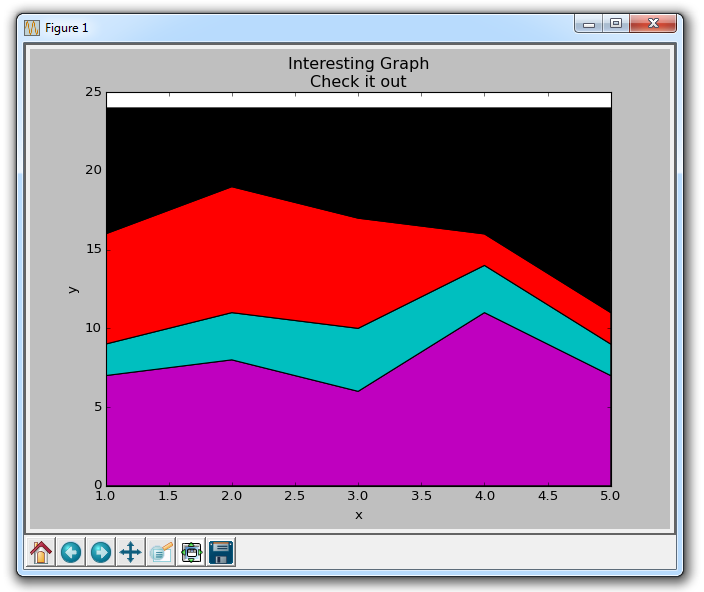
Here we can see, at least in color, how we spend our time. The problem is, without looking back at the code, we don't know what color is what. The next problem is that with polygons we can't actually add "labels" to the data. So anywhere that's more than just lines, with a fill or a stacked diagram like this, we can't inherently mark out specific parts. This shouldn't stop programmers. We can fix this:
import matplotlib.pyplot as plt
days = [1,2,3,4,5]
sleeping = [7,8,6,11,7]
eating =   [2,3,4,3,2]
working =  [7,8,7,2,2]
playing =  [8,5,7,8,13]
plt.plot([],[],color='m', label='Sleeping', linewidth=5)
plt.plot([],[],color='c', label='Eating', linewidth=5)
plt.plot([],[],color='r', label='Working', linewidth=5)
plt.plot([],[],color='k', label='Playing', linewidth=5)
plt.stackplot(days, sleeping,eating,working,playing, colors=['m','c','r','k'])
plt.xlabel('x')
plt.ylabel('y')
plt.title('Interesting Graph\nCheck it out')
plt.legend()
plt.show()
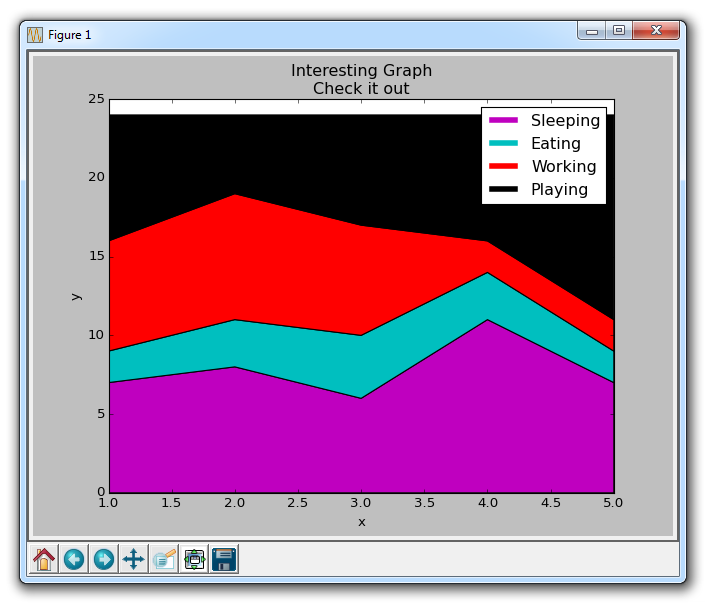
What we do here is draw some empty rows, give them the same color as our stacked plot, and the correct labels. We also give them a line width of 5 to make the lines appear wider in the legend. Now we can easily see how we spend our time.
Pie Chart
Pie charts are much like stacked charts, except they are located at a certain point in time. Typically, pie charts are used to show how a part contributes to a whole, usually in %. Fortunately, Matplotlib takes care of the slice size and everything, we just need to provide the numerical value.
import matplotlib.pyplot as plt
slices = [7,2,2,13]
activities = ['sleeping','eating','working','playing']
cols = ['c','m','r','b']
plt.pie(slices,
        labels=activities,
        colors=cols,
        startangle=90,
        shadow= True,
        explode=(0,0.1,0,0),
        autopct='%1.1f%%')
plt.title('Interesting Graph\nCheck it out')
plt.show()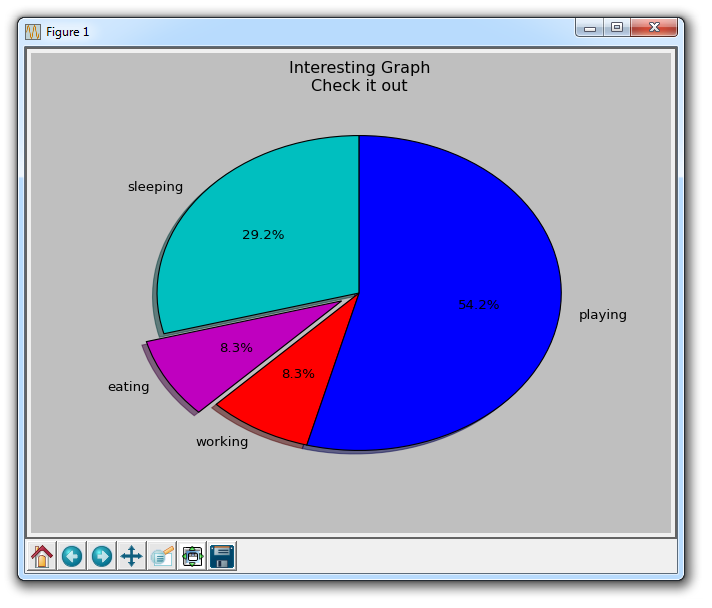
In plt.pie, we need to specify the "slice", which is the relative size of each part. We then specify a list of colors for the corresponding slices. Next, we can choose to specify the "start angle" of the graphic. This allows you to start drawing anywhere. In our example, we chose a 90-degree angle for the pie chart, which means the first segment is a vertical line. Next, we have the option to add a character-sized shadow to the drawing, and then we can even use explode to pull out a slice.
We have a total of four slices, so for explode, if we don't want to pull out any slices, we pass in 0,0,0,0. If we want to pull the first slice, we pass in 0.1,0,0,0.
Finally, we use autopct to choose to place the percentage on the chart.
The above is the detailed content of How to draw stacked charts and pie charts using Matplotlib. For more information, please follow other related articles on the PHP Chinese website!

 Python: Automation, Scripting, and Task ManagementApr 16, 2025 am 12:14 AM
Python excels in automation, scripting, and task management. 1) Automation: File backup is realized through standard libraries such as os and shutil. 2) Script writing: Use the psutil library to monitor system resources. 3) Task management: Use the schedule library to schedule tasks. Python's ease of use and rich library support makes it the preferred tool in these areas.
 Python and Time: Making the Most of Your Study TimeApr 14, 2025 am 12:02 AM
To maximize the efficiency of learning Python in a limited time, you can use Python's datetime, time, and schedule modules. 1. The datetime module is used to record and plan learning time. 2. The time module helps to set study and rest time. 3. The schedule module automatically arranges weekly learning tasks.
 Python: Games, GUIs, and MoreApr 13, 2025 am 12:14 AM
Python excels in gaming and GUI development. 1) Game development uses Pygame, providing drawing, audio and other functions, which are suitable for creating 2D games. 2) GUI development can choose Tkinter or PyQt. Tkinter is simple and easy to use, PyQt has rich functions and is suitable for professional development.
 Python vs. C : Applications and Use Cases ComparedApr 12, 2025 am 12:01 AM
Python is suitable for data science, web development and automation tasks, while C is suitable for system programming, game development and embedded systems. Python is known for its simplicity and powerful ecosystem, while C is known for its high performance and underlying control capabilities.
 The 2-Hour Python Plan: A Realistic ApproachApr 11, 2025 am 12:04 AM
You can learn basic programming concepts and skills of Python within 2 hours. 1. Learn variables and data types, 2. Master control flow (conditional statements and loops), 3. Understand the definition and use of functions, 4. Quickly get started with Python programming through simple examples and code snippets.
 Python: Exploring Its Primary ApplicationsApr 10, 2025 am 09:41 AM
Python is widely used in the fields of web development, data science, machine learning, automation and scripting. 1) In web development, Django and Flask frameworks simplify the development process. 2) In the fields of data science and machine learning, NumPy, Pandas, Scikit-learn and TensorFlow libraries provide strong support. 3) In terms of automation and scripting, Python is suitable for tasks such as automated testing and system management.
 How Much Python Can You Learn in 2 Hours?Apr 09, 2025 pm 04:33 PM
You can learn the basics of Python within two hours. 1. Learn variables and data types, 2. Master control structures such as if statements and loops, 3. Understand the definition and use of functions. These will help you start writing simple Python programs.
 How to teach computer novice programming basics in project and problem-driven methods within 10 hours?Apr 02, 2025 am 07:18 AM
How to teach computer novice programming basics within 10 hours? If you only have 10 hours to teach computer novice some programming knowledge, what would you choose to teach...


Hot AI Tools

Undresser.AI Undress
AI-powered app for creating realistic nude photos

AI Clothes Remover
Online AI tool for removing clothes from photos.

Undress AI Tool
Undress images for free

Clothoff.io
AI clothes remover

AI Hentai Generator
Generate AI Hentai for free.

Hot Article
Hot Tools

WebStorm Mac version
Useful JavaScript development tools

SAP NetWeaver Server Adapter for Eclipse
Integrate Eclipse with SAP NetWeaver application server.

VSCode Windows 64-bit Download
A free and powerful IDE editor launched by Microsoft

SublimeText3 Chinese version
Chinese version, very easy to use

Atom editor mac version download
The most popular open source editor

