


 Backend DevelopmentPHP TutorialDetailed analysis of how to define colors, draw points, lines and rectangles in PHP?
Detailed analysis of how to define colors, draw points, lines and rectangles in PHP?

In the previous article, I brought you "How to output pictures in PHP? (Detailed explanation of the legend) ", which introduces in detail how to output images in PHP. This article continues to show you how we should draw images in PHP. I hope it can help you!

Drawing images in PHP is all based on the canvas in the previous article, create the canvas, and then draw the image on the canvas. When we think of images, we think of colors, so first, let's take a look at how we should define colors for images in PHP.
Image definition color
When we use PHP to operate images, it is inevitable to set the color and outline different colors Came out with this beautiful image. So how should we provide color to images in PHP? At this time we will use the two functions imagecolorallocate() and imagecolorallocatealpha(). Next, let's take a look at how to use these two functions.
imagecolorallocate()Function
imagecolorallocate() function can be used for images Assign colors. If you want to set multiple colors, you need to call this function multiple times. The syntax format of the function is:
imagecolorallocate(resource $image, int $red, int $green, int $blue)
Among them, $image represents the image whose color needs to be set, and the function will return an identifier. Represents the color composed of the given RGB components. $red, $green and $blue are the red, green and blue components of the required color respectively. The value range is an integer from 0 to 255 or hexadecimal 0x00 to 0xFF.
The example is as follows:
<?php
$image = imagecreate(100, 100);
$blue = imagecolorallocate($image, 0, 0, 255);
header('Content-type:image/jpeg');
imagejpeg($image);
imagedestroy($image);
?>Output result:

## imagecolorallocatealpha()
Function
imagecolorallocatealpha(resource $image, int $red, int $green, int $blue, int $alpha)Among them, the previous parameters are consistent with the parameters of the imagecolorallocate() function, $alphab represents the transparency parameter, and the value range is from 0 to Between 127, 0 means completely opaque and 127 means completely transparent. The example is as follows:
<?php
$size=300;
$image=imagecreatetruecolor($size,$size);
$back=imagecolorallocate($image,0,0,0);
$border=imagecolorallocate($image,255,255,255);
imagefilledrectangle($image,0,0,$size-1,$size-1,$back);
imagerectangle($image,0,0,$size-1,$size-1,$border);
$yellow_x=100;
$yellow_y=75;
$red_x=100;
$red_y=165;
$blue_x=187;
$blue_y=125;
$radius=150;
//用alpha值分配一些颜色
$yellow=imagecolorallocatealpha($image,200,200,0,75);
$red=imagecolorallocatealpha($image,200,0,0,75);
$blue=imagecolorallocatealpha($image,0,0,200,75);
//画3个交迭的圆
imagefilledellipse($image,$yellow_x,$yellow_y,$radius,$radius,$yellow);
imagefilledellipse($image,$red_x,$red_y,$radius,$radius,$red);
imagefilledellipse($image,$blue_x,$blue_y,$radius,$radius,$blue);
//不要忘记输出正确的header!
header('Content-type:image/png');
//最后输出结果
imagepng($image);
imagedestroy($image);
?>Output result: ##From this, through imagecolorallocate() and imagecolorallocatealpha() These two functions can already define colors on images. At the same time, images are not only made up of colors, but also dots, lines and different shapes. Then let's take a look at how to solve these problems.
Drawing points and lines
Drawing points and lines can be said to be the most basic operation of drawing images in PHP, although it is very simple. Basic, but with flexible application, more complex images can be drawn through them. We can draw a point in the canvas through the
function, and can also set the color of the point. The syntax of its function The format is as follows: <pre class='brush:php;toolbar:false;'>imagesetpixel(resource $image, int $x, int $y, int $color)</pre> Among them, $image represents the created canvas, $x and $y represent the coordinate point at ($x, $y), and the color of this coordinate point is $color.
To draw a line segment, you can use the
function. Its syntax format is as follows: <pre class='brush:php;toolbar:false;'>imageline(resource $image, int $x1, int $y1, int $x2, int $y2, int $color)</pre> Among them, it represents the coordinate ($x1,$y1) A line segment with color $color to coordinates ($x2,$y2).
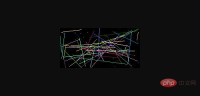
Next we can give an example by combining loops and random numbers:
<?php
$img = imagecreate(200, 100);
imagecolorallocate($img, 0, 0, 0);
$blue = imagecolorallocate($img, 0, 0, 255);
$red = imagecolorallocate($img, 255, 0, 0);
for ($i=0; $i <= 50; $i++) {
$color = imagecolorallocate($img, rand(0, 255), rand(0, 255), rand(0, 255));
imagesetpixel($img, rand(0, 200), rand(0, 100), $color);
imageline($img, rand(0, 200), rand(0, 100), rand(0, 200), rand(0, 100), $color);
}
header('Content-type:image/jpeg');
imagejpeg($img);
imagedestroy($img);
?>Output result:
Draw a rectangle
In PHP, if we want to draw a rectangle, we need to pass
Or imagefilledrectangle() function to perform. The imagefilledrectangle() function fills the rectangle after it is drawn, but the imagerectangle() function does not. Their syntax format is as follows:
imagerectangle(resource $image, int $x1, int $y1, int $x2, int $y2, int $color)
imagefilledrectangle(resource $image, int $x1, int $y1, int $x2, int $y2, int $color)
Among them, both represent drawing a coordinate of the upper left corner ($x1, $y1) and the coordinates of the lower right corner ($x2, $y2). Rectangle, the difference between the two is: the color after the imagerectangle() function represents the color of the rectangle's edges, and the color after the imagefilledrectangle() function represents the fill color within the rectangle.
Next, draw a rectangle through the imagerectangle() or imagefilledrectangle() function through an example. The example is as follows:
<?php
$img = imagecreate(300, 150);
imagecolorallocate($img, 255, 255, 255);
$green = imagecolorallocate($img, 0, 255, 0);
$blue = imagecolorallocate($img, 0, 0, 255);
imagerectangle($img, 5, 5, 145, 145, $green);
imagefilledrectangle($img, 150, 5, 295, 145, $blue);
header('Content-type:image/jpeg');
imagejpeg($img);
imagedestroy($img);
?>Output result:
Recommended learning: "PHP Video Tutorial"
The above is the detailed content of Detailed analysis of how to define colors, draw points, lines and rectangles in PHP?. For more information, please follow other related articles on the PHP Chinese website!

 PHP and Python: Different Paradigms ExplainedApr 18, 2025 am 12:26 AM
PHP is mainly procedural programming, but also supports object-oriented programming (OOP); Python supports a variety of paradigms, including OOP, functional and procedural programming. PHP is suitable for web development, and Python is suitable for a variety of applications such as data analysis and machine learning.
 PHP and Python: A Deep Dive into Their HistoryApr 18, 2025 am 12:25 AM
PHP originated in 1994 and was developed by RasmusLerdorf. It was originally used to track website visitors and gradually evolved into a server-side scripting language and was widely used in web development. Python was developed by Guidovan Rossum in the late 1980s and was first released in 1991. It emphasizes code readability and simplicity, and is suitable for scientific computing, data analysis and other fields.
 Choosing Between PHP and Python: A GuideApr 18, 2025 am 12:24 AM
PHP is suitable for web development and rapid prototyping, and Python is suitable for data science and machine learning. 1.PHP is used for dynamic web development, with simple syntax and suitable for rapid development. 2. Python has concise syntax, is suitable for multiple fields, and has a strong library ecosystem.
 PHP and Frameworks: Modernizing the LanguageApr 18, 2025 am 12:14 AM
PHP remains important in the modernization process because it supports a large number of websites and applications and adapts to development needs through frameworks. 1.PHP7 improves performance and introduces new features. 2. Modern frameworks such as Laravel, Symfony and CodeIgniter simplify development and improve code quality. 3. Performance optimization and best practices further improve application efficiency.
 PHP's Impact: Web Development and BeyondApr 18, 2025 am 12:10 AM
PHPhassignificantlyimpactedwebdevelopmentandextendsbeyondit.1)ItpowersmajorplatformslikeWordPressandexcelsindatabaseinteractions.2)PHP'sadaptabilityallowsittoscaleforlargeapplicationsusingframeworkslikeLaravel.3)Beyondweb,PHPisusedincommand-linescrip
 How does PHP type hinting work, including scalar types, return types, union types, and nullable types?Apr 17, 2025 am 12:25 AM
PHP type prompts to improve code quality and readability. 1) Scalar type tips: Since PHP7.0, basic data types are allowed to be specified in function parameters, such as int, float, etc. 2) Return type prompt: Ensure the consistency of the function return value type. 3) Union type prompt: Since PHP8.0, multiple types are allowed to be specified in function parameters or return values. 4) Nullable type prompt: Allows to include null values and handle functions that may return null values.
 How does PHP handle object cloning (clone keyword) and the __clone magic method?Apr 17, 2025 am 12:24 AM
In PHP, use the clone keyword to create a copy of the object and customize the cloning behavior through the \_\_clone magic method. 1. Use the clone keyword to make a shallow copy, cloning the object's properties but not the object's properties. 2. The \_\_clone method can deeply copy nested objects to avoid shallow copying problems. 3. Pay attention to avoid circular references and performance problems in cloning, and optimize cloning operations to improve efficiency.
 PHP vs. Python: Use Cases and ApplicationsApr 17, 2025 am 12:23 AM
PHP is suitable for web development and content management systems, and Python is suitable for data science, machine learning and automation scripts. 1.PHP performs well in building fast and scalable websites and applications and is commonly used in CMS such as WordPress. 2. Python has performed outstandingly in the fields of data science and machine learning, with rich libraries such as NumPy and TensorFlow.


Hot AI Tools

Undresser.AI Undress
AI-powered app for creating realistic nude photos

AI Clothes Remover
Online AI tool for removing clothes from photos.

Undress AI Tool
Undress images for free

Clothoff.io
AI clothes remover

AI Hentai Generator
Generate AI Hentai for free.

Hot Article
Hot Tools

DVWA
Damn Vulnerable Web App (DVWA) is a PHP/MySQL web application that is very vulnerable. Its main goals are to be an aid for security professionals to test their skills and tools in a legal environment, to help web developers better understand the process of securing web applications, and to help teachers/students teach/learn in a classroom environment Web application security. The goal of DVWA is to practice some of the most common web vulnerabilities through a simple and straightforward interface, with varying degrees of difficulty. Please note that this software

PhpStorm Mac version
The latest (2018.2.1) professional PHP integrated development tool

SublimeText3 English version
Recommended: Win version, supports code prompts!

SecLists
SecLists is the ultimate security tester's companion. It is a collection of various types of lists that are frequently used during security assessments, all in one place. SecLists helps make security testing more efficient and productive by conveniently providing all the lists a security tester might need. List types include usernames, passwords, URLs, fuzzing payloads, sensitive data patterns, web shells, and more. The tester can simply pull this repository onto a new test machine and he will have access to every type of list he needs.

ZendStudio 13.5.1 Mac
Powerful PHP integrated development environment

