



In the previous article "Mid-Autumn Festival Tips: How to Use CSS to Realize the Revolution of the Earth and the Moon (Collection)", I introduced you to how to use CSS to realize the rotation of the Earth and the Moon. The following article will help you understand the this pointing problem in js. It has certain reference value. Friends in need can refer to it. I hope it will be helpful to you.

This points to the problem in JS
Believe me, as long as you remember the 7 steps in this article, you can completely master the ## in JS #this points to.
this points to it.
Console console of Chrome.
this will not be changed, as long as the current function is an arrow function, there is no need to look at other rules.
this of an arrow function is the point of the outer this when it is created. There are two key points here:
this direction has been determined.
this in the arrow function points to this in the outer layer.
this of the arrow function, you must first know the direction of the outer layer this, and you need to continue to apply the seven-step formula in the outer layer.
When using the new keyword to call a function, this in the function must be a new object created by JS.
Readers may have questions, "If thenew key is used to call the arrow function, will this of the arrow function be modified?".
func = () => {}
new func() // throw error

new.
bind refers to Function.prototype.bind() Detailed address: https://developer.mozilla.org/zh-CN/docs/Web/JavaScript /Reference/Global_Objects/Function/bindWhen binding multiple times, only the value of the first bind is recognizedError-prone points
function func() {
  console.log(this)
}

func.bind(1).bind(2)() // 1
This is not allowed in arrow functions Will be modifiedfunc = () => {
// 这里 this 指向取决于外层 this,参考口诀 7 「不在函数里」
console.log(this)
}
func.bind(1)() // Window,口诀 1 优先
bind and newError-prone pointsfunction func() {
console.log(this, this.__proto__ === func.prototype)
}
boundFunc = func.bind(1)
new boundFunc() // Object true,口诀 2 优先4. apply and call
apply()and The first parameter of call() is both this. The difference is that when calling through apply, the actual parameters are placed in the array, while through callThe actual parameters are separated by commas when called.
func = () => {
  // 这里 this 指向取决于外层 this,参考口诀 7 「不在函数里」
  console.log(this)
}

func.apply(1) // Window,口诀 1 优先
This will not be modified in the bind functionError prone point
function func() {
  console.log(this)
}

boundFunc = func.bind(1)
boundFunc.apply(2) // 1,口诀 3 优先
5. Obijian point (obj.)function func() {
console.log(this.x)
}
obj = { x: 1 }
obj.func = func
obj.func() // 1
There is no need for code examples here. Arrow functions and bind functions have higher priority. If you are interested, you can try it yourself. 6. Direct call When the function does not meet the previous scenario and is called directly, this will point to the global object. The global object is Window in the browser environment and Global in the Node.js environment.
function func() {
  console.log(this)
}

func() // Window
Let’s take a complicated example. The outer outerFunc serves the purpose of confusion.
function outerFunc() {
  console.log(this) // { x: 1 }

  function func() {
    console.log(this) // Window
  }

  func()
}

outerFunc.bind({ x: 1 })()
7. Not in the function<script></script> tag of the browser, or# In the module file of ##Node.js. 1. In the
tag, this points to Window. 2. In the module file of
, this points to the default export object of Module, which is module. exports. Non-strict mode
Strict mode was proposed in
ES5. Before the ES5 specification, that is, in non-strict mode, this cannot be undefined or null. So **In non-strict mode, through the above seven steps, if this points to undefined or null, then this will point to the global object. **The global object is Window in the browser environment and Global in the Node.js environment. For example, in the following code, in non-strict mode,
all points to the global object. <pre class='brush:php;toolbar:false;'>function a() {
console.log("function a:", this)
;(() => {
console.log("arrow function: ", this)
})()
}
a()
a.bind(null)()
a.bind(undefined)()
a.bind().bind(2)()
a.apply()</pre>The execution result in non-strict mode is:
在严格模式下,执行同样的代码进行对比。记住要一次性将所有代码复制粘贴到控制台中,才能运行在严格模式下(因为第一行 "use strict" 才会对后面的代码生效)。
"use strict"

function a() {
  console.log("function a:", this)
  ;(() => {
    console.log("arrow function: ", this)
  })()
}

a()

a.bind(null)()

a.bind(undefined)()

a.bind().bind(2)()

a.apply()
严格模式下执行结果为:
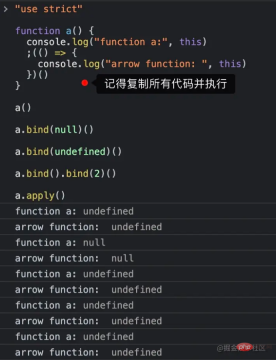
七步口诀在严格模式下和非严格模式下都是完备的,只是在非严格模式下null或undefined会被转换为全局对象。所以我没有将这点列入口诀中。
做题复习
先背诵口诀再做题,“箭头函数、new、bind、apply和call、欧比届点(obj.)、直接调用、不在函数里”。
1. 下面代码执行后,func.count 值为多少?
function func(num) {
  this.count++
}

func.count = 0
func(1)
答案
func.count值为 0。
按照口诀,func()调用时属于第 6 类「直接调用」。在非严格模式下,this指向全局对象。this跟func 一点关系都没有,所以 func.count保持不变so easy。
2. 以下箭头函数中 this 指向谁呢?
obj = {
  func() {
    const arrowFunc = () => {
      console.log(this._name)
    }

    return arrowFunc
  },

  _name: "obj",
}

obj.func()()

func = obj.func
func()()

obj.func.bind({ _name: "newObj" })()()

obj.func.bind()()()

obj.func.bind({ _name: "bindObj" }).apply({ _name: "applyObj" })()
答案
// obj
// undefined
// newObj
// undefined
// bindObj
是不是很简单,你学废了吗?
推荐学习:JS视频教程
The above is the detailed content of An article explaining the problem of this pointing in js (with code). For more information, please follow other related articles on the PHP Chinese website!

 Understanding the JavaScript Engine: Implementation DetailsApr 17, 2025 am 12:05 AM
Understanding how JavaScript engine works internally is important to developers because it helps write more efficient code and understand performance bottlenecks and optimization strategies. 1) The engine's workflow includes three stages: parsing, compiling and execution; 2) During the execution process, the engine will perform dynamic optimization, such as inline cache and hidden classes; 3) Best practices include avoiding global variables, optimizing loops, using const and lets, and avoiding excessive use of closures.
 Python vs. JavaScript: The Learning Curve and Ease of UseApr 16, 2025 am 12:12 AM
Python is more suitable for beginners, with a smooth learning curve and concise syntax; JavaScript is suitable for front-end development, with a steep learning curve and flexible syntax. 1. Python syntax is intuitive and suitable for data science and back-end development. 2. JavaScript is flexible and widely used in front-end and server-side programming.
 Python vs. JavaScript: Community, Libraries, and ResourcesApr 15, 2025 am 12:16 AM
Python and JavaScript have their own advantages and disadvantages in terms of community, libraries and resources. 1) The Python community is friendly and suitable for beginners, but the front-end development resources are not as rich as JavaScript. 2) Python is powerful in data science and machine learning libraries, while JavaScript is better in front-end development libraries and frameworks. 3) Both have rich learning resources, but Python is suitable for starting with official documents, while JavaScript is better with MDNWebDocs. The choice should be based on project needs and personal interests.
 From C/C to JavaScript: How It All WorksApr 14, 2025 am 12:05 AM
The shift from C/C to JavaScript requires adapting to dynamic typing, garbage collection and asynchronous programming. 1) C/C is a statically typed language that requires manual memory management, while JavaScript is dynamically typed and garbage collection is automatically processed. 2) C/C needs to be compiled into machine code, while JavaScript is an interpreted language. 3) JavaScript introduces concepts such as closures, prototype chains and Promise, which enhances flexibility and asynchronous programming capabilities.
 JavaScript Engines: Comparing ImplementationsApr 13, 2025 am 12:05 AM
Different JavaScript engines have different effects when parsing and executing JavaScript code, because the implementation principles and optimization strategies of each engine differ. 1. Lexical analysis: convert source code into lexical unit. 2. Grammar analysis: Generate an abstract syntax tree. 3. Optimization and compilation: Generate machine code through the JIT compiler. 4. Execute: Run the machine code. V8 engine optimizes through instant compilation and hidden class, SpiderMonkey uses a type inference system, resulting in different performance performance on the same code.
 Beyond the Browser: JavaScript in the Real WorldApr 12, 2025 am 12:06 AM
JavaScript's applications in the real world include server-side programming, mobile application development and Internet of Things control: 1. Server-side programming is realized through Node.js, suitable for high concurrent request processing. 2. Mobile application development is carried out through ReactNative and supports cross-platform deployment. 3. Used for IoT device control through Johnny-Five library, suitable for hardware interaction.
 Building a Multi-Tenant SaaS Application with Next.js (Backend Integration)Apr 11, 2025 am 08:23 AM
I built a functional multi-tenant SaaS application (an EdTech app) with your everyday tech tool and you can do the same. First, what’s a multi-tenant SaaS application? Multi-tenant SaaS applications let you serve multiple customers from a sing
 How to Build a Multi-Tenant SaaS Application with Next.js (Frontend Integration)Apr 11, 2025 am 08:22 AM
This article demonstrates frontend integration with a backend secured by Permit, building a functional EdTech SaaS application using Next.js. The frontend fetches user permissions to control UI visibility and ensures API requests adhere to role-base


Hot AI Tools

Undresser.AI Undress
AI-powered app for creating realistic nude photos

AI Clothes Remover
Online AI tool for removing clothes from photos.

Undress AI Tool
Undress images for free

Clothoff.io
AI clothes remover

AI Hentai Generator
Generate AI Hentai for free.

Hot Article
Hot Tools

Notepad++7.3.1
Easy-to-use and free code editor

SecLists
SecLists is the ultimate security tester's companion. It is a collection of various types of lists that are frequently used during security assessments, all in one place. SecLists helps make security testing more efficient and productive by conveniently providing all the lists a security tester might need. List types include usernames, passwords, URLs, fuzzing payloads, sensitive data patterns, web shells, and more. The tester can simply pull this repository onto a new test machine and he will have access to every type of list he needs.

Zend Studio 13.0.1
Powerful PHP integrated development environment

DVWA
Damn Vulnerable Web App (DVWA) is a PHP/MySQL web application that is very vulnerable. Its main goals are to be an aid for security professionals to test their skills and tools in a legal environment, to help web developers better understand the process of securing web applications, and to help teachers/students teach/learn in a classroom environment Web application security. The goal of DVWA is to practice some of the most common web vulnerabilities through a simple and straightforward interface, with varying degrees of difficulty. Please note that this software

ZendStudio 13.5.1 Mac
Powerful PHP integrated development environment

