


 Web Front-endJS TutorialJS array learning: how to delete any element based on the array subscript
JS array learning: how to delete any element based on the array subscript

In the previous article "JS Array Learning: How to Remove Head or Tail Elements", we introduced how to delete elements at the beginning or end of an array. Let's continue learning and practicing JavaScript arrays and see how to delete any element based on the array subscript. Interested friends can learn about it~
We all know that each element in the array has a serial number , this serial number starts from 0 and is called the index. According to this array subscript, we can use the form array name[subscript] to access the element of the specified subscript.
After accessing the specified element, you can use the delete operator to delete the element, but the length of the array will not change; the deleted element will change It is a gap element.
var arr=new Array("香蕉","苹果","梨子","橙子","橘子","榴莲");
console.log(arr);

delete arr[1];  //删除下标为1的元素(第二个元素)
console.log(arr);
The gap element can be read and written. The length attribute does not exclude gaps. The return value of the null element position is undefined
console.log(arr[1]);
Explanation: An empty element and an element whose value is undefined are two different concepts. Even the return value of an empty element is undefined. When JavaScript initializes an array, it can allocate memory only if it actually stores valuable elements.
The delete operator can only be used to delete one array element at a time, and because the length of the array is not changed, we cannot observe changes in the array through the length attribute. So if you want to delete one or more elements at a specified subscript position, and actually delete these elements, the length of the array needs to be changed. What should you do?
You can use the splice() method. As I said before, splice() is a powerful method. We have already learned how to use it to insert elements. This time we will learn how to use splice() to delete one or more elements at a specified subscript position. .
Syntax for deleting elements:
array.splice(index,howmany)
The first parameter
indexcan specify the starting subscript position (that is, the position where the element is deleted) ;The second parameter
howmanyspecifies the number of elements that should be deleted (that is, one or more elements that need to be deleted).
Let’s take a closer look at the following example:
var arr= [1,2,3,4,5];
console.log(arr);

arr.splice(1,2);
console.log(arr);
It can be seen that: use arr.splice(1,2)Delete 2 elements starting from the position of subscript 1 (the second element of the array), that is, arr[1] and arr[2] are deleted, so the output result is :

Using the splice() method, we can also delete elements at the beginning and end of the array:
If you want To delete an element at the beginning of the array, just set the value of the first parameter index of the method to 0
var arr= [1,2,3,4,5];
console.log(arr);

arr.splice(0,2);
console.log(arr);
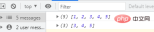
If If you want to delete elements at the end of the array, set the value of the first parameter index of the method to a negative number, then it will be positioned from the right side of the array to the left according to the absolute value; and the value of the second parameter howmany must be equal to index value.
var arr= [1,2,3,4,5];
console.log(arr);

//从倒数第二个元素开始,截取两个元素
arr.splice(-2,2);
console.log(arr);
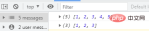
Okay, that’s all. If you need it, you can read: javascript advanced tutorial
The above is the detailed content of JS array learning: how to delete any element based on the array subscript. For more information, please follow other related articles on the PHP Chinese website!

 JavaScript in Action: Real-World Examples and ProjectsApr 19, 2025 am 12:13 AM
JavaScript's application in the real world includes front-end and back-end development. 1) Display front-end applications by building a TODO list application, involving DOM operations and event processing. 2) Build RESTfulAPI through Node.js and Express to demonstrate back-end applications.
 JavaScript and the Web: Core Functionality and Use CasesApr 18, 2025 am 12:19 AM
The main uses of JavaScript in web development include client interaction, form verification and asynchronous communication. 1) Dynamic content update and user interaction through DOM operations; 2) Client verification is carried out before the user submits data to improve the user experience; 3) Refreshless communication with the server is achieved through AJAX technology.
 Understanding the JavaScript Engine: Implementation DetailsApr 17, 2025 am 12:05 AM
Understanding how JavaScript engine works internally is important to developers because it helps write more efficient code and understand performance bottlenecks and optimization strategies. 1) The engine's workflow includes three stages: parsing, compiling and execution; 2) During the execution process, the engine will perform dynamic optimization, such as inline cache and hidden classes; 3) Best practices include avoiding global variables, optimizing loops, using const and lets, and avoiding excessive use of closures.
 Python vs. JavaScript: The Learning Curve and Ease of UseApr 16, 2025 am 12:12 AM
Python is more suitable for beginners, with a smooth learning curve and concise syntax; JavaScript is suitable for front-end development, with a steep learning curve and flexible syntax. 1. Python syntax is intuitive and suitable for data science and back-end development. 2. JavaScript is flexible and widely used in front-end and server-side programming.
 Python vs. JavaScript: Community, Libraries, and ResourcesApr 15, 2025 am 12:16 AM
Python and JavaScript have their own advantages and disadvantages in terms of community, libraries and resources. 1) The Python community is friendly and suitable for beginners, but the front-end development resources are not as rich as JavaScript. 2) Python is powerful in data science and machine learning libraries, while JavaScript is better in front-end development libraries and frameworks. 3) Both have rich learning resources, but Python is suitable for starting with official documents, while JavaScript is better with MDNWebDocs. The choice should be based on project needs and personal interests.
 From C/C to JavaScript: How It All WorksApr 14, 2025 am 12:05 AM
The shift from C/C to JavaScript requires adapting to dynamic typing, garbage collection and asynchronous programming. 1) C/C is a statically typed language that requires manual memory management, while JavaScript is dynamically typed and garbage collection is automatically processed. 2) C/C needs to be compiled into machine code, while JavaScript is an interpreted language. 3) JavaScript introduces concepts such as closures, prototype chains and Promise, which enhances flexibility and asynchronous programming capabilities.
 JavaScript Engines: Comparing ImplementationsApr 13, 2025 am 12:05 AM
Different JavaScript engines have different effects when parsing and executing JavaScript code, because the implementation principles and optimization strategies of each engine differ. 1. Lexical analysis: convert source code into lexical unit. 2. Grammar analysis: Generate an abstract syntax tree. 3. Optimization and compilation: Generate machine code through the JIT compiler. 4. Execute: Run the machine code. V8 engine optimizes through instant compilation and hidden class, SpiderMonkey uses a type inference system, resulting in different performance performance on the same code.
 Beyond the Browser: JavaScript in the Real WorldApr 12, 2025 am 12:06 AM
JavaScript's applications in the real world include server-side programming, mobile application development and Internet of Things control: 1. Server-side programming is realized through Node.js, suitable for high concurrent request processing. 2. Mobile application development is carried out through ReactNative and supports cross-platform deployment. 3. Used for IoT device control through Johnny-Five library, suitable for hardware interaction.


Hot AI Tools

Undresser.AI Undress
AI-powered app for creating realistic nude photos

AI Clothes Remover
Online AI tool for removing clothes from photos.

Undress AI Tool
Undress images for free

Clothoff.io
AI clothes remover

AI Hentai Generator
Generate AI Hentai for free.

Hot Article
Hot Tools

PhpStorm Mac version
The latest (2018.2.1) professional PHP integrated development tool

SublimeText3 Mac version
God-level code editing software (SublimeText3)

SAP NetWeaver Server Adapter for Eclipse
Integrate Eclipse with SAP NetWeaver application server.

EditPlus Chinese cracked version
Small size, syntax highlighting, does not support code prompt function

DVWA
Damn Vulnerable Web App (DVWA) is a PHP/MySQL web application that is very vulnerable. Its main goals are to be an aid for security professionals to test their skills and tools in a legal environment, to help web developers better understand the process of securing web applications, and to help teachers/students teach/learn in a classroom environment Web application security. The goal of DVWA is to practice some of the most common web vulnerabilities through a simple and straightforward interface, with varying degrees of difficulty. Please note that this software

