



This article mainly introduces the complete analysis of prototype prototype in JavaScript. Prototype is an important support for the "everything is an object" argument in the js world. It explains the __proto__ attribute and prototype chain and other dry information. Friends who need it can refer to it
To understand prototype in JS, you must first understand the following concepts
1. Everything in JS is an object
2. Everything in JS is derived from Object Comes from, that is, the end point of the prototype chain of all things points to Object.prototype
  // ["constructor", "toString", "toLocaleString", "valueOf", "hasOwnProperty", "isPrototypeOf",
   // "propertyIsEnumerable", "__defineGetter__", "__lookupGetter__", "__defineSetter__",
   // "__lookupSetter__"]
   console.log(Object.getOwnPropertyNames(Object.prototype));
3. The subtle relationship between constructors and instances (objects) in JS
The constructor agrees on its instance by defining prototype Specifications, and then use new to construct instances, their role is to produce objects.
And the constructor (method) itself is an instance of the method (Function), so its __proto__ (prototype chain) can also be found
Object / function F() {} This is the constructor, one is provided by JS native API, and the other is customized
new Object() / new F() This is what it looks like Example
An instance can "only" check __proto__ to know what prototype it is based on,
but "cannot" redefine the prototype of the instance to create an instance of the instance.
Practice brings true knowledge, only by observing/thinking yourself can you truly understand:
  // 先来看看构造函数到底是什么
  // function Empty() {}  function Empty() {}
  console.log(Function.prototype, Function.__proto__);
  // Object {}          function Empty() {}
  console.log(Object.prototype, Object.__proto__);
  function F() {}
  // F {}              function Empty() {}
  console.log(F.prototype, F.__proto__);
You may be dizzy, let’s break it down.
prototype The format of prototype output is: constructor name prototype
First, let’s take a look at what Object.prototype outputs?
Object {} -> The previous Object is a constructor The name of the function, the last one represents the prototype, here is a {}, that is, an instance of an Object object (empty object)
Then we will understand what F {} means, F is the name of the constructor, and the prototype is also An empty object
  // 再来看看由构造函数构造出来的实例
  var o = new Object(); // var o = {};
  // undefined       Object {}
  console.log(o.prototype, o.__proto__);
  function F() {}
  var i = new F();
  // undefined       F {}
  console.log(i.prototype, i.__proto__);
Let’s go a little deeper and define the prototype of F to see what happens?
  function F() {}
  F.prototype.a = function() {};
  var i = new F();
  // undefined       F {a: function}
  console.log(i.prototype, i.__proto__);
In this way we can clearly see that i is constructed from F, The prototype is {a: function}, which means that the original empty object prototype has a new a method
Let’s change the situation again, what will happen if we completely cover the prototype of F?
function F() {}
  F.prototype = {
    a: function() {}
  };
  var i = new F();
  // undefined       Object {a: function}
  console.log(i.prototype, i.__proto__);
Why~ Why does it show that i is constructed from Object? No!
Because we completely overwrite the prototype of F, which actually means specifying the prototype as object {a: function}, but this will cause the original The constructor information is lost and becomes the constructor specified by the object {a: function}.
So what is the constructor of the object {a: function}?
Because the object {a: function} is actually relative to
var o = {a: function() {}} // new了一个ObjectThen of course the constructor of o is Object
Let’s correct this mistake
  function F() {}
  F.prototype = {
    a: function() {}
  }
  // 重新指定正确的构造函数
  F.prototype.constructor = F;
  var i = new F();
  // undefined       F {a: function, constructor: function}
  console.log(i.prototype, i.__proto__);
Now we can get the correct prototype information again~
Prototype chain
Then let’s take a look at what the prototype chain is?
Simply speaking, it is the same as the inheritance relationship (chain) in OOP. You go up layer by layer. , until the final Object.prototype

Another thing to understand is that any object has a prototype!
  Object // 这是一个函数, 函数是 Function 的实例对象, 那么就是由 Function 构造出来的
  Object.__proto__ == Function.prototype // 那么Object的原型, true
  // 这个是一个普通对象了, 因此属于 Object 的实例
  Function.prototype.__proto__ == Object.prototype // true
  // 这已经是原型链的最顶层了, 因此最终的指向 null
  Object.prototype.__proto__ == null // true

  Function // 这也是一个函数, 没错吧!
  Function.__proto__ == Function.prototype // true

  function A() {} // 这是一个自定义的函数, 终归还是一个函数, 没错吧!
  A.__proto__ == Function.prototype // 任何函数都是 Function 的实例, 因此A的原型是?
  var a = new A()
  a.__proto__ == A.prototype // 实例a是由A构造函数构造出来的, 因此a的原型是由A的prototype属性定义的
  A.prototype.__proto__ == Object.prototype // 普通对象都是 Object 的示例
Prototype and __proto__Each object contains a __proto__, pointing to the "prototype" of this object. A similar thing is that each function contains a prototype. What does this prototype object do?
function Foo(){};
var foo = new Foo();
console.log(foo.__proto__);
Just think about it, what does the __proto__ of this foo object point to?

function Foo(){};
var foo = new Foo();
console.log(foo.__proto__);
console.log(Foo.prototype);
console.log(foo.__proto__ === Foo.prototype);

foo.__proto__ --> Foo.prototypeWhat’s the point of designing JS like this? Recall what was said above, in the world of JS, objects are not created based on classes (molds), but derived from prototypes (another object). When we perform the new operation to create a new object, we will not go into the specific implementation of the new operation, but one thing we are sure of is that the __proto__ of the new object points to a prototype object. Just this code
function Foo(){};
var foo = new Foo();
foo.__proto__到底要指向谁了?你怎么不能指向Foo这个函数本身吧,虽然函数也是对象,这个有机会会详细讲。但如何foo.__proto__指向Foo固然不合适,因为Foo是一个函数,有很多逻辑代码,foo作为一个对象,继承逻辑处理没有任何意义,它要继承的是“原型对象”的属性。
所以,每个函数会自动生成一个prototype对象,由这个函数new出来的对象的__proto__就指向这个函数的prototype。
foo.__proto__ --> Foo.prototype
总结说了这么多,感觉还是没完全说清楚,不如上一张图。我曾经参考过其他网友的图,但总觉得哪里没说清楚,所以我自己画了一张图,如果觉得我的不错,请点个赞!(老子可是费了牛劲才画出来)。
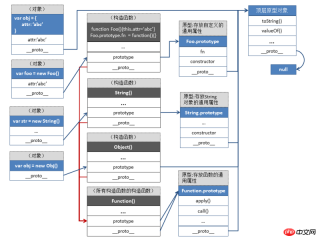
咱们就着这张图,记住如下几个事实:
1. 每个对象中都有一个_proto_属性。
JS世界中没有类(模具)的概念,对象是从另一个对象(原型)衍生出来的,所以每个对象中会有一个_proto_属性指向它的原型对象。(参考左上角的那个用字面量形式定义的对象obj,它在内存中开辟了一个空间存放对象自身的属性,同时生成一个_proto_指向它的原型——顶层原型对象。)
2. 每个函数都有一个prototype属性。
“构造函数”为何叫构造函数,因为它要构造对象。那么根据上面第一条事实,构造出来的新对象的_proto_属性指向谁了?总不能指向构造函数自身,虽然它也是个对象,但你不希望新对象继承函数的属性与方法吧。所以,在每个构造函数都会有一个prototype属性,指向一个对象作为这个构造函数构造出来的新对象的原型。
3. 函数也是对象。
每个函数都有一些通用的属性和方法,比如apply()/call()等。但这些通用的方法是如何继承的呢?函数又是怎么创建出来的呢?试想想,一切皆对象,包括函数也是对象,而且是通过构造函数构造出来的对象。那么根据上面第二条事实,每个函数也会有_proto_指向它的构造函数的prototype。而这个构造函数的函数就是Function,JS中的所有函数都是由Function构造出来的。函数的通用属性与方法就存放在Function.prototype这个原型对象上。
上面是我整理给大家的,希望今后会对大家有帮助。
相关文章:
全面分析JavaScript面向对象概念中的Object类型与作用域(附有示例)
详细解读JavaScript设计模式开发中的桥接模式(高级篇)
The above is the detailed content of Comprehensive analysis of prototypes in JavaScript. For more information, please follow other related articles on the PHP Chinese website!

 JavaScript and the Web: Core Functionality and Use CasesApr 18, 2025 am 12:19 AM
The main uses of JavaScript in web development include client interaction, form verification and asynchronous communication. 1) Dynamic content update and user interaction through DOM operations; 2) Client verification is carried out before the user submits data to improve the user experience; 3) Refreshless communication with the server is achieved through AJAX technology.
 Understanding the JavaScript Engine: Implementation DetailsApr 17, 2025 am 12:05 AM
Understanding how JavaScript engine works internally is important to developers because it helps write more efficient code and understand performance bottlenecks and optimization strategies. 1) The engine's workflow includes three stages: parsing, compiling and execution; 2) During the execution process, the engine will perform dynamic optimization, such as inline cache and hidden classes; 3) Best practices include avoiding global variables, optimizing loops, using const and lets, and avoiding excessive use of closures.
 Python vs. JavaScript: The Learning Curve and Ease of UseApr 16, 2025 am 12:12 AM
Python is more suitable for beginners, with a smooth learning curve and concise syntax; JavaScript is suitable for front-end development, with a steep learning curve and flexible syntax. 1. Python syntax is intuitive and suitable for data science and back-end development. 2. JavaScript is flexible and widely used in front-end and server-side programming.
 Python vs. JavaScript: Community, Libraries, and ResourcesApr 15, 2025 am 12:16 AM
Python and JavaScript have their own advantages and disadvantages in terms of community, libraries and resources. 1) The Python community is friendly and suitable for beginners, but the front-end development resources are not as rich as JavaScript. 2) Python is powerful in data science and machine learning libraries, while JavaScript is better in front-end development libraries and frameworks. 3) Both have rich learning resources, but Python is suitable for starting with official documents, while JavaScript is better with MDNWebDocs. The choice should be based on project needs and personal interests.
 From C/C to JavaScript: How It All WorksApr 14, 2025 am 12:05 AM
The shift from C/C to JavaScript requires adapting to dynamic typing, garbage collection and asynchronous programming. 1) C/C is a statically typed language that requires manual memory management, while JavaScript is dynamically typed and garbage collection is automatically processed. 2) C/C needs to be compiled into machine code, while JavaScript is an interpreted language. 3) JavaScript introduces concepts such as closures, prototype chains and Promise, which enhances flexibility and asynchronous programming capabilities.
 JavaScript Engines: Comparing ImplementationsApr 13, 2025 am 12:05 AM
Different JavaScript engines have different effects when parsing and executing JavaScript code, because the implementation principles and optimization strategies of each engine differ. 1. Lexical analysis: convert source code into lexical unit. 2. Grammar analysis: Generate an abstract syntax tree. 3. Optimization and compilation: Generate machine code through the JIT compiler. 4. Execute: Run the machine code. V8 engine optimizes through instant compilation and hidden class, SpiderMonkey uses a type inference system, resulting in different performance performance on the same code.
 Beyond the Browser: JavaScript in the Real WorldApr 12, 2025 am 12:06 AM
JavaScript's applications in the real world include server-side programming, mobile application development and Internet of Things control: 1. Server-side programming is realized through Node.js, suitable for high concurrent request processing. 2. Mobile application development is carried out through ReactNative and supports cross-platform deployment. 3. Used for IoT device control through Johnny-Five library, suitable for hardware interaction.
 Building a Multi-Tenant SaaS Application with Next.js (Backend Integration)Apr 11, 2025 am 08:23 AM
I built a functional multi-tenant SaaS application (an EdTech app) with your everyday tech tool and you can do the same. First, what’s a multi-tenant SaaS application? Multi-tenant SaaS applications let you serve multiple customers from a sing


Hot AI Tools

Undresser.AI Undress
AI-powered app for creating realistic nude photos

AI Clothes Remover
Online AI tool for removing clothes from photos.

Undress AI Tool
Undress images for free

Clothoff.io
AI clothes remover

AI Hentai Generator
Generate AI Hentai for free.

Hot Article
Hot Tools

DVWA
Damn Vulnerable Web App (DVWA) is a PHP/MySQL web application that is very vulnerable. Its main goals are to be an aid for security professionals to test their skills and tools in a legal environment, to help web developers better understand the process of securing web applications, and to help teachers/students teach/learn in a classroom environment Web application security. The goal of DVWA is to practice some of the most common web vulnerabilities through a simple and straightforward interface, with varying degrees of difficulty. Please note that this software

PhpStorm Mac version
The latest (2018.2.1) professional PHP integrated development tool

SublimeText3 English version
Recommended: Win version, supports code prompts!

SecLists
SecLists is the ultimate security tester's companion. It is a collection of various types of lists that are frequently used during security assessments, all in one place. SecLists helps make security testing more efficient and productive by conveniently providing all the lists a security tester might need. List types include usernames, passwords, URLs, fuzzing payloads, sensitive data patterns, web shells, and more. The tester can simply pull this repository onto a new test machine and he will have access to every type of list he needs.

ZendStudio 13.5.1 Mac
Powerful PHP integrated development environment

