



In mysql, filesort refers to file sorting, which sorts the obtained data in memory through the corresponding sorting algorithm. There are two types of filesort: 1. Dual-way sorting, which first takes out the corresponding sorting field and the row pointer information that can directly locate the row data according to the corresponding conditions, and then sorts it in the sort buffer; 2. Single-way sorting, which is a one-time sorting Take out all the fields of the rows that meet the condition, and then sort them in the sort buffer.

The operating environment of this tutorial: windows7 system, mysql8 version, Dell G3 computer.
There are two sorting implementation methods for ORDER BY in MySQL:
1. Use ordered index to obtain ordered data
2. File sorting (filesort)
When analyzing the query in explain, use the ordered index to obtain the ordered data and display Using index, and file sorting displays Using fileso rt.
Only when all columns in ORDER BY must be included in the same index, and the order of the index is exactly the same as the order in the order by clause, and the sort direction of all columns (ascending order Or descending order) are the same, (when using ASC mode and DESC mode mixedly, no index is used)
The combination of where statement and order by statement satisfies the leftmost prefix
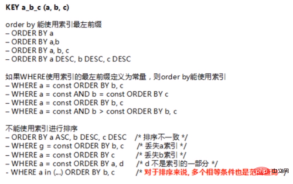
In other cases, use file sorting as follows:
1) where statement and order by statement , using different indexes
2) Too many rows are checked, and no covering index is used
3) In ORDER BY Columns are not included in the same index, that is, different indexes are used
‑ ‑4) Both ASC and DESC are used for index columns
‑ ‑ 5) The index column in the where statement or ORDER BY statement uses expressions, including function expressions
∼ 6) The combination of where statement and ORDER BY statement satisfies the leftmost prefix, but in the where statement What is being searched for is the range.
filesort
This filesort does not mean sorting through disk files, but only tells us that a sorting operation has been performed. That is, the execution plan given by MySQL Query Optimizer (viewed through the EXPLAIN command) is called file sorting (filesort)
File sorting is to sort the obtained data in memory through the corresponding sorting algorithm : MySQL needs to sort data in memory, and the memory area used is the sorting area set by the sort_buffer_size system variable. This sorting area is exclusive to each Thread, so there may be multiple sort buffer memory areas in MySQL at the same time.
There are two types of filesort
Dual-way sorting: First, the corresponding sorting field is taken out according to the corresponding conditions and the row data can be directly located. Row pointer information is then sorted in the sort buffer. After sorting, the query field is taken out according to the row pointer, and disk IO is executed twice.
Single-way sorting: All fields that meet the conditional rows are taken out at one time, and then sorted in the sort buffer. Execute disk io once.
MySQL mainly determines which sorting algorithm needs to be used by comparing the size of the system parameter max_length_for_sort_data we set and the sum of the field type sizes taken out by the Query statement. If max_length_for_sort_data is larger, the second optimized algorithm is used, otherwise the first algorithm is used. So if you want the efficiency of the ORDER BY operation to be as high as possible, you must be careful about the setting of the max_length_for_sort_data parameter. A colleague's database once experienced a large number of sorting waits, resulting in high system load and long response time. Finally, it was found that MySQL used the traditional first sorting algorithm. After increasing max_length_for_sort_data After changing the parameter value, the system load was immediately greatly relieved and the response was much faster.
If the order by clause only refers to the first table in the join, MySQL will sort the first table first and then join. That is, the Using Filesort of Extra in expain. Otherwise, MySQL first saves the results to the temporary table (Temporary Table), and then sorts the data in the temporary table. At this time, the Extra in expain displays Using temporary Using Filesort.
【Related recommendations: mysql video tutorial】
The above is the detailed content of What is filesort in mysql. For more information, please follow other related articles on the PHP Chinese website!

 Explain the role of InnoDB redo logs and undo logs.Apr 15, 2025 am 12:16 AM
InnoDB uses redologs and undologs to ensure data consistency and reliability. 1.redologs record data page modification to ensure crash recovery and transaction persistence. 2.undologs records the original data value and supports transaction rollback and MVCC.
 What are the key metrics to look for in an EXPLAIN output (type, key, rows, Extra)?Apr 15, 2025 am 12:15 AM
Key metrics for EXPLAIN commands include type, key, rows, and Extra. 1) The type reflects the access type of the query. The higher the value, the higher the efficiency, such as const is better than ALL. 2) The key displays the index used, and NULL indicates no index. 3) rows estimates the number of scanned rows, affecting query performance. 4) Extra provides additional information, such as Usingfilesort prompts that it needs to be optimized.
 What is the Using temporary status in EXPLAIN and how to avoid it?Apr 15, 2025 am 12:14 AM
Usingtemporary indicates that the need to create temporary tables in MySQL queries, which are commonly found in ORDERBY using DISTINCT, GROUPBY, or non-indexed columns. You can avoid the occurrence of indexes and rewrite queries and improve query performance. Specifically, when Usingtemporary appears in EXPLAIN output, it means that MySQL needs to create temporary tables to handle queries. This usually occurs when: 1) deduplication or grouping when using DISTINCT or GROUPBY; 2) sort when ORDERBY contains non-index columns; 3) use complex subquery or join operations. Optimization methods include: 1) ORDERBY and GROUPB
 Describe the different SQL transaction isolation levels (Read Uncommitted, Read Committed, Repeatable Read, Serializable) and their implications in MySQL/InnoDB.Apr 15, 2025 am 12:11 AM
MySQL/InnoDB supports four transaction isolation levels: ReadUncommitted, ReadCommitted, RepeatableRead and Serializable. 1.ReadUncommitted allows reading of uncommitted data, which may cause dirty reading. 2. ReadCommitted avoids dirty reading, but non-repeatable reading may occur. 3.RepeatableRead is the default level, avoiding dirty reading and non-repeatable reading, but phantom reading may occur. 4. Serializable avoids all concurrency problems but reduces concurrency. Choosing the appropriate isolation level requires balancing data consistency and performance requirements.
 MySQL vs. Other Databases: Comparing the OptionsApr 15, 2025 am 12:08 AM
MySQL is suitable for web applications and content management systems and is popular for its open source, high performance and ease of use. 1) Compared with PostgreSQL, MySQL performs better in simple queries and high concurrent read operations. 2) Compared with Oracle, MySQL is more popular among small and medium-sized enterprises because of its open source and low cost. 3) Compared with Microsoft SQL Server, MySQL is more suitable for cross-platform applications. 4) Unlike MongoDB, MySQL is more suitable for structured data and transaction processing.
 How does MySQL index cardinality affect query performance?Apr 14, 2025 am 12:18 AM
MySQL index cardinality has a significant impact on query performance: 1. High cardinality index can more effectively narrow the data range and improve query efficiency; 2. Low cardinality index may lead to full table scanning and reduce query performance; 3. In joint index, high cardinality sequences should be placed in front to optimize query.
 MySQL: Resources and Tutorials for New UsersApr 14, 2025 am 12:16 AM
The MySQL learning path includes basic knowledge, core concepts, usage examples, and optimization techniques. 1) Understand basic concepts such as tables, rows, columns, and SQL queries. 2) Learn the definition, working principles and advantages of MySQL. 3) Master basic CRUD operations and advanced usage, such as indexes and stored procedures. 4) Familiar with common error debugging and performance optimization suggestions, such as rational use of indexes and optimization queries. Through these steps, you will have a full grasp of the use and optimization of MySQL.
 Real-World MySQL: Examples and Use CasesApr 14, 2025 am 12:15 AM
MySQL's real-world applications include basic database design and complex query optimization. 1) Basic usage: used to store and manage user data, such as inserting, querying, updating and deleting user information. 2) Advanced usage: Handle complex business logic, such as order and inventory management of e-commerce platforms. 3) Performance optimization: Improve performance by rationally using indexes, partition tables and query caches.


Hot AI Tools

Undresser.AI Undress
AI-powered app for creating realistic nude photos

AI Clothes Remover
Online AI tool for removing clothes from photos.

Undress AI Tool
Undress images for free

Clothoff.io
AI clothes remover

AI Hentai Generator
Generate AI Hentai for free.

Hot Article
Hot Tools

SAP NetWeaver Server Adapter for Eclipse
Integrate Eclipse with SAP NetWeaver application server.

SublimeText3 Mac version
God-level code editing software (SublimeText3)

Atom editor mac version download
The most popular open source editor

Dreamweaver CS6
Visual web development tools

EditPlus Chinese cracked version
Small size, syntax highlighting, does not support code prompt function

