


 Backend DevelopmentPython TutorialPractical records of some problems in saving and loading pytorch models
Practical records of some problems in saving and loading pytorch models

This article brings you relevant knowledge about Python, which mainly introduces practical records of some problems in saving and loading pytorch models. Let’s take a look at them together. I hope it will be helpful to everyone. help.

[Related recommendations: Python3 video tutorial ]
1. How to save and load models in torch
1. Saving and loading model parameters and model structure
torch.save(model,path)
torch.load(path)
2. Only saving and loading model parameters - this method is safer, but a little more troublesome
torch.save(model.state_dict(),path)
model_state_dic = torch.load(path)
model.load_state_dic(model_state_dic)
2. Problems in model saving and loading in torch
1. Problems in loading after saving the model structure and parameters in a single card model
When the model is saved, the path to the model structure definition file will be recorded. , when loading, it will be parsed according to the path and the parameters will be loaded; when the model definition file path is modified, an error will be reported when using torch.load(path).
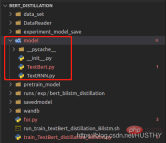
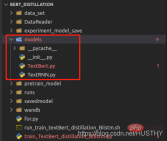

After changing the model folder to models, an error will be reported when loading again.
import torch
from model.TextRNN import TextRNN

load_model = torch.load('experiment_model_save/textRNN.bin')
print('load_model',load_model)
In this way of saving the complete model structure and parameters, be sure not to change the model definition file path.
2. After saving the single-card training model on a multi-card machine, an error will be reported when loading it on a single-card machine.
If there are multiple graphics cards on a multi-card machine, starting from 0, the model is now n>= After the graphics card training on 1 is saved, the copy is loaded on a single-card machine
import torch
from model.TextRNN import TextRNN

load_model = torch.load('experiment_model_save/textRNN_cuda_1.bin')
print('load_model',load_model)
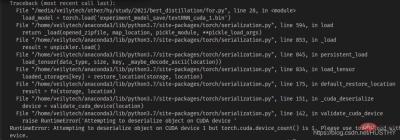
There will be a cuda device mismatch problem - the model code segment widget type you saved If you use cuda1, then when you use torch.load() to open it, it will look for cuda1 by default, and then load the model to the device. At this time, you can directly use map_location to solve the problem and load the model onto the CPU.
load_model = torch.load('experiment_model_save/textRNN_cuda_1.bin',map_location=torch.device('cpu'))
3. Problems that occur after saving the model structure and parameters of the multi-GPU training model and then loading it
When using multiple GPUs to train the model at the same time, whether the model structure and parameters are saved together or separately Model parameters will cause problems when loading under a single card
a. Save the model structure and parameters together and then use them when loading

torch.distributed.init_process_group(backend='nccl')
The above-mentioned multi-process method, so you must declare it when loading, otherwise an error will be reported.
b. Saving model parameters separately
model = Transformer(num_encoder_layers=6,num_decoder_layers=6)
state_dict = torch.load('train_model/clip/experiment.pt')
model.load_state_dict(state_dict)
The same problem will occur, but the problem here is that the key of the parameter dictionary is different from the key defined by the model

The reason is that under multi-GPU training, when using distributed training, the model will be packaged. The code is as follows:
model = torch.load('train_model/clip/Vtransformers_bert_6_layers_encoder_clip.bin')
print(model)
model.cuda(args.local_rank)
。。。。。。
model = nn.parallel.DistributedDataParallel(model,device_ids=[args.local_rank],find_unused_parameters=True)
print('model',model)
Model structure before packaging:
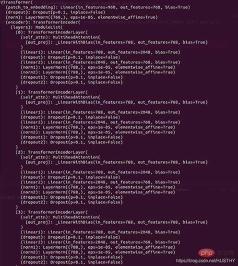
Packaged model
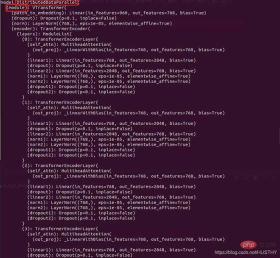
There are more DistributedDataParallel and modules in the outer layer, so the weight will appear when loading the model weight in a single card environment The keys are inconsistent.
3. The correct method of saving and loading the model
    if gpu_count > 1:
        torch.save(model.module.state_dict(),save_path)
    else:
        torch.save(model.state_dict(),save_path)
    model = Transformer(num_encoder_layers=6,num_decoder_layers=6)
    state_dict = torch.load(save_path)
    model.load_state_dict(state_dict)
This is a better paradigm, and there will be no error in loading.
【Related recommendations: Python3 video tutorial】
The above is the detailed content of Practical records of some problems in saving and loading pytorch models. For more information, please follow other related articles on the PHP Chinese website!

 Python and Time: Making the Most of Your Study TimeApr 14, 2025 am 12:02 AM
To maximize the efficiency of learning Python in a limited time, you can use Python's datetime, time, and schedule modules. 1. The datetime module is used to record and plan learning time. 2. The time module helps to set study and rest time. 3. The schedule module automatically arranges weekly learning tasks.
 Python: Games, GUIs, and MoreApr 13, 2025 am 12:14 AM
Python excels in gaming and GUI development. 1) Game development uses Pygame, providing drawing, audio and other functions, which are suitable for creating 2D games. 2) GUI development can choose Tkinter or PyQt. Tkinter is simple and easy to use, PyQt has rich functions and is suitable for professional development.
 Python vs. C : Applications and Use Cases ComparedApr 12, 2025 am 12:01 AM
Python is suitable for data science, web development and automation tasks, while C is suitable for system programming, game development and embedded systems. Python is known for its simplicity and powerful ecosystem, while C is known for its high performance and underlying control capabilities.
 The 2-Hour Python Plan: A Realistic ApproachApr 11, 2025 am 12:04 AM
You can learn basic programming concepts and skills of Python within 2 hours. 1. Learn variables and data types, 2. Master control flow (conditional statements and loops), 3. Understand the definition and use of functions, 4. Quickly get started with Python programming through simple examples and code snippets.
 Python: Exploring Its Primary ApplicationsApr 10, 2025 am 09:41 AM
Python is widely used in the fields of web development, data science, machine learning, automation and scripting. 1) In web development, Django and Flask frameworks simplify the development process. 2) In the fields of data science and machine learning, NumPy, Pandas, Scikit-learn and TensorFlow libraries provide strong support. 3) In terms of automation and scripting, Python is suitable for tasks such as automated testing and system management.
 How Much Python Can You Learn in 2 Hours?Apr 09, 2025 pm 04:33 PM
You can learn the basics of Python within two hours. 1. Learn variables and data types, 2. Master control structures such as if statements and loops, 3. Understand the definition and use of functions. These will help you start writing simple Python programs.
 How to teach computer novice programming basics in project and problem-driven methods within 10 hours?Apr 02, 2025 am 07:18 AM
How to teach computer novice programming basics within 10 hours? If you only have 10 hours to teach computer novice some programming knowledge, what would you choose to teach...
 How to avoid being detected by the browser when using Fiddler Everywhere for man-in-the-middle reading?Apr 02, 2025 am 07:15 AM
How to avoid being detected when using FiddlerEverywhere for man-in-the-middle readings When you use FiddlerEverywhere...


Hot AI Tools

Undresser.AI Undress
AI-powered app for creating realistic nude photos

AI Clothes Remover
Online AI tool for removing clothes from photos.

Undress AI Tool
Undress images for free

Clothoff.io
AI clothes remover

AI Hentai Generator
Generate AI Hentai for free.

Hot Article
Hot Tools

SublimeText3 Chinese version
Chinese version, very easy to use

Atom editor mac version download
The most popular open source editor

VSCode Windows 64-bit Download
A free and powerful IDE editor launched by Microsoft

Zend Studio 13.0.1
Powerful PHP integrated development environment

DVWA
Damn Vulnerable Web App (DVWA) is a PHP/MySQL web application that is very vulnerable. Its main goals are to be an aid for security professionals to test their skills and tools in a legal environment, to help web developers better understand the process of securing web applications, and to help teachers/students teach/learn in a classroom environment Web application security. The goal of DVWA is to practice some of the most common web vulnerabilities through a simple and straightforward interface, with varying degrees of difficulty. Please note that this software

