



Two methods to find the average: 1. Use forEach() and length attributes to find the average, the syntax is "function f(v){s =v;}array object.forEach(f);avg=s /Array object.length;"; 2. Use reduce() and length attributes to find it, the syntax is "function f(p,c){s=p c;return s;}Array object.reduce(f);avg=s/ Array object.length;".

The operating environment of this tutorial: windows7 system, javascript version 1.8.5, Dell G3 computer.
Method 1: Use forEach() length attribute
Implementation idea:
Use forEach() to iterate through the array to calculate the sum of elements
Use the length attribute to calculate the length of the array
Divide the sum of the array elements by the array Length
Implementation code:
var a = [10, 11, 12], sum = 0,len,avg;

function f(value) {
sum += value;
}
a.forEach(f);
console.log("数组元素总和为:"+sum);

len=a.length;
console.log("数组长度为:"+len);

avg=sum/len;
console.log("数组平均数为:"+avg);
Description:
The forEach() method is used to call each element of the array and pass the element to the callback function.
array.forEach(funtion callbackfn(value, index, array), thisValue)
funtion callbackfn(value, index, array): Required parameters, specify the callback function, can receive up to three parameters:
value : The value of the array element.
index: Numeric index of the array element.
array: Array object containing the element.
thisValue: an omitted parameter, an object that can be referenced by this in the callback function. If thisArg is omitted, the value of this is undefined.
Method 2: Use the reduce() length attribute
Implementation idea:
Use reduce() to iterate over the array to calculate the sum of elements
Use the length attribute to calculate the length of the array
Divide the sum of the array elements by the array Length
Implementation code:
var a = [11, 12, 13], sum = 0,len,avg;

function f(pre,curr) {
	sum=pre+curr;
	return sum;
}
a.reduce(f);
console.log("数组元素总和为:"+sum);

len=a.length;
console.log("数组长度为:"+len);

avg=sum/len;
console.log("数组平均数为:"+avg);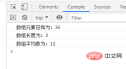
Description:
reduce() method The specified callback function can be called on all elements in the array. The return value of this callback function is the cumulative result, and this return value is provided as a parameter the next time the callback function is called.
array.reduce(function callbackfn(previousValue, currentVaule, currentIndex, array), initialValue)
function callbackfn(previousValue, currentVaule, currentIndex, array): Required parameters, specify the callback function, can receive up to 4 parameters:
previousValue: The value obtained by calling the callback function last time. If initialValue is provided to the reduce() method, the previousValue is initialValue when the function is first called.
currentValue: The value of the current element array.
currentIndex: The numeric index of the current array element.
array: Array object containing the element.
initialValue: Omissible parameter, initial value passed to the function.
【Related recommendations: javascript video tutorial, programming video】
The above is the detailed content of How to find the average of an array in javascript. For more information, please follow other related articles on the PHP Chinese website!

 The Benefits of React: Performance, Reusability, and MoreApr 15, 2025 am 12:05 AM
React’s popularity includes its performance optimization, component reuse and a rich ecosystem. 1. Performance optimization achieves efficient updates through virtual DOM and diffing mechanisms. 2. Component Reuse Reduces duplicate code by reusable components. 3. Rich ecosystem and one-way data flow enhance the development experience.
 React: Creating Dynamic and Interactive User InterfacesApr 14, 2025 am 12:08 AM
React is the tool of choice for building dynamic and interactive user interfaces. 1) Componentization and JSX make UI splitting and reusing simple. 2) State management is implemented through the useState hook to trigger UI updates. 3) The event processing mechanism responds to user interaction and improves user experience.
 React vs. Backend Frameworks: A ComparisonApr 13, 2025 am 12:06 AM
React is a front-end framework for building user interfaces; a back-end framework is used to build server-side applications. React provides componentized and efficient UI updates, and the backend framework provides a complete backend service solution. When choosing a technology stack, project requirements, team skills, and scalability should be considered.
 HTML and React: The Relationship Between Markup and ComponentsApr 12, 2025 am 12:03 AM
The relationship between HTML and React is the core of front-end development, and they jointly build the user interface of modern web applications. 1) HTML defines the content structure and semantics, and React builds a dynamic interface through componentization. 2) React components use JSX syntax to embed HTML to achieve intelligent rendering. 3) Component life cycle manages HTML rendering and updates dynamically according to state and attributes. 4) Use components to optimize HTML structure and improve maintainability. 5) Performance optimization includes avoiding unnecessary rendering, using key attributes, and keeping the component single responsibility.
 React and the Frontend: Building Interactive ExperiencesApr 11, 2025 am 12:02 AM
React is the preferred tool for building interactive front-end experiences. 1) React simplifies UI development through componentization and virtual DOM. 2) Components are divided into function components and class components. Function components are simpler and class components provide more life cycle methods. 3) The working principle of React relies on virtual DOM and reconciliation algorithm to improve performance. 4) State management uses useState or this.state, and life cycle methods such as componentDidMount are used for specific logic. 5) Basic usage includes creating components and managing state, and advanced usage involves custom hooks and performance optimization. 6) Common errors include improper status updates and performance issues, debugging skills include using ReactDevTools and Excellent
 React and the Frontend Stack: The Tools and TechnologiesApr 10, 2025 am 09:34 AM
React is a JavaScript library for building user interfaces, with its core components and state management. 1) Simplify UI development through componentization and state management. 2) The working principle includes reconciliation and rendering, and optimization can be implemented through React.memo and useMemo. 3) The basic usage is to create and render components, and the advanced usage includes using Hooks and ContextAPI. 4) Common errors such as improper status update, you can use ReactDevTools to debug. 5) Performance optimization includes using React.memo, virtualization lists and CodeSplitting, and keeping code readable and maintainable is best practice.
 React's Role in HTML: Enhancing User ExperienceApr 09, 2025 am 12:11 AM
React combines JSX and HTML to improve user experience. 1) JSX embeds HTML to make development more intuitive. 2) The virtual DOM mechanism optimizes performance and reduces DOM operations. 3) Component-based management UI to improve maintainability. 4) State management and event processing enhance interactivity.
 React Components: Creating Reusable Elements in HTMLApr 08, 2025 pm 05:53 PM
React components can be defined by functions or classes, encapsulating UI logic and accepting input data through props. 1) Define components: Use functions or classes to return React elements. 2) Rendering component: React calls render method or executes function component. 3) Multiplexing components: pass data through props to build a complex UI. The lifecycle approach of components allows logic to be executed at different stages, improving development efficiency and code maintainability.


Hot AI Tools

Undresser.AI Undress
AI-powered app for creating realistic nude photos

AI Clothes Remover
Online AI tool for removing clothes from photos.

Undress AI Tool
Undress images for free

Clothoff.io
AI clothes remover

AI Hentai Generator
Generate AI Hentai for free.

Hot Article
Hot Tools

SublimeText3 Chinese version
Chinese version, very easy to use

Atom editor mac version download
The most popular open source editor

VSCode Windows 64-bit Download
A free and powerful IDE editor launched by Microsoft

Zend Studio 13.0.1
Powerful PHP integrated development environment

DVWA
Damn Vulnerable Web App (DVWA) is a PHP/MySQL web application that is very vulnerable. Its main goals are to be an aid for security professionals to test their skills and tools in a legal environment, to help web developers better understand the process of securing web applications, and to help teachers/students teach/learn in a classroom environment Web application security. The goal of DVWA is to practice some of the most common web vulnerabilities through a simple and straightforward interface, with varying degrees of difficulty. Please note that this software

