



This article will take you to continue learningVue, and introduce in detail the life cycle and data sharing in the essential knowledge for getting started with Vue. I hope it will be helpful to everyone!

1. Component life cycle
##1.1 Life cycle & life cycle function
1️⃣ Life Cycle refers to the entire stage of a component fromcreation → running → destruction , emphasizes a time period . (Learning video sharing: vue video tutorial)
2️⃣ Life cycle function: It is abuilt-in function provided by the vue framework, which will accompany the life cycle of the component, Automatically execute in order.
? Warm reminder?:Life cycle emphasizes time period, lifecycle function emphasizes time point.
1.2 Classification of component life cycle functions
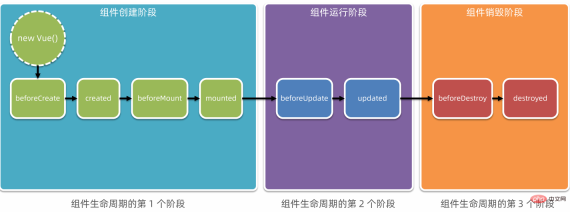
1.3 Life cycle diagram Indication
You can refer to the "life cycle diagram" given in vue official documentation to further understand the process of component life cycle execution:https://cn.vuejs.org/ v2/guide/instance.html#Life cycle diagram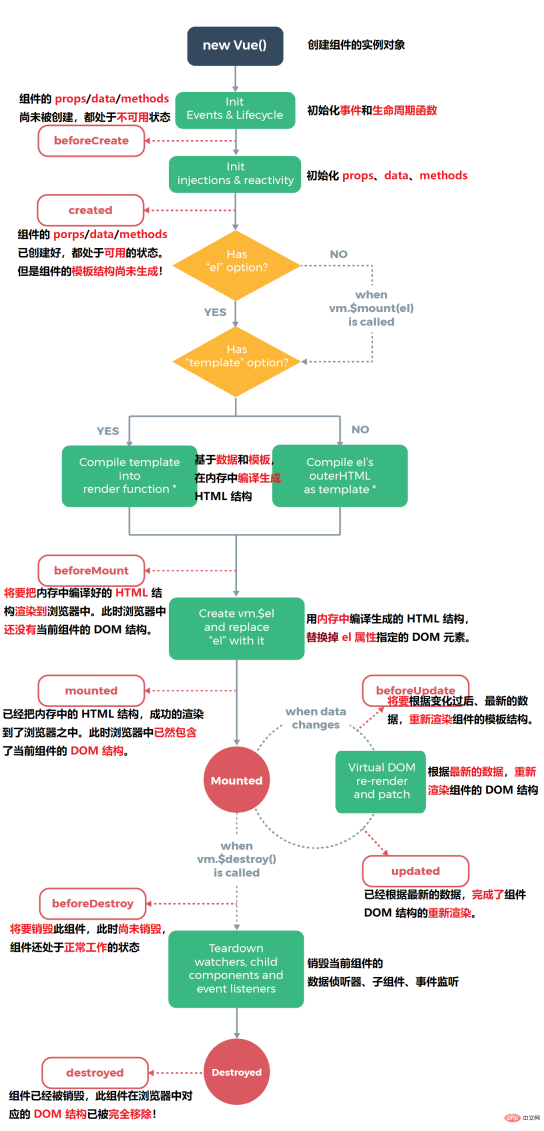
2. Data sharing between components
2.1 Relationship between components
In project development, the most common relationships between components are divided into the following two types:Father-son relationship
Brother relationship
2.2 Data sharing between parent and child components
Data sharing between parent and child components is divided into:Parent → Child Shared data
Child → ParentShared data
2.2.1 Parent component to child Components share data
To share data from a parent component to a child component, you need to usecustom attributes. The sample code is as follows: 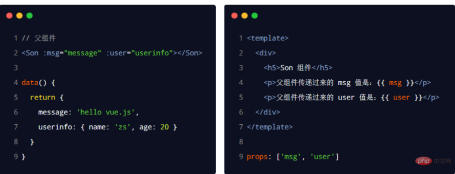
2.2.2 Child component shares data with parent component
Uses when child component shares data with parent componentCustom events. The sample code is as follows: 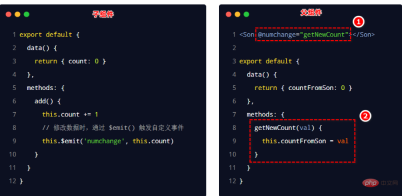
2.3 Data sharing between sibling components
In vue2.x, sibling components The data sharing scheme between them isEventBus. 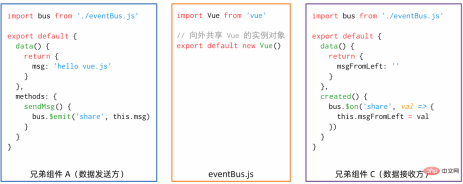 ?Steps for using EventBus?:
- Create the
- eventBus.js
module and share a Vue instance object externally;On the data sender, call the - bus.$emit
('event name', data to be sent) method to trigger the custom event;On the data receiver, call - bus.$on
('Event name', event handling function) method registers a custom event;
3. ref reference
3.1 What is ref reference
1️⃣ ref is used to assist developers to obtain DOM withoutnot relying on jQuery. A reference to an element or component. 2️⃣ Each vue component instance contains a
$refs object, which stores references to the corresponding DOM elements or components. By default, component's $refs point to an empty object . The code demonstration is as follows:
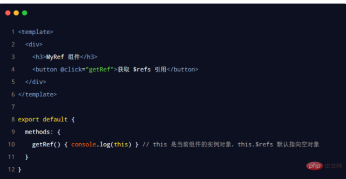
3.2 Use ref to reference the DOM elementIf you want to use If ref refers to a DOM element on the page, it can be operated as follows:
The code is demonstrated as follows: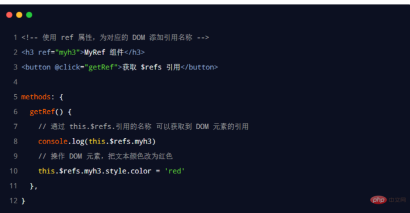
##3.3 Use ref to reference component instances
If you want to use ref To reference the component instance on the page, you can operate as follows: 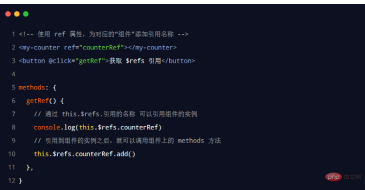
3.4 Control the on-demand switching of text boxes and buttons
Use Boolean valueinputVisible to control the on-demand switching of the text box and button in the component. The sample code is as follows: 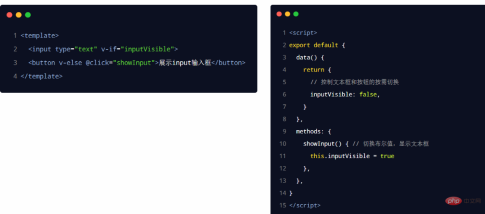
3.5 Let the text box automatically gain focus
After the text box is displayed, if you want If it gets focus immediately, you can add a ref reference to it and call the.focus() method of the native DOM object. The sample code is as follows: 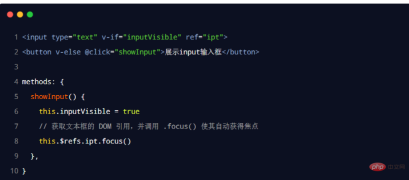
##3.6 this.$nextTick(cb) method
$nextTick of the component The (cb) method will defer the cb callback to execution after the next DOM update cycle. The popular understanding is: wait for the DOM update of the component to be completed before executing the cb callback function. This ensures that the cb callback function can operate on the latest DOM elements. 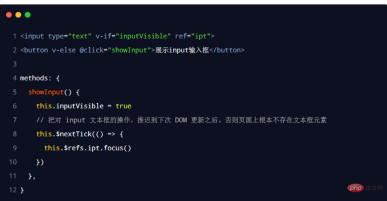 (Learning video sharing:
The above is the detailed content of A brief analysis of life cycle and data sharing in Vue. For more information, please follow other related articles on the PHP Chinese website!

 The Frontend Landscape: How Netflix Approached its ChoicesApr 15, 2025 am 12:13 AM
Netflix's choice in front-end technology mainly focuses on three aspects: performance optimization, scalability and user experience. 1. Performance optimization: Netflix chose React as the main framework and developed tools such as SpeedCurve and Boomerang to monitor and optimize the user experience. 2. Scalability: They adopt a micro front-end architecture, splitting applications into independent modules, improving development efficiency and system scalability. 3. User experience: Netflix uses the Material-UI component library to continuously optimize the interface through A/B testing and user feedback to ensure consistency and aesthetics.
 React vs. Vue: Which Framework Does Netflix Use?Apr 14, 2025 am 12:19 AM
Netflixusesacustomframeworkcalled"Gibbon"builtonReact,notReactorVuedirectly.1)TeamExperience:Choosebasedonfamiliarity.2)ProjectComplexity:Vueforsimplerprojects,Reactforcomplexones.3)CustomizationNeeds:Reactoffersmoreflexibility.4)Ecosystema
 The Choice of Frameworks: What Drives Netflix's Decisions?Apr 13, 2025 am 12:05 AM
Netflix mainly considers performance, scalability, development efficiency, ecosystem, technical debt and maintenance costs in framework selection. 1. Performance and scalability: Java and SpringBoot are selected to efficiently process massive data and high concurrent requests. 2. Development efficiency and ecosystem: Use React to improve front-end development efficiency and utilize its rich ecosystem. 3. Technical debt and maintenance costs: Choose Node.js to build microservices to reduce maintenance costs and technical debt.
 React, Vue, and the Future of Netflix's FrontendApr 12, 2025 am 12:12 AM
Netflix mainly uses React as the front-end framework, supplemented by Vue for specific functions. 1) React's componentization and virtual DOM improve the performance and development efficiency of Netflix applications. 2) Vue is used in Netflix's internal tools and small projects, and its flexibility and ease of use are key.
 Vue.js in the Frontend: Real-World Applications and ExamplesApr 11, 2025 am 12:12 AM
Vue.js is a progressive JavaScript framework suitable for building complex user interfaces. 1) Its core concepts include responsive data, componentization and virtual DOM. 2) In practical applications, it can be demonstrated by building Todo applications and integrating VueRouter. 3) When debugging, it is recommended to use VueDevtools and console.log. 4) Performance optimization can be achieved through v-if/v-show, list rendering optimization, asynchronous loading of components, etc.
 Vue.js and React: Understanding the Key DifferencesApr 10, 2025 am 09:26 AM
Vue.js is suitable for small to medium-sized projects, while React is more suitable for large and complex applications. 1. Vue.js' responsive system automatically updates the DOM through dependency tracking, making it easy to manage data changes. 2.React adopts a one-way data flow, and data flows from the parent component to the child component, providing a clear data flow and an easy-to-debug structure.
 Vue.js vs. React: Project-Specific ConsiderationsApr 09, 2025 am 12:01 AM
Vue.js is suitable for small and medium-sized projects and fast iterations, while React is suitable for large and complex applications. 1) Vue.js is easy to use and is suitable for situations where the team is insufficient or the project scale is small. 2) React has a richer ecosystem and is suitable for projects with high performance and complex functional needs.
 How to jump a tag to vueApr 08, 2025 am 09:24 AM
The methods to implement the jump of a tag in Vue include: using the a tag in the HTML template to specify the href attribute. Use the router-link component of Vue routing. Use this.$router.push() method in JavaScript. Parameters can be passed through the query parameter and routes are configured in the router options for dynamic jumps.


Hot AI Tools

Undresser.AI Undress
AI-powered app for creating realistic nude photos

AI Clothes Remover
Online AI tool for removing clothes from photos.

Undress AI Tool
Undress images for free

Clothoff.io
AI clothes remover

AI Hentai Generator
Generate AI Hentai for free.

Hot Article
Hot Tools

Notepad++7.3.1
Easy-to-use and free code editor

Zend Studio 13.0.1
Powerful PHP integrated development environment

SecLists
SecLists is the ultimate security tester's companion. It is a collection of various types of lists that are frequently used during security assessments, all in one place. SecLists helps make security testing more efficient and productive by conveniently providing all the lists a security tester might need. List types include usernames, passwords, URLs, fuzzing payloads, sensitive data patterns, web shells, and more. The tester can simply pull this repository onto a new test machine and he will have access to every type of list he needs.

DVWA
Damn Vulnerable Web App (DVWA) is a PHP/MySQL web application that is very vulnerable. Its main goals are to be an aid for security professionals to test their skills and tools in a legal environment, to help web developers better understand the process of securing web applications, and to help teachers/students teach/learn in a classroom environment Web application security. The goal of DVWA is to practice some of the most common web vulnerabilities through a simple and straightforward interface, with varying degrees of difficulty. Please note that this software

SAP NetWeaver Server Adapter for Eclipse
Integrate Eclipse with SAP NetWeaver application server.

