


 Web Front-endFront-end Q&AWhat is the CSS property used to set the absolute positioning of an element?
What is the CSS property used to set the absolute positioning of an element?

The CSS attribute used to set the absolute positioning of an element is "position". You only need to set the value of the position attribute to "absolute". The syntax is "element {position:absolute;}"; set to absolute positioning The element is completely removed from the document flow and positioned relative to its containing block.
The operating environment of this tutorial: Windows 7 system, CSS3&&HTML5 version, Dell G3 computer.
The CSS property used to set the absolute positioning of an element is "positon".
The position attribute specifies the positioning type of the element. You only need to set the value of the positon attribute to "absolute" to achieve absolute positioning.
An element set to absolute positioning is completely removed from the document flow and positioned relative to its containing block, which may be another element in the document or the initial containing block. The space previously occupied by the element in normal document flow is closed, as if the element did not exist. The element generates a block-level box after positioning, regardless of what type of box it originally generated in the normal flow.
Basic features of absolute positioning
The first feature of absolute positioning is that it will start from It is separated from the document flow and is not affected by other elements. The positioning is "absolute", so it is called absolute positioning. If it is relative positioning, it will be affected by other elements, then the positioning is "relative";
Positioning is not used: that is, the element is in the normal document flow
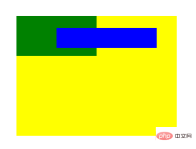
        <div class="frame">
            <div id="div1"></div>
            <div id="div2"></div>
        </div>
.frame {
margin: 0 auto;
margin-top: 50px;
width: 400px;
height: 300px;
background-color: yellow;
}
#div1 {
width: 100px;
height: 50px;
background-color: blue;
}
#div2 {
width: 200px;
height: 100px;
background-color: green;
}When we add absolute positioning to the element, The element will break away from the current document flow;
#div1 {
	position: absolute;
}
That is to say, the absolutely positioned element has no position in the document flow, it is separated from the document flow out, the subsequent elements will fill in its original position;
The second feature of absolute positioning is that the positioning position has a positioning attribute relative to the first one (that is, position is relative or absolute );
#div1 {
	top: 30px;
}
#When setting a positioning value for an absolutely positioned element, the element will search upwards along the DOM tree until it finds an element with If the ancestor element of the positioning attribute is positioned relative to the element, in this example, since its ancestor elements have no positioning attribute, the absolutely positioned element will be positioned relative to the body; if a positioning attribute is added to its parent element , the absolutely positioned element will be relative to the parent element;
.frame {
	position: relative;
	/* 或者 position: absolute; */
}
##Advanced features of absolute positioning
The first advanced feature of an absolutely positioned element is its automatic scaling function. When we set the width to auto (or not set it, the default is auto), the absolutely positioned element will be based on its left and right automatically scales its size ( Note: Please remember that the positioning value of an absolutely positioned element is relative to the first ancestor element with a positioning attribute );
#div1 {
	width: auto;
	left: 100;
	right: 50px;
}
According to the first advanced feature, we can derive the second advanced feature. Since the absolute behavior element has the function of automatic scaling, if the width value is auto, at this time, if we set both left and right If it is 0, the element will fill up with its relative element. If we set the width to a fixed value at this time, this is an absolutely positioned element, which will give priority to the left value as the positioning mark ( This standard applies from left to right In the document stream that is read from right to left, and in a small number of document streams that are read from right to left, right is given priority). If we set margin to auto at this time, the absolutely positioned element will be centered;
#div1 {
	margin: auto;
	width: 100px;
	left: 0;
	right: 0;
}
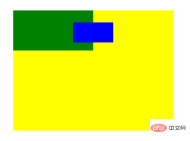
其实并不一定非要设置成0,在 margin: auto 下,只要 left 和 right 的值相等,且不超过其 相对元素减去该绝对定位元素 width 的一半,就可以实现居中;如果其 left 超出了范围,那么会取 left 的值作为定位( 从左向右的文档流); /* 至于在范围能的值不等情况,大家可以自行测试一下 */
以上例子均在水平方向实现,那么垂直方向是怎么样的呢?其实垂直方向的作用效果是一样,垂直方向同样可以自动拉伸,同理我们也可以实现垂直方向上的自动居中;
#div1 {
	top: 0;
	bottom: 0;
}

和水平居中有一点不同的是,无论 top 和 bottom 的值设置为多少,只要相等,就可以垂直居中。
(学习视频分享:css视频教程)
The above is the detailed content of What is the CSS property used to set the absolute positioning of an element?. For more information, please follow other related articles on the PHP Chinese website!

 React Inside HTML: Integrating JavaScript for Dynamic Web PagesApr 16, 2025 am 12:06 AM
To integrate React into HTML, follow these steps: 1. Introduce React and ReactDOM in HTML files. 2. Define a React component. 3. Render the component into HTML elements using ReactDOM. Through these steps, static HTML pages can be transformed into dynamic, interactive experiences.
 The Benefits of React: Performance, Reusability, and MoreApr 15, 2025 am 12:05 AM
React’s popularity includes its performance optimization, component reuse and a rich ecosystem. 1. Performance optimization achieves efficient updates through virtual DOM and diffing mechanisms. 2. Component Reuse Reduces duplicate code by reusable components. 3. Rich ecosystem and one-way data flow enhance the development experience.
 React: Creating Dynamic and Interactive User InterfacesApr 14, 2025 am 12:08 AM
React is the tool of choice for building dynamic and interactive user interfaces. 1) Componentization and JSX make UI splitting and reusing simple. 2) State management is implemented through the useState hook to trigger UI updates. 3) The event processing mechanism responds to user interaction and improves user experience.
 React vs. Backend Frameworks: A ComparisonApr 13, 2025 am 12:06 AM
React is a front-end framework for building user interfaces; a back-end framework is used to build server-side applications. React provides componentized and efficient UI updates, and the backend framework provides a complete backend service solution. When choosing a technology stack, project requirements, team skills, and scalability should be considered.
 HTML and React: The Relationship Between Markup and ComponentsApr 12, 2025 am 12:03 AM
The relationship between HTML and React is the core of front-end development, and they jointly build the user interface of modern web applications. 1) HTML defines the content structure and semantics, and React builds a dynamic interface through componentization. 2) React components use JSX syntax to embed HTML to achieve intelligent rendering. 3) Component life cycle manages HTML rendering and updates dynamically according to state and attributes. 4) Use components to optimize HTML structure and improve maintainability. 5) Performance optimization includes avoiding unnecessary rendering, using key attributes, and keeping the component single responsibility.
 React and the Frontend: Building Interactive ExperiencesApr 11, 2025 am 12:02 AM
React is the preferred tool for building interactive front-end experiences. 1) React simplifies UI development through componentization and virtual DOM. 2) Components are divided into function components and class components. Function components are simpler and class components provide more life cycle methods. 3) The working principle of React relies on virtual DOM and reconciliation algorithm to improve performance. 4) State management uses useState or this.state, and life cycle methods such as componentDidMount are used for specific logic. 5) Basic usage includes creating components and managing state, and advanced usage involves custom hooks and performance optimization. 6) Common errors include improper status updates and performance issues, debugging skills include using ReactDevTools and Excellent
 React and the Frontend Stack: The Tools and TechnologiesApr 10, 2025 am 09:34 AM
React is a JavaScript library for building user interfaces, with its core components and state management. 1) Simplify UI development through componentization and state management. 2) The working principle includes reconciliation and rendering, and optimization can be implemented through React.memo and useMemo. 3) The basic usage is to create and render components, and the advanced usage includes using Hooks and ContextAPI. 4) Common errors such as improper status update, you can use ReactDevTools to debug. 5) Performance optimization includes using React.memo, virtualization lists and CodeSplitting, and keeping code readable and maintainable is best practice.
 React's Role in HTML: Enhancing User ExperienceApr 09, 2025 am 12:11 AM
React combines JSX and HTML to improve user experience. 1) JSX embeds HTML to make development more intuitive. 2) The virtual DOM mechanism optimizes performance and reduces DOM operations. 3) Component-based management UI to improve maintainability. 4) State management and event processing enhance interactivity.


Hot AI Tools

Undresser.AI Undress
AI-powered app for creating realistic nude photos

AI Clothes Remover
Online AI tool for removing clothes from photos.

Undress AI Tool
Undress images for free

Clothoff.io
AI clothes remover

AI Hentai Generator
Generate AI Hentai for free.

Hot Article
Hot Tools

Atom editor mac version download
The most popular open source editor

SublimeText3 Linux new version
SublimeText3 Linux latest version

Dreamweaver CS6
Visual web development tools

mPDF
mPDF is a PHP library that can generate PDF files from UTF-8 encoded HTML. The original author, Ian Back, wrote mPDF to output PDF files "on the fly" from his website and handle different languages. It is slower than original scripts like HTML2FPDF and produces larger files when using Unicode fonts, but supports CSS styles etc. and has a lot of enhancements. Supports almost all languages, including RTL (Arabic and Hebrew) and CJK (Chinese, Japanese and Korean). Supports nested block-level elements (such as P, DIV),

SAP NetWeaver Server Adapter for Eclipse
Integrate Eclipse with SAP NetWeaver application server.

