



The JavaScript document object model is a tree type. Document Object Model (DOM) is a standard programming interface for processing extensible markup languages recommended by the W3C organization. It is a tree-based API document.

The operating environment of this tutorial: windows7 system, javascript version 1.8.5, Dell G3 computer.
In JavaScript, the document object model is a tree.
The Document Object Model (DOM) is a standard programming interface for processing extensible markup languages recommended by the W3C organization. DOM is a tree-based API document.
Document: a real existing file such as: web page file (HTML text)
Object: an independent data collection such as: document object document Data collection of elements and content
Model: The document object is represented as a tree model. In this tree model, the elements and content of the web page are represented as nodes

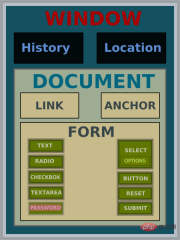
Properties of the Window object:
-
parent :
The parent window object has the same meaning as the parent window containing a certain window self: this window, has the same meaning as referencing the current window top: refers to the top browser window in a series of nested windows frames: in the window object An array containing all frame objects document: Represents the current document object displayed in the window history: The history object of the window, including a list of recently visited URLs in the window location: Represents the URL address associated with the window object event: Window event object (Only for IE) name: window name opener: window object representing the open window defaultStatus: window status bar default value status: window status bar display information navigator: used to obtain browser information appName "Netscape" for Mozilla "Microsoft Internet Explorer" for IE
-
Window object method
alert(): Alert dialog box
confirm(): Confirm dialog box
prompt() : Information input dialog box
close() : Close the window
blur() : The window loses focus
focus() : The window gains focus
open (): Open a new window and create a new window object
showModalDialog(): Open a modal dialog box
showModelessDialog(): Open a non-modal dialog box
The dialog box obtains the parameters passed in through window.dialogArguments
The dialog box returns information to the window that opens the modal dialog box through window.returnValue. It can return the object to prevent the opening of a new window (such as submitting a form) :
-
Attributes of the document object
title: Set the document title, which is equivalent to the HTML
tag<p>bgColor: Set the background color of the page, corresponding to the bgcolor attribute in </p> fgColor: Set the foreground color of the page, corresponding to the text attribute in the
tagalinkColor: Set the color of the active link (the focus is on this link)
linkColor: Set the color of the unclicked link
vlinkColor: Set the color of the clicked link
URL: URL of the document forms: Array of form objects, corresponding to the
-
Methods of document objects
close(): used to close windows other than the current window
write(): dynamically write content to the page
getElementById() : Get the object with the specified ID value
getElementsByName() : Get the object with the specified Name value, return the array
getElementsByTagName("tr") : Get the object with the specified TagName, return the array
createElement(): Create the specified HTML tag object var obj =createElement("input");
history object
Properties
current: The URL of the document currently displayed in the window
Method
back() : Load the previous page in the history table, equivalent to clicking the browser's return button
forward(): Load the next page in the history table, equivalent to clicking the browser's return button Click the forward button on the browser
go(string): Load the most recent document in the history table whose URL string contains this substring
-
go(n): When n>0, load the nth document from the past in the history table; when n=0, load the current document; when n
location object
attribute
hash
host
hostname
href
Method
assign(url): When assigning the URL directly to location, JavaScript calls this method
reload(): Reload the window
- ## replace(): Replace the window
javascript advanced tutorial】
The above is the detailed content of Is the javascript document object model a tree type?. For more information, please follow other related articles on the PHP Chinese website!

 Frontend Development with React: Advantages and TechniquesApr 17, 2025 am 12:25 AM
The advantages of React are its flexibility and efficiency, which are reflected in: 1) Component-based design improves code reusability; 2) Virtual DOM technology optimizes performance, especially when handling large amounts of data updates; 3) The rich ecosystem provides a large number of third-party libraries and tools. By understanding how React works and uses examples, you can master its core concepts and best practices to build an efficient, maintainable user interface.
 React vs. Other Frameworks: Comparing and Contrasting OptionsApr 17, 2025 am 12:23 AM
React is a JavaScript library for building user interfaces, suitable for large and complex applications. 1. The core of React is componentization and virtual DOM, which improves UI rendering performance. 2. Compared with Vue, React is more flexible but has a steep learning curve, which is suitable for large projects. 3. Compared with Angular, React is lighter, dependent on the community ecology, and suitable for projects that require flexibility.
 Demystifying React in HTML: How It All WorksApr 17, 2025 am 12:21 AM
React operates in HTML via virtual DOM. 1) React uses JSX syntax to write HTML-like structures. 2) Virtual DOM management UI update, efficient rendering through Diffing algorithm. 3) Use ReactDOM.render() to render the component to the real DOM. 4) Optimization and best practices include using React.memo and component splitting to improve performance and maintainability.
 React in Action: Examples of Real-World ApplicationsApr 17, 2025 am 12:20 AM
React is widely used in e-commerce, social media and data visualization. 1) E-commerce platforms use React to build shopping cart components, use useState to manage state, onClick to process events, and map function to render lists. 2) Social media applications interact with the API through useEffect to display dynamic content. 3) Data visualization uses react-chartjs-2 library to render charts, and component design is easy to embed applications.
 Frontend Architecture with React: Best PracticesApr 17, 2025 am 12:10 AM
Best practices for React front-end architecture include: 1. Component design and reuse: design a single responsibility, easy to understand and test components to achieve high reuse. 2. State management: Use useState, useReducer, ContextAPI or Redux/MobX to manage state to avoid excessive complexity. 3. Performance optimization: Optimize performance through React.memo, useCallback, useMemo and other methods to find the balance point. 4. Code organization and modularity: Organize code according to functional modules to improve manageability and maintainability. 5. Testing and Quality Assurance: Testing with Jest and ReactTestingLibrary to ensure the quality and reliability of the code
 React Inside HTML: Integrating JavaScript for Dynamic Web PagesApr 16, 2025 am 12:06 AM
To integrate React into HTML, follow these steps: 1. Introduce React and ReactDOM in HTML files. 2. Define a React component. 3. Render the component into HTML elements using ReactDOM. Through these steps, static HTML pages can be transformed into dynamic, interactive experiences.
 The Benefits of React: Performance, Reusability, and MoreApr 15, 2025 am 12:05 AM
React’s popularity includes its performance optimization, component reuse and a rich ecosystem. 1. Performance optimization achieves efficient updates through virtual DOM and diffing mechanisms. 2. Component Reuse Reduces duplicate code by reusable components. 3. Rich ecosystem and one-way data flow enhance the development experience.
 React: Creating Dynamic and Interactive User InterfacesApr 14, 2025 am 12:08 AM
React is the tool of choice for building dynamic and interactive user interfaces. 1) Componentization and JSX make UI splitting and reusing simple. 2) State management is implemented through the useState hook to trigger UI updates. 3) The event processing mechanism responds to user interaction and improves user experience.


Hot AI Tools

Undresser.AI Undress
AI-powered app for creating realistic nude photos

AI Clothes Remover
Online AI tool for removing clothes from photos.

Undress AI Tool
Undress images for free

Clothoff.io
AI clothes remover

AI Hentai Generator
Generate AI Hentai for free.

Hot Article
Hot Tools

Notepad++7.3.1
Easy-to-use and free code editor

SecLists
SecLists is the ultimate security tester's companion. It is a collection of various types of lists that are frequently used during security assessments, all in one place. SecLists helps make security testing more efficient and productive by conveniently providing all the lists a security tester might need. List types include usernames, passwords, URLs, fuzzing payloads, sensitive data patterns, web shells, and more. The tester can simply pull this repository onto a new test machine and he will have access to every type of list he needs.

Zend Studio 13.0.1
Powerful PHP integrated development environment

DVWA
Damn Vulnerable Web App (DVWA) is a PHP/MySQL web application that is very vulnerable. Its main goals are to be an aid for security professionals to test their skills and tools in a legal environment, to help web developers better understand the process of securing web applications, and to help teachers/students teach/learn in a classroom environment Web application security. The goal of DVWA is to practice some of the most common web vulnerabilities through a simple and straightforward interface, with varying degrees of difficulty. Please note that this software

ZendStudio 13.5.1 Mac
Powerful PHP integrated development environment

