



You can use the npm tool to install the mysql package in nodejs. The specific installation method: 1. Open the terminal and enter the specified project directory; 2. Execute the "npm install mysql --save" command and wait for the download and installation to complete. Can.

The operating environment of this tutorial: windows7 system, nodejs version 14.15.4, DELL G3 computer.
Nodejs method of installing mysql package and connecting to MySQL
First, install nodejs and npm.
I wrote a simple example. The entire example uses the express framework. The express and ejs templates have been downloaded in node_modules. Let’s take a look at the directory first:
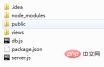
server.js =》 node.js server startup file
db.js =》Database operation file
views =》Store template files, that is, where all pages are stored
public =》Store all static resources, such as css js images and the like
How to connect to MySQL:
The first step is to install an npm package called MySQL. This package is officially provided and its stability can be guaranteed. Of course, there are other npm packages. , here we only use the mysql package. The installation method is very simple. Enter the command npm install mysql --save and wait for the download to complete.
If you see this, the installation is successful. .
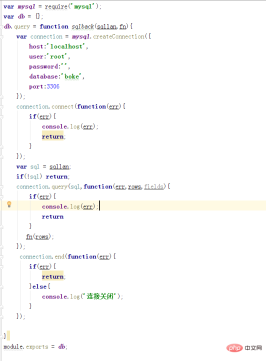
Then we open the db.js file and write some codes necessary for database operations. See the picture below:
The code is very small, meaning It is also obvious that the first step requires the introduction of the mysql package. Then we create an empty object and assign it a method called query. This method accepts two parameters. The first parameter is the SQL statement when you query the data. The second parameter is the callback function to obtain the query results.
Looking inside the function, the first block of code is used to set the configuration for operating mysql:
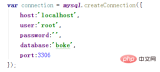
host represents the address of mysql installation, because I am Local database, so use localhost directly
user represents the user name of mysql
password represents the password of mysql
database represents the name of the specific library you want to choose to operate
port represents the port, which can be left blank. The default is 3306
The return value of mysql.createConnection, connection, is a specific object for our next operation of mysql. All operation methods are based on it.
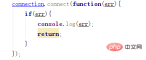
Call the connect method of connection to determine whether the connection is successful. If it fails, print out the error message and stop running.
Call the query method of connection to directly send sql statements to the database, and use the callback function to return the result. There are three parameters in the callback function, The first parameter is the error object. If the operation fails, it will stop and print the error message. The second parameter is the specific returned result. Under normal circumstances, it is an array containing a lot of json. The third parameter is also an array. Contains the explanation of each data, such as which database the current data belongs to, which table, etc. The second parameter we use most is naturally
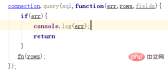
Close the connection after the database operation is completed
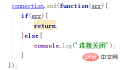
The whole process is very simple, but there are two problems. The first one is the problem of lost database connection. I don’t know if anyone has encountered it. When I visit the homepage for the first time, the connection The database is normal. When I visit the homepage for the second time, the database cannot be connected, and an error is reported saying that the connection is lost. The reason for this is that we close the database connection after each database operation. When we access the database again, we cannot find the connection, but the connection has to be closed. Some people may find it strange that the db.js file is accessed every time we visit the homepage. Isn't there a new connection generated every time? Yes, it’s just that the code that generated the connection at the beginning was not placed in the db.query function, but was placed outside, as shown below:
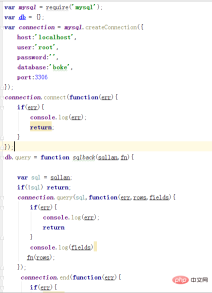
This will cause the connection to be generated only once. After it is closed, the second interview will not be connected. After placing it in the function, use exports to expose the interface to the outside world. Every time you visit the homepage, you will go through the process of creating a connection again, and you will get a new connection every time, so there will be no problem in accessing. In fact, the connection pool can be used directly in the project. Saved a lot of trouble.
The second problem is that we introduced db.js in server.js
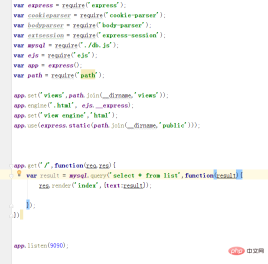
You may have seen at this time that mysql.query has two Parameters, the first one is sql, the second one is the callback function. The callback function has a result parameter, which is actually the result of the database query. Some people may ask why not use return directly in db.js to return the query results, what kind of callback is there?
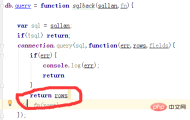
In fact, here are some problems caused by the asynchrony of node.js. If we change the code in server.js to the following picture
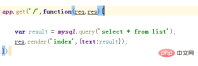
Because we have seen that the query method of the mysql package is an asynchronous operation, this results in the following res.render() method not waiting for the result to be queried before executing it. Often the result has not come out yet. The page has already been rendered, but the data has not been obtained, so an error will be reported. Therefore, we had to pass a callback function in. After the mysql query method ended, the results were passed into the callback function we wrote ourselves through parameters, so that we can get the results in the callback function. Then perform rendering. Of course, to deal with this problem, you can also introduce the third-party package async to solve the asynchronous problem. It depends on the individual.
[Related recommendations: "How to install nodejs in a windows environment? 》】
The above is the detailed content of How to install mysql package in nodejs. For more information, please follow other related articles on the PHP Chinese website!

 Frontend Development with React: Advantages and TechniquesApr 17, 2025 am 12:25 AM
The advantages of React are its flexibility and efficiency, which are reflected in: 1) Component-based design improves code reusability; 2) Virtual DOM technology optimizes performance, especially when handling large amounts of data updates; 3) The rich ecosystem provides a large number of third-party libraries and tools. By understanding how React works and uses examples, you can master its core concepts and best practices to build an efficient, maintainable user interface.
 React vs. Other Frameworks: Comparing and Contrasting OptionsApr 17, 2025 am 12:23 AM
React is a JavaScript library for building user interfaces, suitable for large and complex applications. 1. The core of React is componentization and virtual DOM, which improves UI rendering performance. 2. Compared with Vue, React is more flexible but has a steep learning curve, which is suitable for large projects. 3. Compared with Angular, React is lighter, dependent on the community ecology, and suitable for projects that require flexibility.
 Demystifying React in HTML: How It All WorksApr 17, 2025 am 12:21 AM
React operates in HTML via virtual DOM. 1) React uses JSX syntax to write HTML-like structures. 2) Virtual DOM management UI update, efficient rendering through Diffing algorithm. 3) Use ReactDOM.render() to render the component to the real DOM. 4) Optimization and best practices include using React.memo and component splitting to improve performance and maintainability.
 React in Action: Examples of Real-World ApplicationsApr 17, 2025 am 12:20 AM
React is widely used in e-commerce, social media and data visualization. 1) E-commerce platforms use React to build shopping cart components, use useState to manage state, onClick to process events, and map function to render lists. 2) Social media applications interact with the API through useEffect to display dynamic content. 3) Data visualization uses react-chartjs-2 library to render charts, and component design is easy to embed applications.
 Frontend Architecture with React: Best PracticesApr 17, 2025 am 12:10 AM
Best practices for React front-end architecture include: 1. Component design and reuse: design a single responsibility, easy to understand and test components to achieve high reuse. 2. State management: Use useState, useReducer, ContextAPI or Redux/MobX to manage state to avoid excessive complexity. 3. Performance optimization: Optimize performance through React.memo, useCallback, useMemo and other methods to find the balance point. 4. Code organization and modularity: Organize code according to functional modules to improve manageability and maintainability. 5. Testing and Quality Assurance: Testing with Jest and ReactTestingLibrary to ensure the quality and reliability of the code
 React Inside HTML: Integrating JavaScript for Dynamic Web PagesApr 16, 2025 am 12:06 AM
To integrate React into HTML, follow these steps: 1. Introduce React and ReactDOM in HTML files. 2. Define a React component. 3. Render the component into HTML elements using ReactDOM. Through these steps, static HTML pages can be transformed into dynamic, interactive experiences.
 The Benefits of React: Performance, Reusability, and MoreApr 15, 2025 am 12:05 AM
React’s popularity includes its performance optimization, component reuse and a rich ecosystem. 1. Performance optimization achieves efficient updates through virtual DOM and diffing mechanisms. 2. Component Reuse Reduces duplicate code by reusable components. 3. Rich ecosystem and one-way data flow enhance the development experience.
 React: Creating Dynamic and Interactive User InterfacesApr 14, 2025 am 12:08 AM
React is the tool of choice for building dynamic and interactive user interfaces. 1) Componentization and JSX make UI splitting and reusing simple. 2) State management is implemented through the useState hook to trigger UI updates. 3) The event processing mechanism responds to user interaction and improves user experience.


Hot AI Tools

Undresser.AI Undress
AI-powered app for creating realistic nude photos

AI Clothes Remover
Online AI tool for removing clothes from photos.

Undress AI Tool
Undress images for free

Clothoff.io
AI clothes remover

AI Hentai Generator
Generate AI Hentai for free.

Hot Article
Hot Tools

Notepad++7.3.1
Easy-to-use and free code editor

SecLists
SecLists is the ultimate security tester's companion. It is a collection of various types of lists that are frequently used during security assessments, all in one place. SecLists helps make security testing more efficient and productive by conveniently providing all the lists a security tester might need. List types include usernames, passwords, URLs, fuzzing payloads, sensitive data patterns, web shells, and more. The tester can simply pull this repository onto a new test machine and he will have access to every type of list he needs.

Zend Studio 13.0.1
Powerful PHP integrated development environment

DVWA
Damn Vulnerable Web App (DVWA) is a PHP/MySQL web application that is very vulnerable. Its main goals are to be an aid for security professionals to test their skills and tools in a legal environment, to help web developers better understand the process of securing web applications, and to help teachers/students teach/learn in a classroom environment Web application security. The goal of DVWA is to practice some of the most common web vulnerabilities through a simple and straightforward interface, with varying degrees of difficulty. Please note that this software

ZendStudio 13.5.1 Mac
Powerful PHP integrated development environment

