



How to delete page breaks in word: 1. Double-click to open the word software; 2. Click on the taskbar, click "View", and click "Outline View" on the left side of the operation bar; 3. Find the page break that needs to be deleted ;4. Click the delete button to delete the page break.

The operating environment of this article: Windows 7 system, Microsoft Office word 2010 version, Dell G3 computer.
How to delete word page breaks?
First, double-click the mouse to open the word software.
Drag the article you want to change into the software and open it. As shown in the picture, the upper part of the article is separate from the lower part, and the lower part is on another page.
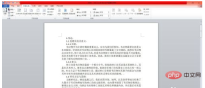
Second, check the page break position.
Click on the taskbar above the text - click "View" - click "Outline View" on the left side of the action bar - so that you can see whether there are page breaks in your article.
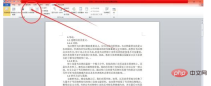
Third, find the page break that needs to be deleted.
As shown in the picture, after we adjust it to the outline view, we can clearly see the page breaks in the article and find the places that need to be deleted first.
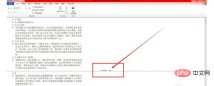
Fourth, delete the page breaks.
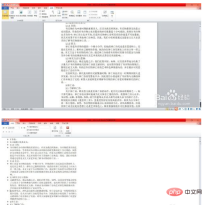
After finding the page break - click it with the left mouse button - press and hold the delete key to complete the deletion of the page break. After deleting, click View - Page View - to return to editing.
In this way, paging is cancelled.
Recommended study: "Word Tutorial"
The above is the detailed content of How to delete page breaks in word. For more information, please follow other related articles on the PHP Chinese website!

Hot AI Tools

Undresser.AI Undress
AI-powered app for creating realistic nude photos

AI Clothes Remover
Online AI tool for removing clothes from photos.

Undress AI Tool
Undress images for free

Clothoff.io
AI clothes remover

AI Hentai Generator
Generate AI Hentai for free.

Hot Article
Hot Tools

ZendStudio 13.5.1 Mac
Powerful PHP integrated development environment

Notepad++7.3.1
Easy-to-use and free code editor

mPDF
mPDF is a PHP library that can generate PDF files from UTF-8 encoded HTML. The original author, Ian Back, wrote mPDF to output PDF files "on the fly" from his website and handle different languages. It is slower than original scripts like HTML2FPDF and produces larger files when using Unicode fonts, but supports CSS styles etc. and has a lot of enhancements. Supports almost all languages, including RTL (Arabic and Hebrew) and CJK (Chinese, Japanese and Korean). Supports nested block-level elements (such as P, DIV),

EditPlus Chinese cracked version
Small size, syntax highlighting, does not support code prompt function

Dreamweaver CS6
Visual web development tools

