



Compression method: 1. Use DW software to open the CSS file; 2. Use the "Find and Replace" tool to delete all spaces in the file; 3. Delete excess semicolons in the style code; 4. Delete excess Just leave the lines blank so that the code lines up (close to each other).

The operating environment of this tutorial: windows7 system, CSS3&&AdobeDreamweaverCS6 version, Dell G3 computer.
Where to start with CSS code compression
After the web page is developed, the CSS code to be published to the website can be directly reduced and compressed, such as deleting spaces, removing line breaks, and removing redundant Semicolons, etc.
Of course, some CSS codes can be optimized, which can greatly reduce the amount of code and thus reduce the file size.
How to compress css files
Use the find and replace tool of DW software to replace the compressed CSS code.
1. Open the CSS file with DW software
2. Delete the space compression code
2-1: Use the shortcut key "Ctrl F" to bring up the find and replace tool options Card.
2-2: Type (input) an English half-width lowercase "space" at the search location
Enter a space in the "Search" input box
Enter a space in the "Find" input box. There is no need to fill in the following characters or codes in the "Replace" input box. This way, when performing the replacement, it is equivalent to replacing the space. There are no characters, which is equivalent to deleting the space position.
2-3: Click "Replace All"
After clicking "Replace All", you can delete the excess spaces and complete the compression.
3. Delete the extra semicolon
In the CSS code, the end of the last CSS style in each CSS selector is not needed "Semicolon" ends, in other words, there is no need for a semicolon to end the last CSS style in each selector before the "last curly brace".
Also use the "Find and Replace" function of the DW software to delete it to avoid deleting other "semicolons" by mistake. At this time, click "Search" in the "Find and Replace" tab Fill in ";}" (curly brackets after the semicolon) in the "input box, enter only "}" (curly brackets after the semicolon) in the "Replace" input box, and then click "Replace All" to complete the deletion of redundant semicolon symbols. .
4. Delete the excess blank lines so that the codes are lined up in a row (close to each other)
You can manually delete the blank lines, or you can use DW software to quickly delete the blank lines. The specific deletion and compression are as follows.
4-1: First open the CSS file code in DW
4-2: Select the empty line
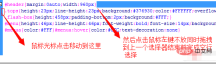
First move the mouse cursor to the beginning of the selector, and then click the left mouse button While holding it, pull it up to the end of the previous selector (after the curly braces after the previous CSS style selector). At this time, you can select the empty row. At this time, the empty row is selected in the blue area.
4-3: Call up the "Find and Replace" tool
After selecting, release the left mouse button and use the shortcut key "Ctrl F" , you can call up the "Find and Replace" tab. At this time, the "Find" input box of the "Find and Replace" tab will be automatically filled with the blank line you just selected.

4-4: Click "Replace All" to complete the compression
There is no need to enter any more characters or codes in the "Replace" input box, just click "Replace" Done" to complete the replacement.

#Quickly use DW software to compress and streamline CSS code (files) in a few steps.
Benefits of css compression:
1. Reduce file size
2. Reduce network transmission volume and bandwidth usage
3. Reduce the processing pressure on the server
4. Improve the rendering and display speed of the page
(Learning video sharing: css video tutorial )
The above is the detailed content of How to compress css files. For more information, please follow other related articles on the PHP Chinese website!

 React Inside HTML: Integrating JavaScript for Dynamic Web PagesApr 16, 2025 am 12:06 AM
To integrate React into HTML, follow these steps: 1. Introduce React and ReactDOM in HTML files. 2. Define a React component. 3. Render the component into HTML elements using ReactDOM. Through these steps, static HTML pages can be transformed into dynamic, interactive experiences.
 The Benefits of React: Performance, Reusability, and MoreApr 15, 2025 am 12:05 AM
React’s popularity includes its performance optimization, component reuse and a rich ecosystem. 1. Performance optimization achieves efficient updates through virtual DOM and diffing mechanisms. 2. Component Reuse Reduces duplicate code by reusable components. 3. Rich ecosystem and one-way data flow enhance the development experience.
 React: Creating Dynamic and Interactive User InterfacesApr 14, 2025 am 12:08 AM
React is the tool of choice for building dynamic and interactive user interfaces. 1) Componentization and JSX make UI splitting and reusing simple. 2) State management is implemented through the useState hook to trigger UI updates. 3) The event processing mechanism responds to user interaction and improves user experience.
 React vs. Backend Frameworks: A ComparisonApr 13, 2025 am 12:06 AM
React is a front-end framework for building user interfaces; a back-end framework is used to build server-side applications. React provides componentized and efficient UI updates, and the backend framework provides a complete backend service solution. When choosing a technology stack, project requirements, team skills, and scalability should be considered.
 HTML and React: The Relationship Between Markup and ComponentsApr 12, 2025 am 12:03 AM
The relationship between HTML and React is the core of front-end development, and they jointly build the user interface of modern web applications. 1) HTML defines the content structure and semantics, and React builds a dynamic interface through componentization. 2) React components use JSX syntax to embed HTML to achieve intelligent rendering. 3) Component life cycle manages HTML rendering and updates dynamically according to state and attributes. 4) Use components to optimize HTML structure and improve maintainability. 5) Performance optimization includes avoiding unnecessary rendering, using key attributes, and keeping the component single responsibility.
 React and the Frontend: Building Interactive ExperiencesApr 11, 2025 am 12:02 AM
React is the preferred tool for building interactive front-end experiences. 1) React simplifies UI development through componentization and virtual DOM. 2) Components are divided into function components and class components. Function components are simpler and class components provide more life cycle methods. 3) The working principle of React relies on virtual DOM and reconciliation algorithm to improve performance. 4) State management uses useState or this.state, and life cycle methods such as componentDidMount are used for specific logic. 5) Basic usage includes creating components and managing state, and advanced usage involves custom hooks and performance optimization. 6) Common errors include improper status updates and performance issues, debugging skills include using ReactDevTools and Excellent
 React and the Frontend Stack: The Tools and TechnologiesApr 10, 2025 am 09:34 AM
React is a JavaScript library for building user interfaces, with its core components and state management. 1) Simplify UI development through componentization and state management. 2) The working principle includes reconciliation and rendering, and optimization can be implemented through React.memo and useMemo. 3) The basic usage is to create and render components, and the advanced usage includes using Hooks and ContextAPI. 4) Common errors such as improper status update, you can use ReactDevTools to debug. 5) Performance optimization includes using React.memo, virtualization lists and CodeSplitting, and keeping code readable and maintainable is best practice.
 React's Role in HTML: Enhancing User ExperienceApr 09, 2025 am 12:11 AM
React combines JSX and HTML to improve user experience. 1) JSX embeds HTML to make development more intuitive. 2) The virtual DOM mechanism optimizes performance and reduces DOM operations. 3) Component-based management UI to improve maintainability. 4) State management and event processing enhance interactivity.


Hot AI Tools

Undresser.AI Undress
AI-powered app for creating realistic nude photos

AI Clothes Remover
Online AI tool for removing clothes from photos.

Undress AI Tool
Undress images for free

Clothoff.io
AI clothes remover

AI Hentai Generator
Generate AI Hentai for free.

Hot Article
Hot Tools

VSCode Windows 64-bit Download
A free and powerful IDE editor launched by Microsoft

DVWA
Damn Vulnerable Web App (DVWA) is a PHP/MySQL web application that is very vulnerable. Its main goals are to be an aid for security professionals to test their skills and tools in a legal environment, to help web developers better understand the process of securing web applications, and to help teachers/students teach/learn in a classroom environment Web application security. The goal of DVWA is to practice some of the most common web vulnerabilities through a simple and straightforward interface, with varying degrees of difficulty. Please note that this software

SublimeText3 Linux new version
SublimeText3 Linux latest version

Dreamweaver CS6
Visual web development tools

MantisBT
Mantis is an easy-to-deploy web-based defect tracking tool designed to aid in product defect tracking. It requires PHP, MySQL and a web server. Check out our demo and hosting services.

