




Having a good understanding of constructors is the key to mastering the JavaScript language. We all know that JavaScript is not like other languages. It does not have the class keyword, but it has a constructor that is very similar to function. In this article, let’s learn in detail how JavaScript constructors construct objects.
Constructors are very similar to ordinary functions, but we use them through the new keyword. There are two main types of constructors, native constructors (Array, Object), which can be automatically generated in the execution environment, and custom constructors, where you can define your own methods and properties.
Using constructors is very effective when you want to create many similar objects (with the same properties and methods). Most programmers follow the convention of using a capital letter to distinguish constructors from ordinary functions. Take a look at the code below.
function Book() {
    // unfinished code
}
var myBook = new Book();
The last line of code creates a Book object and assigns it to a variable; after this is completed, myBook is also a Book instance even if the Book constructor does not do anything. As you can see, apart from capitalizing the first letter and using the new keyword, there is no difference between constructors and ordinary functions.
Determine the type of instance
To determine whether an object is an instance of some kind, we can use the instanceof operator:
myBook instanceof Book    // => true
myBook instanceof String  // => false
Note: If the right side is not an instance of a function, an error will be reported:
myBook instanceof {}; // => TypeError: invalid 'instanceof' operand ({})Another method is to use the constructor attribute. All object instances have a constructor attribute. This attribute Points to the constructor that created it.
myBook.constructor == Book; // => true
Just like the constructor of myBook points to Book. All objects inherit the constructor attribute from their prototype:
var s = new String("text");
s.constructor === String;      // => true
"text".constructor === String; // => true
var o = new Object();
o.constructor === Object;      // => true
var o = {};
o.constructor === Object;      // => true
var a = new Array();
a.constructor === Array;       // => true
[].constructor === Array;      // => true
Although using constructor can be used to detect instance types, it is recommended to use the instanceof method. Because the constructor attribute can be overridden... it is not very reliable to use.
Custom Constructor
Constructors are like cookie stampers. Made from the same impression, they are all the same model (the same is true for men who don’t have a good thing).
function Book(name, year) {
    this.name = name;
    this.year = '(' + year + ')';
}
The Book constructor requires two parameters. When using the new keyword to construct an object, the two formal parameters will be passed to the name and year of the Book object.
var firstBook = new Book("Pro AngularJS", 2014);
var secondBook = new Book("Secrets Of The JavaScript Ninja", 2013);
var thirdBook = new Book("JavaScript Patterns", 2010);

console.log(firstBook.name, firstBook.year);
console.log(secondBook.name, secondBook.year);
console.log(thirdBook.name, thirdBook.year);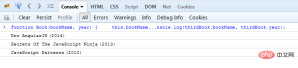
As you can see, we can quickly create another book by passing different parameters. The same is true for JavaScript's Array() and Date().
Object.defineProperty method
The Object.defineProperty method can be used in the constructor to configure properties.
function Book(name) {
    Object.defineProperty(this, "name", {
        get: function() {
            return "Book: " + name;
        },
        set: function(newName) {
            name = newName;
        },
        configurable: false
    });
}
var myBook = new Book("Single Page Web Applications");
console.log(myBook.name);    // => Book: Single Page Web Applications
// we cannot delete the name property because "configurable" is set to false
delete myBook.name;
console.log(myBook.name);    // => Book: Single Page Web Applications
// but we can change the value of the name property
myBook.name = "Testable JavaScript";
console.log(myBook.name);    // => Book: Testable JavaScript
The above code calls the ancestor method. It provides getter and setter interfaces. The getter method is responsible for returning the encapsulated value, and the setter method accepts parameters and assigns the value to the property. When we operate access on a property, these two methods are called. By configuring configurable, we can set whether the value can be deleted.
Object literal representation is the preferred constructor
The JavaScript language has nine built-in constructors: Object(), Array(), String(), Number(), Boolean(), Date(), Function(), Error() and RegExp(). When we need to create these values, we are free to use literals or constructors. But under the same circumstances, literal objects are not only easier to read, but also faster because they can be optimized during parsing. So use literals when you need to use simple objects.
// a number object
// numbers have a toFixed() method
var obj = new Object(5);
obj.toFixed(2);     // => 5.00
// we can achieve the same result using literals
var num = 5;
num.toFixed(2);     // => 5.00
// a string object
// strings have a slice() method
var obj = new String("text");
obj.slice(0,2);     // => "te"
// same as above
var string = "text";
string.slice(0,2);  // => "te"
Using the new keyword is essential
Remember to use the new keyword when using the constructor. If you accidentally forget, then the constructor This in points to the global object (default is window in the browser).
function Book(name, year) {
    console.log(this);
    this.name = name;
    this.year = year;
}
var myBook = Book("js book", 2014);
console.log(myBook instanceof Book);
console.log(window.name, window.year);
var myBook = new Book("js book", 2014);
console.log(myBook instanceof Book);
console.log(myBook.name, myBook.year);
The result of running the above code is as follows:

If it is in strict mode, the above code will throw an error because of strict mode We are not allowed to call the constructor without using the new keyword.
Constructor with a higher scope of application
In order to solve the risk of forgetting to use the new keyword, we can create a constructor with a higher scope of application by judging the value of this Constructor.
function Book(name) {
    if (!(this instanceof Book)) {
        // the constructor was called without "new".
        return new Book(name);
    }
}
After adding this code, we can use the constructor 'unscrupulously'.
function Book(name, year) {
    if (!(this instanceof Book)) {
        return new Book(name, year);
    }
    this.name = name;
    this.year = year;
}
var person1 = new Book("js book", 2014);
var person2 = Book("js book", 2014);
console.log(person1 instanceof Book);    // => true
console.log(person2 instanceof Book);    // => true
Many built-in constructors do this. By judging whether this is the current type. If the programmer forgets to add the new keyword, then we will return an object passed through new.
Conclusion
JavaScript does not have such a term (but it can be object-oriented), so it is confusing for programmers who are accustomed to using classes. Of course, JavaScript's constructor is no different from an ordinary function, it is just generated through the new keyword. It is very useful if we need to "print cookies".
Recommended tutorial: "JavaScript Video Tutorial"
The above is the detailed content of Learn more about constructors in JavaScript. For more information, please follow other related articles on the PHP Chinese website!

 Python vs. JavaScript: Community, Libraries, and ResourcesApr 15, 2025 am 12:16 AM
Python and JavaScript have their own advantages and disadvantages in terms of community, libraries and resources. 1) The Python community is friendly and suitable for beginners, but the front-end development resources are not as rich as JavaScript. 2) Python is powerful in data science and machine learning libraries, while JavaScript is better in front-end development libraries and frameworks. 3) Both have rich learning resources, but Python is suitable for starting with official documents, while JavaScript is better with MDNWebDocs. The choice should be based on project needs and personal interests.
 From C/C to JavaScript: How It All WorksApr 14, 2025 am 12:05 AM
The shift from C/C to JavaScript requires adapting to dynamic typing, garbage collection and asynchronous programming. 1) C/C is a statically typed language that requires manual memory management, while JavaScript is dynamically typed and garbage collection is automatically processed. 2) C/C needs to be compiled into machine code, while JavaScript is an interpreted language. 3) JavaScript introduces concepts such as closures, prototype chains and Promise, which enhances flexibility and asynchronous programming capabilities.
 JavaScript Engines: Comparing ImplementationsApr 13, 2025 am 12:05 AM
Different JavaScript engines have different effects when parsing and executing JavaScript code, because the implementation principles and optimization strategies of each engine differ. 1. Lexical analysis: convert source code into lexical unit. 2. Grammar analysis: Generate an abstract syntax tree. 3. Optimization and compilation: Generate machine code through the JIT compiler. 4. Execute: Run the machine code. V8 engine optimizes through instant compilation and hidden class, SpiderMonkey uses a type inference system, resulting in different performance performance on the same code.
 Beyond the Browser: JavaScript in the Real WorldApr 12, 2025 am 12:06 AM
JavaScript's applications in the real world include server-side programming, mobile application development and Internet of Things control: 1. Server-side programming is realized through Node.js, suitable for high concurrent request processing. 2. Mobile application development is carried out through ReactNative and supports cross-platform deployment. 3. Used for IoT device control through Johnny-Five library, suitable for hardware interaction.
 Building a Multi-Tenant SaaS Application with Next.js (Backend Integration)Apr 11, 2025 am 08:23 AM
I built a functional multi-tenant SaaS application (an EdTech app) with your everyday tech tool and you can do the same. First, what’s a multi-tenant SaaS application? Multi-tenant SaaS applications let you serve multiple customers from a sing
 How to Build a Multi-Tenant SaaS Application with Next.js (Frontend Integration)Apr 11, 2025 am 08:22 AM
This article demonstrates frontend integration with a backend secured by Permit, building a functional EdTech SaaS application using Next.js. The frontend fetches user permissions to control UI visibility and ensures API requests adhere to role-base
 JavaScript: Exploring the Versatility of a Web LanguageApr 11, 2025 am 12:01 AM
JavaScript is the core language of modern web development and is widely used for its diversity and flexibility. 1) Front-end development: build dynamic web pages and single-page applications through DOM operations and modern frameworks (such as React, Vue.js, Angular). 2) Server-side development: Node.js uses a non-blocking I/O model to handle high concurrency and real-time applications. 3) Mobile and desktop application development: cross-platform development is realized through ReactNative and Electron to improve development efficiency.
 The Evolution of JavaScript: Current Trends and Future ProspectsApr 10, 2025 am 09:33 AM
The latest trends in JavaScript include the rise of TypeScript, the popularity of modern frameworks and libraries, and the application of WebAssembly. Future prospects cover more powerful type systems, the development of server-side JavaScript, the expansion of artificial intelligence and machine learning, and the potential of IoT and edge computing.


Hot AI Tools

Undresser.AI Undress
AI-powered app for creating realistic nude photos

AI Clothes Remover
Online AI tool for removing clothes from photos.

Undress AI Tool
Undress images for free

Clothoff.io
AI clothes remover

AI Hentai Generator
Generate AI Hentai for free.

Hot Article
Hot Tools

VSCode Windows 64-bit Download
A free and powerful IDE editor launched by Microsoft

SublimeText3 Chinese version
Chinese version, very easy to use

Dreamweaver Mac version
Visual web development tools

mPDF
mPDF is a PHP library that can generate PDF files from UTF-8 encoded HTML. The original author, Ian Back, wrote mPDF to output PDF files "on the fly" from his website and handle different languages. It is slower than original scripts like HTML2FPDF and produces larger files when using Unicode fonts, but supports CSS styles etc. and has a lot of enhancements. Supports almost all languages, including RTL (Arabic and Hebrew) and CJK (Chinese, Japanese and Korean). Supports nested block-level elements (such as P, DIV),

Atom editor mac version download
The most popular open source editor

