


 DatabaseRedisIntroduction to Redis master-slave replication and detailed explanation of its principles
Introduction to Redis master-slave replication and detailed explanation of its principles


#redis is a key-value storage system. Similar to Memcached, it supports relatively more stored value types, including string (string), list (linked list), set (set), zset (sorted set - ordered set) and hash (hash type). These data types all support push/pop, add/remove, intersection, union, difference, and richer operations, and these operations are all atomic. On this basis, redis supports various different ways of sorting. Like memcached, data is cached in memory to ensure efficiency. The difference is that redis will periodically write updated data to disk or write modification operations to additional record files, and on this basis, master-slave (master-slave) synchronization is achieved.
Overview
In existing enterprises, 80% of companies mostly use redis stand-alone service. In actual scenarios, a single node redis is prone to risks.
Facing problems
1. Machine failure. We deploy to a Redis server. When a machine failure occurs, we need to migrate to another server and ensure that the data is synchronized. Data is the most important thing. If you don't care, you basically won't use Redis. 2. Capacity bottleneck. When we need to expand Redis memory, from 16G memory to 64G, a single machine will definitely not be able to satisfy it. Of course, you can buy a new 128G machine.
Solution
To achieve greater storage capacity of the distributed database and withstand high concurrent access, we will convert the original centralized data
The data in the library is stored on multiple other network nodes. In order to solve the problem of this single node, Redis will also deploy multiple copies of data toother nodes for replication to achieve high availability of Redis and redundant backup of data,
To ensure the high availability of data and services.
Master-slave replicationWhat is master-slave replication
Master-slave replication , refers to copying data from one Redis server to other Redis servers. The former is called the master node (master), and the latter is called the slave node (slave). Data replication is one-way and can only be from the master node to the slave node.
By default, each Redis server is a master node; and a master node can have multiple slave nodes (or no slave nodes), but a slave node can only have one master node.
The role of master-slave replication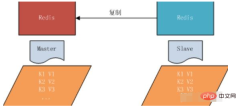
1. Data redundancy: Master-slave replication realizes hot backup of data , is a data redundancy method other than persistence. 2. Fault recovery: When a problem occurs on the master node, the slave node can provide services to achieve rapid fault recovery; it is actually a kind of service redundancy.
3. Load balancing: Based on master-slave replication, combined with read-write separation, the master node can provide write services,the slave nodes can provide read services (that is, when writing Redis data The application connects to the master node, and when reading Redis data, the application connects to the slave node) to share the server load; especially in the scenario of less writing and more reading, the read load is shared through multiple slave nodes
, which can greatly increase the concurrency of the Redis server. 4. Read and write separation: It can be used to achieve read and write separation, main library writing, slave library reading. Reading and writing separation can not only improve the load capacity of the server, but also can be used as needed. Change, change the number of slave libraries;
5. The cornerstone of high availability: In addition to the above functions, master-slave replication is also the basis for the implementation of sentinels and clusters.Therefore, master-slave replication is Redis High availability foundation.
Enable master-slave replication
There are 3 ways to enable master-slave replication from the slave node:1. Configuration file: Add to the configuration file of the slave server:
slaveof <masterip>
<masterport>
2. Start command: Add redis-server after starting the command
--slaveof <masterip>
<masterport>
3. 客户端命令: Redis 服务器启动后,直接通过客户端执行命令:
slaveof
<masterip>
<masterport>
则该 Redis 实例成为从节点。
通过 info replication 命令可以看到复制的一些信息主从复制原理主从复制过程大体可以分为 3 个阶段:连接建立阶段(即准备阶段)、数据同步阶段、命令传播阶段。在从节点执行 slaveof 命令后,复制过程便开始运作,下面图示大概可以看到,从图中可以看出复制过程大致分为 6 个过程
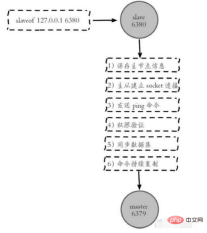
主从配置之后的日志记录也可以看出这个流程
1)保存主节点(master)信息。
执行 slaveof 后 Redis 会打印如下日志:

2)从节点(slave)内部通过每秒运行的定时任务维护复制相关逻辑,当定时任务发现存在新的主节点后,会尝试与该节点建立网络连接
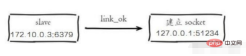
从节点与主节点建立网络连接
从节点会建立一个 socket 套接字,从节点建立了一个端口为 51234 的套接字,专门用于接受主节点发送的复制命令。从节点连接成功后打印如下日志:

如果从节点无法建立连接,定时任务会无限重试直到连接成功或者执行 slaveof noone 取消复制关于连接失败,可以在从节点执行 info replication 查看<span style="font-size: 14px; line-height: 1.76em;">master_link_down_since_seconds</span> 指标,它会记录与主节点连接失败的系统时间。从
节点连接主节点失败时也会每秒打印如下日志,方便发现问题:
# Error condition on socket for SYNC: {socket_error_reason}3)发送 ping 命令。
连接建立成功后从节点发送 ping 请求进行首次通信,ping 请求主要目的如下:
·检测主从之间网络套接字是否可用。
·检测主节点当前是否可接受处理命令。
如果发送 ping 命令后,从节点没有收到主节点的 pong 回复或者超时,比如网络超时或者主节点正在阻塞无法响应命令,从节点会断开复制连接,下次定时任务会发起重连
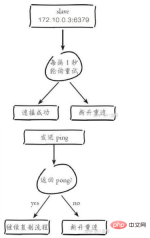
从节点发送的 ping 命令成功返回,Redis 打印如下日志,并继续后续复制流程:

4)权限验证。如果主节点设置了 requirepass 参数,则需要密码验证,从节点必须配
置 masterauth 参数保证与主节点相同的密码才能通过验证;如果验证失败复制将终
止,从节点重新发起复制流程。
5)同步数据集。主从复制连接正常通信后,对于首次建立复制的场景,主节点会把持
有的数据全部发送给从节点,这部分操作是耗时最长的步骤。
6)命令持续复制。当主节点把当前的数据同步给从节点后,便完成了复制的建立流程。
接下来主节点会持续地把写命令发送给从节点,保证主从数据一致性。
更多redis知识请关注redis数据库教程栏目。
The above is the detailed content of Introduction to Redis master-slave replication and detailed explanation of its principles. For more information, please follow other related articles on the PHP Chinese website!

 Redis: Exploring Its Data Model and StructureApr 16, 2025 am 12:09 AM
Redis's data model and structure include five main types: 1. String: used to store text or binary data, and supports atomic operations. 2. List: Ordered elements collection, suitable for queues and stacks. 3. Set: Unordered unique elements set, supporting set operation. 4. Ordered Set (SortedSet): A unique set of elements with scores, suitable for rankings. 5. Hash table (Hash): a collection of key-value pairs, suitable for storing objects.
 Redis: Classifying Its Database ApproachApr 15, 2025 am 12:06 AM
Redis's database methods include in-memory databases and key-value storage. 1) Redis stores data in memory, and reads and writes fast. 2) It uses key-value pairs to store data, supports complex data structures such as lists, collections, hash tables and ordered collections, suitable for caches and NoSQL databases.
 Why Use Redis? Benefits and AdvantagesApr 14, 2025 am 12:07 AM
Redis is a powerful database solution because it provides fast performance, rich data structures, high availability and scalability, persistence capabilities, and a wide range of ecosystem support. 1) Extremely fast performance: Redis's data is stored in memory and has extremely fast read and write speeds, suitable for high concurrency and low latency applications. 2) Rich data structure: supports multiple data types, such as lists, collections, etc., which are suitable for a variety of scenarios. 3) High availability and scalability: supports master-slave replication and cluster mode to achieve high availability and horizontal scalability. 4) Persistence and data security: Data persistence is achieved through RDB and AOF to ensure data integrity and reliability. 5) Wide ecosystem and community support: with a huge ecosystem and active community,
 Understanding NoSQL: Key Features of RedisApr 13, 2025 am 12:17 AM
Key features of Redis include speed, flexibility and rich data structure support. 1) Speed: Redis is an in-memory database, and read and write operations are almost instantaneous, suitable for cache and session management. 2) Flexibility: Supports multiple data structures, such as strings, lists, collections, etc., which are suitable for complex data processing. 3) Data structure support: provides strings, lists, collections, hash tables, etc., which are suitable for different business needs.
 Redis: Identifying Its Primary FunctionApr 12, 2025 am 12:01 AM
The core function of Redis is a high-performance in-memory data storage and processing system. 1) High-speed data access: Redis stores data in memory and provides microsecond-level read and write speed. 2) Rich data structure: supports strings, lists, collections, etc., and adapts to a variety of application scenarios. 3) Persistence: Persist data to disk through RDB and AOF. 4) Publish subscription: Can be used in message queues or real-time communication systems.
 Redis: A Guide to Popular Data StructuresApr 11, 2025 am 12:04 AM
Redis supports a variety of data structures, including: 1. String, suitable for storing single-value data; 2. List, suitable for queues and stacks; 3. Set, used for storing non-duplicate data; 4. Ordered Set, suitable for ranking lists and priority queues; 5. Hash table, suitable for storing object or structured data.
 How to implement redis counterApr 10, 2025 pm 10:21 PM
Redis counter is a mechanism that uses Redis key-value pair storage to implement counting operations, including the following steps: creating counter keys, increasing counts, decreasing counts, resetting counts, and obtaining counts. The advantages of Redis counters include fast speed, high concurrency, durability and simplicity and ease of use. It can be used in scenarios such as user access counting, real-time metric tracking, game scores and rankings, and order processing counting.
 How to use the redis command lineApr 10, 2025 pm 10:18 PM
Use the Redis command line tool (redis-cli) to manage and operate Redis through the following steps: Connect to the server, specify the address and port. Send commands to the server using the command name and parameters. Use the HELP command to view help information for a specific command. Use the QUIT command to exit the command line tool.


Hot AI Tools

Undresser.AI Undress
AI-powered app for creating realistic nude photos

AI Clothes Remover
Online AI tool for removing clothes from photos.

Undress AI Tool
Undress images for free

Clothoff.io
AI clothes remover

AI Hentai Generator
Generate AI Hentai for free.

Hot Article
Hot Tools

Dreamweaver Mac version
Visual web development tools

PhpStorm Mac version
The latest (2018.2.1) professional PHP integrated development tool

SublimeText3 English version
Recommended: Win version, supports code prompts!

DVWA
Damn Vulnerable Web App (DVWA) is a PHP/MySQL web application that is very vulnerable. Its main goals are to be an aid for security professionals to test their skills and tools in a legal environment, to help web developers better understand the process of securing web applications, and to help teachers/students teach/learn in a classroom environment Web application security. The goal of DVWA is to practice some of the most common web vulnerabilities through a simple and straightforward interface, with varying degrees of difficulty. Please note that this software

mPDF
mPDF is a PHP library that can generate PDF files from UTF-8 encoded HTML. The original author, Ian Back, wrote mPDF to output PDF files "on the fly" from his website and handle different languages. It is slower than original scripts like HTML2FPDF and produces larger files when using Unicode fonts, but supports CSS styles etc. and has a lot of enhancements. Supports almost all languages, including RTL (Arabic and Hebrew) and CJK (Chinese, Japanese and Korean). Supports nested block-level elements (such as P, DIV),

