


How to get the selected state of a radio button using JavaScript

To use JavaScript to select the status of a radio button, you need to select the checked attribute of the radio button object. This article introduces how to use JavaScript to obtain the selection status of the radio button.

Let’s first look at the value of the checked attribute
true: Select the radio button
false: The radio button is not selected
When getting the radio button in the form
The situation specified by the id attribute
Referring to the id form control in JavaScript
document.forms.(参照表格的id).(参照控件的id)
When referencing the selected state of the radio button through the id
document.forms.(参照表格的id).(参照How to get the selected state of a radio button using JavaScript的id).checked
can also be accessed
document.(参照表格的name).(参照How to get the selected state of a radio button using JavaScript的id).checked
When specified by the name attribute
The controls for text boxes and check boxes can be obtained from the name, but for radio buttons, if they are set to the same radio button group , you cannot use Get from Name because the value of Name is the same. We will check the selection status from the ID introduced earlier.
The code is as follows
<!DOCTYPE html>
<html>
<head>
<meta http-equiv="Content-Type" content="text/html; charset=utf-8"/>
  <title></title>
  <script type="text/javascript" language="javascript">
    function onHow to get the selected state of a radio button using JavaScriptChange() {
      check1 = document.form1.Radio1.checked;
      check2 = document.form1.Radio2.checked;
      check3 = document.form1.Radio3.checked;
      target = document.getElementById("output");
      if (check1 == true) {
        target.innerHTML = "元素1被选中。<br/>";
      }
      else if (check2 == true) {
        target.innerHTML = "元素2被选中。<br/>";
      }
      else if (check3 == true) {
        target.innerHTML = "元素3被选中。<br/>";
      }
    }
  </script>
</head>
<body>
  <form name="form1" action="">
    <input id="Radio1" name="RadioGroup1" type="radio" onchange="onHow to get the selected state of a radio button using JavaScriptChange();" />
      <label for="Radio1">How to get the selected state of a radio button using JavaScript 元素1</label><br/>
    <input id="Radio2" name="RadioGroup1" type="radio" onchange="onHow to get the selected state of a radio button using JavaScriptChange();" />
      <label for="Radio2">How to get the selected state of a radio button using JavaScript 元素2</label><br />
    <input id="Radio3" name="RadioGroup1" type="radio" onchange="onHow to get the selected state of a radio button using JavaScriptChange();" />
      <label for="Radio3">How to get the selected state of a radio button using JavaScript 元素3</label><br />
  </form>
  <div id="output"></div>
</body>
</html>
Explanation:
  <script type="text/javascript" language="javascript">
    function onHow to get the selected state of a radio button using JavaScriptChange() {
      check1 = document.form1.Radio1.checked;
      check2 = document.form1.Radio2.checked;
      check3 = document.form1.Radio3.checked;
      target = document.getElementById("output");
      if (check1 == true) {
        target.innerHTML = "元素1被选中。<br/>";
      }
      else if (check2 == true) {
        target.innerHTML = "元素2被选中。<br/>";
      }
      else if (check3 == true) {
        target.innerHTML = "元素3被选中。<br/>";
      }
    }
  </script>
The above is the JavaScript code to be executed when the selected state of the radio button changes. You can use the checked attribute to get the selected status of a radio button. True if the radio button is checked, false if not. Make sure the attribute is checked and the message is displayed as HTML for the element with the "output" ID.
 <form name="form1" action="">
    <input id="Checkbox1" type="checkbox" /><label for="Checkbox1">单选项目1</label><br />
    <input id="Checkbox2" type="checkbox" /><label for="Checkbox2">单选项目2</label><br />
    <input type="button" value="Exec" onclick="onButtonClick();" />
  </form>
The above is the HTML of the form part. The form has two checkboxes and a button. Execute the onBVuttonCLick() function on the button's onclick event.
Run results
Execute the above HTML file. The effect shown below will be displayed.

Click the radio button to select it. When selected, a message appears at the bottom of the radio button indicating that the element has been selected.

In the case of using GetElementById
Using DOM, you can get the selection status of the radio button in GetElemenById, using GetElementById, You can get the radio button even if it doesn't exist in the form.
The code is as follows
<!DOCTYPE html>
<html>
<head>
<meta http-equiv="Content-Type" content="text/html; charset=utf-8"/>
  <title></title>
  <script type="text/javascript" language="javascript">
    function onHow to get the selected state of a radio button using JavaScriptChange() {
      radiobtn1 = document.getElementById("Radio1");
      radiobtn2 = document.getElementById("Radio2");
      radiobtn3 = document.getElementById("Radio3");

      target = document.getElementById("output");

      if (radiobtn1.checked == true) {
        target.innerHTML = "元素1被选中。<br/>";
      }
      else if (radiobtn2.checked == true) {
        target.innerHTML = "元素2被选中。<br/>";
      }
      else if (radiobtn3.checked == true) {
        target.innerHTML = "元素3被选中。<br/>";
      }
    }
  </script>

</head>
<body>
  <input id="Radio1" name="RadioGroup1" type="radio" onchange="onHow to get the selected state of a radio button using JavaScriptChange();" /><label for="Radio1">How to get the selected state of a radio button using JavaScript 元素1</label><br/>
  <input id="Radio2" name="RadioGroup1" type="radio" onchange="onHow to get the selected state of a radio button using JavaScriptChange();" /><label for="Radio2">How to get the selected state of a radio button using JavaScript 元素2</label><br />
  <input id="Radio3" name="RadioGroup1" type="radio" onchange="onHow to get the selected state of a radio button using JavaScriptChange();" /><label for="Radio3">How to get the selected state of a radio button using JavaScript 元素3</label><br />
  <div id="output"></div>
</body>
</html>
Instructions:
When a radio button is clicked and the selection state is changed, the onHow to get the selected state of a radio button using JavaScriptChange() function will be called. Inside the function, call the GetElementById method and get the radio button objects for Radio 1, Radio 2, Radio 3. The selection state is determined by the value of the checked property of the radio button object. A message corresponding to the selected state of the radio button appears on the page.
Run results
Use a web browser to execute the above HTML file. The effect shown below will be displayed.
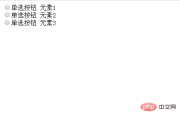
Click the radio button to select. When selected, the selected message will be displayed.

#If you change the radio button to select, the message content will change accordingly.
The above is the detailed content of How to get the selected state of a radio button using JavaScript. For more information, please follow other related articles on the PHP Chinese website!

 JavaScript in Action: Real-World Examples and ProjectsApr 19, 2025 am 12:13 AM
JavaScript's application in the real world includes front-end and back-end development. 1) Display front-end applications by building a TODO list application, involving DOM operations and event processing. 2) Build RESTfulAPI through Node.js and Express to demonstrate back-end applications.
 JavaScript and the Web: Core Functionality and Use CasesApr 18, 2025 am 12:19 AM
The main uses of JavaScript in web development include client interaction, form verification and asynchronous communication. 1) Dynamic content update and user interaction through DOM operations; 2) Client verification is carried out before the user submits data to improve the user experience; 3) Refreshless communication with the server is achieved through AJAX technology.
 Understanding the JavaScript Engine: Implementation DetailsApr 17, 2025 am 12:05 AM
Understanding how JavaScript engine works internally is important to developers because it helps write more efficient code and understand performance bottlenecks and optimization strategies. 1) The engine's workflow includes three stages: parsing, compiling and execution; 2) During the execution process, the engine will perform dynamic optimization, such as inline cache and hidden classes; 3) Best practices include avoiding global variables, optimizing loops, using const and lets, and avoiding excessive use of closures.
 Python vs. JavaScript: The Learning Curve and Ease of UseApr 16, 2025 am 12:12 AM
Python is more suitable for beginners, with a smooth learning curve and concise syntax; JavaScript is suitable for front-end development, with a steep learning curve and flexible syntax. 1. Python syntax is intuitive and suitable for data science and back-end development. 2. JavaScript is flexible and widely used in front-end and server-side programming.
 Python vs. JavaScript: Community, Libraries, and ResourcesApr 15, 2025 am 12:16 AM
Python and JavaScript have their own advantages and disadvantages in terms of community, libraries and resources. 1) The Python community is friendly and suitable for beginners, but the front-end development resources are not as rich as JavaScript. 2) Python is powerful in data science and machine learning libraries, while JavaScript is better in front-end development libraries and frameworks. 3) Both have rich learning resources, but Python is suitable for starting with official documents, while JavaScript is better with MDNWebDocs. The choice should be based on project needs and personal interests.
 From C/C to JavaScript: How It All WorksApr 14, 2025 am 12:05 AM
The shift from C/C to JavaScript requires adapting to dynamic typing, garbage collection and asynchronous programming. 1) C/C is a statically typed language that requires manual memory management, while JavaScript is dynamically typed and garbage collection is automatically processed. 2) C/C needs to be compiled into machine code, while JavaScript is an interpreted language. 3) JavaScript introduces concepts such as closures, prototype chains and Promise, which enhances flexibility and asynchronous programming capabilities.
 JavaScript Engines: Comparing ImplementationsApr 13, 2025 am 12:05 AM
Different JavaScript engines have different effects when parsing and executing JavaScript code, because the implementation principles and optimization strategies of each engine differ. 1. Lexical analysis: convert source code into lexical unit. 2. Grammar analysis: Generate an abstract syntax tree. 3. Optimization and compilation: Generate machine code through the JIT compiler. 4. Execute: Run the machine code. V8 engine optimizes through instant compilation and hidden class, SpiderMonkey uses a type inference system, resulting in different performance performance on the same code.
 Beyond the Browser: JavaScript in the Real WorldApr 12, 2025 am 12:06 AM
JavaScript's applications in the real world include server-side programming, mobile application development and Internet of Things control: 1. Server-side programming is realized through Node.js, suitable for high concurrent request processing. 2. Mobile application development is carried out through ReactNative and supports cross-platform deployment. 3. Used for IoT device control through Johnny-Five library, suitable for hardware interaction.


Hot AI Tools

Undresser.AI Undress
AI-powered app for creating realistic nude photos

AI Clothes Remover
Online AI tool for removing clothes from photos.

Undress AI Tool
Undress images for free

Clothoff.io
AI clothes remover

AI Hentai Generator
Generate AI Hentai for free.

Hot Article
Hot Tools

Dreamweaver Mac version
Visual web development tools

mPDF
mPDF is a PHP library that can generate PDF files from UTF-8 encoded HTML. The original author, Ian Back, wrote mPDF to output PDF files "on the fly" from his website and handle different languages. It is slower than original scripts like HTML2FPDF and produces larger files when using Unicode fonts, but supports CSS styles etc. and has a lot of enhancements. Supports almost all languages, including RTL (Arabic and Hebrew) and CJK (Chinese, Japanese and Korean). Supports nested block-level elements (such as P, DIV),

SublimeText3 Chinese version
Chinese version, very easy to use

WebStorm Mac version
Useful JavaScript development tools

MinGW - Minimalist GNU for Windows
This project is in the process of being migrated to osdn.net/projects/mingw, you can continue to follow us there. MinGW: A native Windows port of the GNU Compiler Collection (GCC), freely distributable import libraries and header files for building native Windows applications; includes extensions to the MSVC runtime to support C99 functionality. All MinGW software can run on 64-bit Windows platforms.

