


 Backend DevelopmentPython TutorialPython crawling method of Anjuke second-hand housing website data sharing
Python crawling method of Anjuke second-hand housing website data sharing

This article mainly brings you a python crawling of Anjuke second-hand housing website data (explanation with examples). The editor thinks it’s pretty good, so I’ll share it with you now and give it as a reference. Let’s follow the editor to take a look, I hope it can help everyone.
Now we will start to officially write the crawler. First, we need to analyze the structure of the website to be crawled: As a student in Henan, let’s take a look at the second-hand housing information in Zhengzhou! 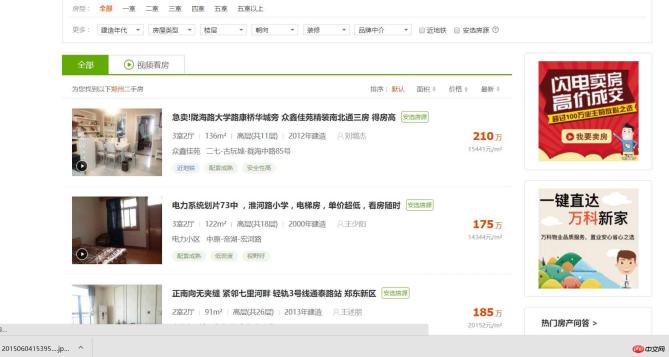
In the above page, we can see the property information one by one. From the above, we can see the property information one by one on the web page. After clicking in, you will find:

Details of the property. OK! So what are we going to do? That is to get all the second-hand housing information in Zhengzhou and save it in the database. What is it used for? As a geographer, it is still somewhat useful. I won’t go into it this time. Okay, let’s officially start. First, I use the requests and BeautifulSoup modules in python3.6 to crawl the page. First, the requests module makes the request:
# 网页的请求头
header = {
'user-agent': 'Mozilla/5.0 (Windows NT 10.0; WOW64) AppleWebKit/537.36 (KHTML, like Gecko) Chrome/60.0.3112.113 Safari/537.36'
}
# url链接
url = 'https://zhengzhou.anjuke.com/sale/'
response = requests.get(url, headers=header)
print(response.text)
After execution, You will get the html code of this website
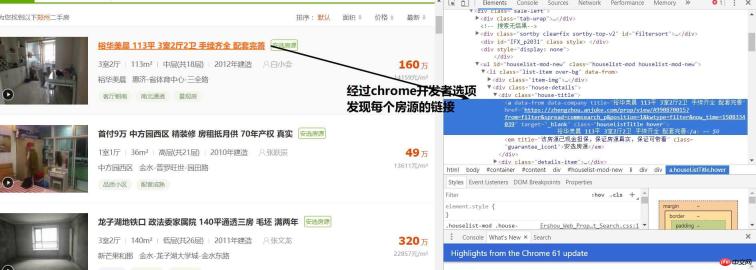
 Through analysis, you can get that each house is in the li tag of class="list-item", then we can proceed based on the BeautifulSoup package Extracting
# 通过BeautifulSoup进行解析出每个房源详细列表并进行打印
soup = BeautifulSoup(response.text, 'html.parser')
result_li = soup.find_all('li', {'class': 'list-item'})
for i in result_li:
  print(i)
can further reduce the amount of code by printing. OK, continue to extract
# 通过BeautifulSoup进行解析出每个房源详细列表并进行打印
soup = BeautifulSoup(response.text, 'html.parser')
result_li = soup.find_all('li', {'class': 'list-item'})
# 进行循环遍历其中的房源详细列表
for i in result_li:
  # 由于BeautifulSoup传入的必须为字符串,所以进行转换
  page_url = str(i)
  soup = BeautifulSoup(page_url, 'html.parser')
  # 由于通过class解析的为一个列表,所以只需要第一个参数
  result_href = soup.find_all('a', {'class': 'houseListTitle'})[0]
  print(result_href.attrs['href'])
. In this way, we You can see the URLs one by one. Do you like it? 
Okay, according to normal logic, you have to enter the page and start analyzing the detailed page, but how to proceed to the next page after crawling? So, we need to first analyze whether the page has a next page
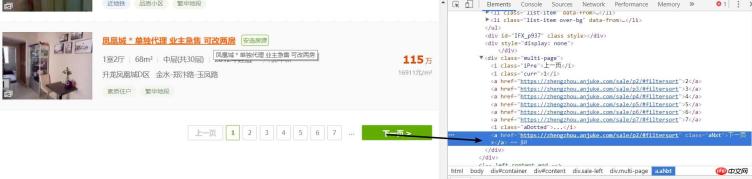
The same method can be used to find that the next page is also so simple, then we You can continue with the original recipe and original taste
# 进行下一页的爬取
result_next_page = soup.find_all('a', {'class': 'aNxt'})
if len(result_next_page) != 0:
  print(result_next_page[0].attrs['href'])
else:
  print('没有下一页了')
Because when the next page exists, there is an a tag in the web page. If not, it will become i tag, so this will do. Therefore, we can improve it and encapsulate the above into a function
import requests
from bs4 import BeautifulSoup

# 网页的请求头
header = {
  'user-agent': 'Mozilla/5.0 (Windows NT 10.0; WOW64) AppleWebKit/537.36 (KHTML, like Gecko) Chrome/60.0.3112.113 Safari/537.36'
}

def get_page(url):
  response = requests.get(url, headers=header)

  # 通过BeautifulSoup进行解析出每个房源详细列表并进行打印
  soup = BeautifulSoup(response.text, 'html.parser')
  result_li = soup.find_all('li', {'class': 'list-item'})

  # 进行下一页的爬取
  result_next_page = soup.find_all('a', {'class': 'aNxt'})
  if len(result_next_page) != 0:
    # 函数进行递归
    get_page(result_next_page[0].attrs['href'])
  else:
    print('没有下一页了')

  # 进行循环遍历其中的房源详细列表
  for i in result_li:
    # 由于BeautifulSoup传入的必须为字符串,所以进行转换
    page_url = str(i)
    soup = BeautifulSoup(page_url, 'html.parser')
    # 由于通过class解析的为一个列表,所以只需要第一个参数
    result_href = soup.find_all('a', {'class': 'houseListTitle'})[0]
    # 先不做分析,等一会进行详细页面函数完成后进行调用
    print(result_href.attrs['href'])


if __name__ == '__main__':
  # url链接
  url = 'https://zhengzhou.anjuke.com/sale/'
  # 页面爬取函数调用
  get_page(url)
Okay, then let’s start the detailed page Crawled
Hey, the power is always cut off, what a trap in the university, I will attach the results first, I will add more when I have free time,
import requests
from bs4 import BeautifulSoup

# 网页的请求头
header = {
  'user-agent': 'Mozilla/5.0 (Windows NT 10.0; WOW64) AppleWebKit/537.36 (KHTML, like Gecko) Chrome/60.0.3112.113 Safari/537.36'
}

def get_page(url):
  response = requests.get(url, headers=header)

  # 通过BeautifulSoup进行解析出每个房源详细列表并进行打印
  soup_idex = BeautifulSoup(response.text, 'html.parser')
  result_li = soup_idex.find_all('li', {'class': 'list-item'})

  # 进行循环遍历其中的房源详细列表
  for i in result_li:
    # 由于BeautifulSoup传入的必须为字符串,所以进行转换
    page_url = str(i)
    soup = BeautifulSoup(page_url, 'html.parser')
    # 由于通过class解析的为一个列表,所以只需要第一个参数
    result_href = soup.find_all('a', {'class': 'houseListTitle'})[0]
    # 详细页面的函数调用
    get_page_detail(result_href.attrs['href'])


  # 进行下一页的爬取
  result_next_page = soup_idex.find_all('a', {'class': 'aNxt'})
  if len(result_next_page) != 0:
    # 函数进行递归
    get_page(result_next_page[0].attrs['href'])
  else:
    print('没有下一页了')

# 进行字符串中空格,换行,tab键的替换及删除字符串两边的空格删除
def my_strip(s):
  return str(s).replace(" ", "").replace("\n", "").replace("\t", "").strip()
# 由于频繁进行BeautifulSoup的使用,封装一下,很鸡肋
def my_Beautifulsoup(response):
  return BeautifulSoup(str(response), 'html.parser')


# 详细页面的爬取
def get_page_detail(url):
  response = requests.get(url, headers=header)
  if response.status_code == 200:
    soup = BeautifulSoup(response.text, 'html.parser')
    # 标题什么的一大堆,哈哈
    result_title = soup.find_all('h3', {'class': 'long-title'})[0]
    result_price = soup.find_all('span', {'class': 'light info-tag'})[0]
    result_house_1 = soup.find_all('p', {'class': 'first-col detail-col'})
    result_house_2 = soup.find_all('p', {'class': 'second-col detail-col'})
    result_house_3 = soup.find_all('p', {'class': 'third-col detail-col'})
    soup_1 = my_Beautifulsoup(result_house_1)
    soup_2 = my_Beautifulsoup(result_house_2)
    soup_3 = my_Beautifulsoup(result_house_3)
    result_house_tar_1 = soup_1.find_all('dd')
    result_house_tar_2 = soup_2.find_all('dd')
    result_house_tar_3 = soup_3.find_all('dd')
    '''
    文博公寓,省实验中学,首付只需70万,大三房,诚心卖,价可谈 270万
    宇泰文博公寓 金水-花园路-文博东路4号 2010年 普通住宅
    3室2厅2卫 140平方米 南北 中层(共32层)
    精装修 19285元/m² 81.00万
    '''
    print(my_strip(result_title.text), my_strip(result_price.text))
    print(my_strip(result_house_tar_1[0].text),
       my_strip(my_Beautifulsoup(result_house_tar_1[1]).find_all('p')[0].text),
       my_strip(result_house_tar_1[2].text), my_strip(result_house_tar_1[3].text))
    print(my_strip(result_house_tar_2[0].text), my_strip(result_house_tar_2[1].text),
       my_strip(result_house_tar_2[2].text), my_strip(result_house_tar_2[3].text))
    print(my_strip(result_house_tar_3[0].text), my_strip(result_house_tar_3[1].text),
       my_strip(result_house_tar_3[2].text))

if __name__ == '__main__':
  # url链接
  url = 'https://zhengzhou.anjuke.com/sale/'
  # 页面爬取函数调用
  get_page(url)
Since I wrote the code while blogging, I made some changes in the get_page function, that is, the recursive call for the next page needs to be placed after the function, and the two functions are encapsulated without introduction,
And the data is not written to mysql, so I will continue to follow up later, thank you!!!
Related recommendations:
python crawling article example tutorial
10 recommended articles about python crawling
Share a Python method to crawl popular comments on NetEase Cloud Music
The above is the detailed content of Python crawling method of Anjuke second-hand housing website data sharing. For more information, please follow other related articles on the PHP Chinese website!

 Learning Python: Is 2 Hours of Daily Study Sufficient?Apr 18, 2025 am 12:22 AM
Is it enough to learn Python for two hours a day? It depends on your goals and learning methods. 1) Develop a clear learning plan, 2) Select appropriate learning resources and methods, 3) Practice and review and consolidate hands-on practice and review and consolidate, and you can gradually master the basic knowledge and advanced functions of Python during this period.
 Python for Web Development: Key ApplicationsApr 18, 2025 am 12:20 AM
Key applications of Python in web development include the use of Django and Flask frameworks, API development, data analysis and visualization, machine learning and AI, and performance optimization. 1. Django and Flask framework: Django is suitable for rapid development of complex applications, and Flask is suitable for small or highly customized projects. 2. API development: Use Flask or DjangoRESTFramework to build RESTfulAPI. 3. Data analysis and visualization: Use Python to process data and display it through the web interface. 4. Machine Learning and AI: Python is used to build intelligent web applications. 5. Performance optimization: optimized through asynchronous programming, caching and code
 Python vs. C : Exploring Performance and EfficiencyApr 18, 2025 am 12:20 AM
Python is better than C in development efficiency, but C is higher in execution performance. 1. Python's concise syntax and rich libraries improve development efficiency. 2.C's compilation-type characteristics and hardware control improve execution performance. When making a choice, you need to weigh the development speed and execution efficiency based on project needs.
 Python in Action: Real-World ExamplesApr 18, 2025 am 12:18 AM
Python's real-world applications include data analytics, web development, artificial intelligence and automation. 1) In data analysis, Python uses Pandas and Matplotlib to process and visualize data. 2) In web development, Django and Flask frameworks simplify the creation of web applications. 3) In the field of artificial intelligence, TensorFlow and PyTorch are used to build and train models. 4) In terms of automation, Python scripts can be used for tasks such as copying files.
 Python's Main Uses: A Comprehensive OverviewApr 18, 2025 am 12:18 AM
Python is widely used in data science, web development and automation scripting fields. 1) In data science, Python simplifies data processing and analysis through libraries such as NumPy and Pandas. 2) In web development, the Django and Flask frameworks enable developers to quickly build applications. 3) In automated scripts, Python's simplicity and standard library make it ideal.
 The Main Purpose of Python: Flexibility and Ease of UseApr 17, 2025 am 12:14 AM
Python's flexibility is reflected in multi-paradigm support and dynamic type systems, while ease of use comes from a simple syntax and rich standard library. 1. Flexibility: Supports object-oriented, functional and procedural programming, and dynamic type systems improve development efficiency. 2. Ease of use: The grammar is close to natural language, the standard library covers a wide range of functions, and simplifies the development process.
 Python: The Power of Versatile ProgrammingApr 17, 2025 am 12:09 AM
Python is highly favored for its simplicity and power, suitable for all needs from beginners to advanced developers. Its versatility is reflected in: 1) Easy to learn and use, simple syntax; 2) Rich libraries and frameworks, such as NumPy, Pandas, etc.; 3) Cross-platform support, which can be run on a variety of operating systems; 4) Suitable for scripting and automation tasks to improve work efficiency.
 Learning Python in 2 Hours a Day: A Practical GuideApr 17, 2025 am 12:05 AM
Yes, learn Python in two hours a day. 1. Develop a reasonable study plan, 2. Select the right learning resources, 3. Consolidate the knowledge learned through practice. These steps can help you master Python in a short time.


Hot AI Tools

Undresser.AI Undress
AI-powered app for creating realistic nude photos

AI Clothes Remover
Online AI tool for removing clothes from photos.

Undress AI Tool
Undress images for free

Clothoff.io
AI clothes remover

AI Hentai Generator
Generate AI Hentai for free.

Hot Article
Hot Tools

WebStorm Mac version
Useful JavaScript development tools

Atom editor mac version download
The most popular open source editor

DVWA
Damn Vulnerable Web App (DVWA) is a PHP/MySQL web application that is very vulnerable. Its main goals are to be an aid for security professionals to test their skills and tools in a legal environment, to help web developers better understand the process of securing web applications, and to help teachers/students teach/learn in a classroom environment Web application security. The goal of DVWA is to practice some of the most common web vulnerabilities through a simple and straightforward interface, with varying degrees of difficulty. Please note that this software

SublimeText3 English version
Recommended: Win version, supports code prompts!

SublimeText3 Mac version
God-level code editing software (SublimeText3)

