



This article mainly introduces the js event loop mechanism, and analyzes js usage and techniques through examples. Let's learn and share together. I hope everyone can use the js event loop mechanism.
var start = new Date()
setTimeout(function () {
 var end = new Date
 console.log('Time elapsed:', end - start, 'ms')
}, 500)
while (new Date() - start < 1000) {
}
Are there any other languages that can accomplish the desired function? Java, in Java.util.Timer, the solution to scheduled tasks is implemented through multi-threading. The task object is stored in the task queue, and a dedicated scheduling thread completes the execution of the task in a new sub-thread
js is single-threaded
The main purpose of JavaScript is to interact with users and manipulate the DOM. This determines that it can only be single-threaded, otherwise it will cause very complex synchronization problems.
In order to take advantage of the computing power of multi-core CPUs, HTML5 proposes the Web Worker standard, which allows JavaScript scripts to create multiple threads, but the child threads are completely controlled by the main thread and are not allowed to operate the DOM. Therefore, this new standard does not change the single-threaded nature of JavaScript.
Function call stack and task queue
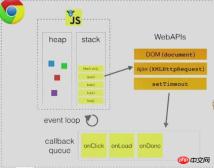
Call stack
A call will be formed when JS is executed Stack. When a function is called, the return address, parameters, and local variables will be pushed onto the stack. If another function is called in the currently running function, the relevant content of the function will also be pushed onto the top of the stack. The function is executed. , the call stack will be popped. The variables will also be popped. Since complex type values are stored in the heap, only pointers are popped. Their values are still in the heap and are recycled by the GC.
Event Loop (event loop) & task queue (task queue)
JavaScript main thread has an execution stack and a task queue
When encountering an asynchronous operation (for example: setTimeout, AJAX), Asynchronous operations will be executed by the browser (OS). After these tasks are completed, the browser will push the predefined callback function into the task queue of the main thread. When the execution stack of the main thread is cleared, the task will be read. The callback function in the queue, when the task queue is read, the main thread continues to execute, thus entering an infinite loop, which is the event loop.
The main thread execution stack & task queue loop execution constitutes an event Loop
Conclusion
setTimeout() just inserts the event into the "task queue". It must wait until the current code (execution stack) is completed before the main thread Will execute the callback function it specifies. If the current code takes a long time, it may take a long time, so there is no way to guarantee that the callback function will be executed at the time specified by setTimeout().
Another example
(function test() {
 setTimeout(function() {console.log(4)}, 0);
 new Promise(function executor(resolve) {
 console.log(1);
 for( var i=0 ; i<10000 ; i++ ) {
 i == 9999 && resolve();
 }
 console.log(2);
 }).then(function() {
 console.log(5);
 });
 console.log(3);
})()
##Macrotask & Microtask
micro-task: process.nextTick, Promises (here refers to the native Promise implemented by the browser) , Object.observe, MutationObserver

Conclusion
process.nextTick(function A() {
 console.log(1);
 process.nextTick(function B(){console.log(2);});
});
setTimeout(function timeout() {
 console.log('TIMEOUT FIRED');
}, 0)
new Promise(function(resolve) {
 console.log('glob1_promise');
 resolve();
}).then(function() {
 console.log('glob1_then')
})
process.nextTick(function() {
 console.log('glob1_nextTick');
})
Related recommendations:
Front-end Advanced (Twelve): Detailed explanation of the event loop mechanism
##js Specific method to change div color in a loop_javascript skillsNode.js event loop tutorialThe above is the detailed content of js event loop mechanism example analysis. For more information, please follow other related articles on the PHP Chinese website!

 Python vs. JavaScript: The Learning Curve and Ease of UseApr 16, 2025 am 12:12 AM
Python is more suitable for beginners, with a smooth learning curve and concise syntax; JavaScript is suitable for front-end development, with a steep learning curve and flexible syntax. 1. Python syntax is intuitive and suitable for data science and back-end development. 2. JavaScript is flexible and widely used in front-end and server-side programming.
 Python vs. JavaScript: Community, Libraries, and ResourcesApr 15, 2025 am 12:16 AM
Python and JavaScript have their own advantages and disadvantages in terms of community, libraries and resources. 1) The Python community is friendly and suitable for beginners, but the front-end development resources are not as rich as JavaScript. 2) Python is powerful in data science and machine learning libraries, while JavaScript is better in front-end development libraries and frameworks. 3) Both have rich learning resources, but Python is suitable for starting with official documents, while JavaScript is better with MDNWebDocs. The choice should be based on project needs and personal interests.
 From C/C to JavaScript: How It All WorksApr 14, 2025 am 12:05 AM
The shift from C/C to JavaScript requires adapting to dynamic typing, garbage collection and asynchronous programming. 1) C/C is a statically typed language that requires manual memory management, while JavaScript is dynamically typed and garbage collection is automatically processed. 2) C/C needs to be compiled into machine code, while JavaScript is an interpreted language. 3) JavaScript introduces concepts such as closures, prototype chains and Promise, which enhances flexibility and asynchronous programming capabilities.
 JavaScript Engines: Comparing ImplementationsApr 13, 2025 am 12:05 AM
Different JavaScript engines have different effects when parsing and executing JavaScript code, because the implementation principles and optimization strategies of each engine differ. 1. Lexical analysis: convert source code into lexical unit. 2. Grammar analysis: Generate an abstract syntax tree. 3. Optimization and compilation: Generate machine code through the JIT compiler. 4. Execute: Run the machine code. V8 engine optimizes through instant compilation and hidden class, SpiderMonkey uses a type inference system, resulting in different performance performance on the same code.
 Beyond the Browser: JavaScript in the Real WorldApr 12, 2025 am 12:06 AM
JavaScript's applications in the real world include server-side programming, mobile application development and Internet of Things control: 1. Server-side programming is realized through Node.js, suitable for high concurrent request processing. 2. Mobile application development is carried out through ReactNative and supports cross-platform deployment. 3. Used for IoT device control through Johnny-Five library, suitable for hardware interaction.
 Building a Multi-Tenant SaaS Application with Next.js (Backend Integration)Apr 11, 2025 am 08:23 AM
I built a functional multi-tenant SaaS application (an EdTech app) with your everyday tech tool and you can do the same. First, what’s a multi-tenant SaaS application? Multi-tenant SaaS applications let you serve multiple customers from a sing
 How to Build a Multi-Tenant SaaS Application with Next.js (Frontend Integration)Apr 11, 2025 am 08:22 AM
This article demonstrates frontend integration with a backend secured by Permit, building a functional EdTech SaaS application using Next.js. The frontend fetches user permissions to control UI visibility and ensures API requests adhere to role-base
 JavaScript: Exploring the Versatility of a Web LanguageApr 11, 2025 am 12:01 AM
JavaScript is the core language of modern web development and is widely used for its diversity and flexibility. 1) Front-end development: build dynamic web pages and single-page applications through DOM operations and modern frameworks (such as React, Vue.js, Angular). 2) Server-side development: Node.js uses a non-blocking I/O model to handle high concurrency and real-time applications. 3) Mobile and desktop application development: cross-platform development is realized through ReactNative and Electron to improve development efficiency.


Hot AI Tools

Undresser.AI Undress
AI-powered app for creating realistic nude photos

AI Clothes Remover
Online AI tool for removing clothes from photos.

Undress AI Tool
Undress images for free

Clothoff.io
AI clothes remover

AI Hentai Generator
Generate AI Hentai for free.

Hot Article
Hot Tools

Dreamweaver Mac version
Visual web development tools

PhpStorm Mac version
The latest (2018.2.1) professional PHP integrated development tool

SublimeText3 English version
Recommended: Win version, supports code prompts!

DVWA
Damn Vulnerable Web App (DVWA) is a PHP/MySQL web application that is very vulnerable. Its main goals are to be an aid for security professionals to test their skills and tools in a legal environment, to help web developers better understand the process of securing web applications, and to help teachers/students teach/learn in a classroom environment Web application security. The goal of DVWA is to practice some of the most common web vulnerabilities through a simple and straightforward interface, with varying degrees of difficulty. Please note that this software

mPDF
mPDF is a PHP library that can generate PDF files from UTF-8 encoded HTML. The original author, Ian Back, wrote mPDF to output PDF files "on the fly" from his website and handle different languages. It is slower than original scripts like HTML2FPDF and produces larger files when using Unicode fonts, but supports CSS styles etc. and has a lot of enhancements. Supports almost all languages, including RTL (Arabic and Hebrew) and CJK (Chinese, Japanese and Korean). Supports nested block-level elements (such as P, DIV),

