



In general development, I often see that many students only use some basic methods in dealing with the Java concurrent development model. For example, Volatile, synchronized. Advanced concurrency packages like Lock and atomic are not often used by many people. I think most of the reasons are caused by the lack of attributes of the principle. In busy development work, who can accurately grasp and use the correct concurrency model? So based on this idea recently, I plan to organize this part of the concurrency control mechanism into an article. It is not only a memory of the knowledge I have mastered, but also I hope that the content mentioned in this article can help most developers. Parallel program development inevitably involves issues such as multi-threading, multi-task collaboration and data sharing. In the JDK, multiple ways are provided to achieve concurrency control between multiple threads. For example, commonly used ones: internal locks, reentrant locks, read-write locks and semaphores. Java memory model In Java, each thread has a working memory area, which stores a copy of the value of the variable in the main memory shared by all threads. When a thread executes, it operates on these variables in its own working memory. In order to access a shared variable, a thread usually first
1. Java concurrency control mechanism detailed explanation

Introduction: In general development, I often see that many students only use some basic methods in dealing with the Java concurrent development model. For example, Volatile, synchronized. Advanced concurrency packages like Lock and atomic are not often used by many people. I think most of the reasons are caused by the lack of attributes of the principle. In the busy development work, who can accurately grasp and use the correct concurrency model
2. Use PHP's OOP features to achieve data protection (1)

Introduction: In PHP 4, var is usually used to declare variables, but in PHP 5, you can use The feature of object-oriented programming (OOP) comes from customizing the visibility of data - that is, accessibility. Visibility here is very similar to variable scope, but provides a better control mechanism. There are the following three types of visibility modifications Symbol:
3. PHP object-oriented access type control
Introduction: public, protected, private A modifier is an access control mechanism introduced in PHP5. By using modifiers, developers can restrict access to members in a class. Literally, these three modifiers are translated into Chinese as public, protected, and private. Let's use code examples to see how public, protected, and private restrict members in a class. Public
4. High-speed development of php applications with cakephp - user and permission control
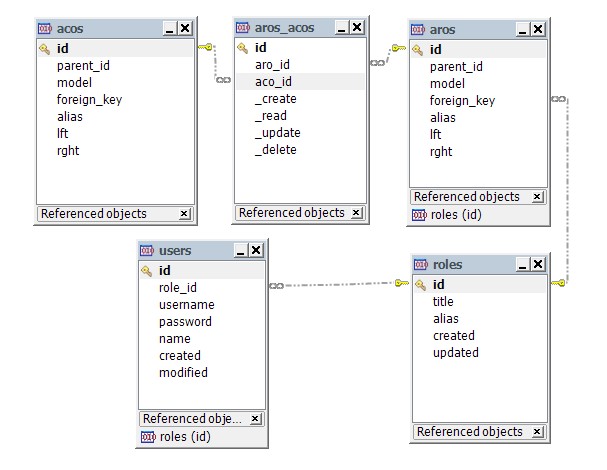
##Introduction: Use cakephp to quickly develop php applications - user and permission control The cakephp framework provides a set of Acl-based access control mechanisms. By using the AuthComponent and AclComponent components, you can quickly implement permission control. ? Permission design based on access control list As can be seen from the ER diagram above, the business object of the aro object is role (role, which is the same concept as group). In the database data, there is no control of
##5.High-speed development of php applications with cakephp - user and permission control
 ##Introduction: Use cakephp to quickly develop php applications - user and permission control The cakephp framework provides a set of Acl-based access control mechanisms. By using the AuthComponent and AclComponent components, you can quickly implement permission control. ?Permission design based on access control list As can be seen from the ER diagram above, the business object of the aro object is role (role and group are the same concept). In the database data, there is no aco operation
##6. Summary of the basic concepts of transactions and locks in sqlserver
Introduction: .1 Basic concepts Concurrency control: Mainly considering the situation where multiple users access the same data in the database at the same time. SQL Server is designed with two concurrent access control mechanisms: locks and row version control. Lock: Mainly used to ensure database integrity and consistency in a multi-user environment. Each transaction will request different types of locks for the resources it depends on, which can prevent it 7. Account scheme system role takes a multi-pronged approach to ensure the security of Oracle Introduction: Account is a name defined in the database system, which is the basic access control mechanism of the database. When connecting to an Oracle database, like other databases, user 8 is required. Oracle Database Writing Effective Transaction Guidelines Introduction: In the Oracle database, a control mechanism called "transaction" is provided. Through things, effective and safe modification operations on data can be completed, making the database Introduction: MySQL Lab 1.? Concurrency and isolation control mechanism in MySQL Meta-data metadata lock: implemented in the table cache cache , providing isolation operations for DDL (Data Definition Language). A special meta-data metadata type called Name Lock. (SQL layer) Table-level data lock (SQL layer) Storage engine-specific mechanism ro 10. Redis source code learning-AOF Introduction: Preface There are many articles on the Internet that introduce the AOF mechanism of redis, but they introduce the AOF process from a macro perspective and there is no specific analysis. The data structures and control mechanisms involved in the AOF process. I especially looked at the 2.8 source code last night, and I feel that many details in the source code are worthy of careful study. Especially the list *aof_rewrite_buf_blocks structure. If you look at the source code carefully, you will find [Related Q&A recommendations]: How does the security control mechanism of MySQL database work? 

The above is the detailed content of 10 recommended courses on control mechanisms. For more information, please follow other related articles on the PHP Chinese website!

 PHP: An Introduction to the Server-Side Scripting LanguageApr 16, 2025 am 12:18 AM
PHP is a server-side scripting language used for dynamic web development and server-side applications. 1.PHP is an interpreted language that does not require compilation and is suitable for rapid development. 2. PHP code is embedded in HTML, making it easy to develop web pages. 3. PHP processes server-side logic, generates HTML output, and supports user interaction and data processing. 4. PHP can interact with the database, process form submission, and execute server-side tasks.
 PHP and the Web: Exploring its Long-Term ImpactApr 16, 2025 am 12:17 AM
PHP has shaped the network over the past few decades and will continue to play an important role in web development. 1) PHP originated in 1994 and has become the first choice for developers due to its ease of use and seamless integration with MySQL. 2) Its core functions include generating dynamic content and integrating with the database, allowing the website to be updated in real time and displayed in personalized manner. 3) The wide application and ecosystem of PHP have driven its long-term impact, but it also faces version updates and security challenges. 4) Performance improvements in recent years, such as the release of PHP7, enable it to compete with modern languages. 5) In the future, PHP needs to deal with new challenges such as containerization and microservices, but its flexibility and active community make it adaptable.
 Why Use PHP? Advantages and Benefits ExplainedApr 16, 2025 am 12:16 AM
The core benefits of PHP include ease of learning, strong web development support, rich libraries and frameworks, high performance and scalability, cross-platform compatibility, and cost-effectiveness. 1) Easy to learn and use, suitable for beginners; 2) Good integration with web servers and supports multiple databases; 3) Have powerful frameworks such as Laravel; 4) High performance can be achieved through optimization; 5) Support multiple operating systems; 6) Open source to reduce development costs.
 Debunking the Myths: Is PHP Really a Dead Language?Apr 16, 2025 am 12:15 AM
PHP is not dead. 1) The PHP community actively solves performance and security issues, and PHP7.x improves performance. 2) PHP is suitable for modern web development and is widely used in large websites. 3) PHP is easy to learn and the server performs well, but the type system is not as strict as static languages. 4) PHP is still important in the fields of content management and e-commerce, and the ecosystem continues to evolve. 5) Optimize performance through OPcache and APC, and use OOP and design patterns to improve code quality.
 The PHP vs. Python Debate: Which is Better?Apr 16, 2025 am 12:03 AM
PHP and Python have their own advantages and disadvantages, and the choice depends on the project requirements. 1) PHP is suitable for web development, easy to learn, rich community resources, but the syntax is not modern enough, and performance and security need to be paid attention to. 2) Python is suitable for data science and machine learning, with concise syntax and easy to learn, but there are bottlenecks in execution speed and memory management.
 PHP's Purpose: Building Dynamic WebsitesApr 15, 2025 am 12:18 AM
PHP is used to build dynamic websites, and its core functions include: 1. Generate dynamic content and generate web pages in real time by connecting with the database; 2. Process user interaction and form submissions, verify inputs and respond to operations; 3. Manage sessions and user authentication to provide a personalized experience; 4. Optimize performance and follow best practices to improve website efficiency and security.
 PHP: Handling Databases and Server-Side LogicApr 15, 2025 am 12:15 AM
PHP uses MySQLi and PDO extensions to interact in database operations and server-side logic processing, and processes server-side logic through functions such as session management. 1) Use MySQLi or PDO to connect to the database and execute SQL queries. 2) Handle HTTP requests and user status through session management and other functions. 3) Use transactions to ensure the atomicity of database operations. 4) Prevent SQL injection, use exception handling and closing connections for debugging. 5) Optimize performance through indexing and cache, write highly readable code and perform error handling.
 How do you prevent SQL Injection in PHP? (Prepared statements, PDO)Apr 15, 2025 am 12:15 AM
Using preprocessing statements and PDO in PHP can effectively prevent SQL injection attacks. 1) Use PDO to connect to the database and set the error mode. 2) Create preprocessing statements through the prepare method and pass data using placeholders and execute methods. 3) Process query results and ensure the security and performance of the code.


Hot AI Tools

Undresser.AI Undress
AI-powered app for creating realistic nude photos

AI Clothes Remover
Online AI tool for removing clothes from photos.

Undress AI Tool
Undress images for free

Clothoff.io
AI clothes remover

AI Hentai Generator
Generate AI Hentai for free.

Hot Article
Hot Tools

VSCode Windows 64-bit Download
A free and powerful IDE editor launched by Microsoft

DVWA
Damn Vulnerable Web App (DVWA) is a PHP/MySQL web application that is very vulnerable. Its main goals are to be an aid for security professionals to test their skills and tools in a legal environment, to help web developers better understand the process of securing web applications, and to help teachers/students teach/learn in a classroom environment Web application security. The goal of DVWA is to practice some of the most common web vulnerabilities through a simple and straightforward interface, with varying degrees of difficulty. Please note that this software

SublimeText3 Linux new version
SublimeText3 Linux latest version

Dreamweaver CS6
Visual web development tools

MantisBT
Mantis is an easy-to-deploy web-based defect tracking tool designed to aid in product defect tracking. It requires PHP, MySQL and a web server. Check out our demo and hosting services.

