



I recently looked at the code of Redis and it seems quite simple. I have the urge to implement (copy) one in other languages. Originally I wanted to use Python to implement it. Then I thought about trying Netty. There are two reasons
First: Java The combination of NIO and Netty's EventLoop is very close to the Redis network model. They are both Ractor models. Even the Redis model is simpler - there is only one EventLoop thread. It is more convenient to write (copy)
Second: Netty architecture is quite good .Take this opportunity to learn.
If we look at Redis Server from a very abstract (simple) perspective, it is a program that listens on 6379. It is essentially a Hashtable that processes single-line requests. And the Redis protocol is also very, very Simple. Much simpler than the http protocol.
The following is the general form of this protocol:
*<参数数量> CR LF
$<参数 1 的字节数量> CR LF<参数 1 的数据> CR LF
...
$<参数 N 的字节数量> CR LF<参数 N 的数据> CR LF
This is basically a very simple finite state machine.
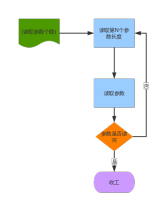
So I set 3 for our command parser state.
public enum State {
    NUMBER_OF_ARGS,
    NUMBER_BYTE_OF_ARGS,
    ARGS_DATA
}
We set the initial state to NUMBER_OF_ARGS, which is the green state. When data arrives, we constantly judge the state of the program. Which state is it and what do we do.
while(true){    switch (state()){        case NUMBER_OF_ARGS:
            //从当前数据中读取参数个数
            break;        case NUMBER_BYTE_OF_ARGS:
            //从数据中读取参数长度
            break;        case ARGS_DATA:
            //按参数长度读取参数
            //判断参数个数.如果到了最后一个.则跳出,否则状态转回NUMBER_BYTE_OF_ARGS
            break;
    }
}
Next we press Let’s implement the above idea.
package me.yunanw.redisinjava;
import io.netty.buffer.ByteBuf;
import io.netty.channel.ChannelHandlerContext;
import io.netty.handler.codec.DecoderException;
import io.netty.handler.codec.ReplayingDecoder;import java.util.List;
/**
 * Created by yunanw on 2016/10/15.
 */
 public class CommandDecoder extends ReplayingDecoder {
 public enum State {
        NUMBER_OF_ARGS,
        NUMBER_BYTE_OF_ARGS,
        ARGS_DATA
    }
    static final char CR = '\r';
    static final char LF = '\n';
    public CommandDecoder(){

        state(State.NUMBER_OF_ARGS);
    }
    protected void decode(ChannelHandlerContext channelHandlerContext, ByteBuf byteBuf, List list) throws Exception {
        RedisFrame frame = doDecode(channelHandlerContext,byteBuf,list);
        if (frame != null){
            list.add(frame);
        }
    }
    private RedisFrame doDecode(ChannelHandlerContext channelHandlerContext, ByteBuf byteBuf, List list) throws Exception {
        RedisFrame frame = null;
        int currentArgsLen = 0;
        int argsCount = 0;
        while(true){
        switch (state()){
        case NUMBER_OF_ARGS:
        if (byteBuf.readByte() != '*'){
        throw new DecoderException("can not found *");
                    }
                    argsCount = parseRedisNumber(byteBuf);
                    frame = new RedisFrame(argsCount);
                    checkpoint(State.NUMBER_BYTE_OF_ARGS);
                    break;
                    case NUMBER_BYTE_OF_ARGS:
                    if (byteBuf.readByte() != '$'){
                    throw new DecoderException("can not found $");
                    }
                    currentArgsLen = parseRedisNumber(byteBuf);
                    checkpoint(State.ARGS_DATA);;
                    break;
                    case ARGS_DATA:
                    frame.AppendArgs(byteBuf.readBytes(currentArgsLen).array());
                    if (byteBuf.readByte() != CR || byteBuf.readByte() != LF)
                    throw new DecoderException("can not found CR OR LF");
                    if ((--argsCount) = 0 && digit < 10)
                     {
                result = (result * 10) + digit;
            } else {
            throw new DecoderException("Invalid character in integer");
            }
        } while ((readByte = byteBuf.readByte()) != CR);
        if ((readByte = byteBuf.readByte()) != LF)
        {
        throw new DecoderException("can not found LF");
        }
        return (negative? -result:result);
    }

}
There is a small problem when writing here. If you understand the above code, you will find a small problem. If due to network reasons, sometimes the data may not be received completely. And our code We haven’t considered this aspect at all? And what the hell is Checkpoint?
First question:
In fact, we have considered this issue. So we inherited a relatively special Decoder--ReplayingDecoder. Let’s take a look at ReplayingDecoder CallDecode method. (The name is very straightforward. You must understand what it does)
</p><pre class="brush:java;toolbar:false">
try {
    decode(ctx, replayable, out);
    //省略} catch (Signal replay) {
    replay.expect(REPLAY);     //省略
    // Return to the checkpoint (or oldPosition) and retry.
    int checkpoint = this.checkpoint;
    if (checkpoint >= 0) {
    in.readerIndex(checkpoint);
    } else {
    // Called by cleanup() - no need to maintain the readerIndex
        // anymore because the buffer has been released already.
    }
    break;
}
Signal replay is an error defined in Netty. When we read the error, Netty will wait until the next time there is When the data arrives, try the Decode method again to see if it can be parsed successfully. So we can assume that all the data we want has been read.
But be careful: the decode method of replaydecoder will be called repeatedly.. So We must be prepared for this in our code.
2: CheckPoint is a state set to prevent it from being executed from the beginning every time Decode is called repeatedly. Let our decode method have a state.
Okay. Now we Create the code for the monitoring part. These are all sets, just copy them down
</p><pre class="brush:java;toolbar:false">
ServerBootstrap bootstrap = new ServerBootstrap();
final DefaultEventExecutorGroup group = new DefaultEventExecutorGroup(1);
try {
    bootstrap.group(new NioEventLoopGroup(), new NioEventLoopGroup())
            .channel(NioServerSocketChannel.class)
            .option(ChannelOption.SO_BACKLOG, 100)
            .localAddress(port)
            .childOption(ChannelOption.TCP_NODELAY, true)
            .childHandler(new ChannelInitializer() {
                @Override
                public void initChannel(SocketChannel ch) throws Exception {
                    ChannelPipeline p = ch.pipeline();
                    p.addLast(new CommandDecoder());
                    p.addLast(new RedisServerHandler());
                }
            });
            // Start the server.
    ChannelFuture f = bootstrap.bind().sync();
    // Wait until the server socket is closed.
    f.channel().closeFuture().sync();
} finally {
// Shut down all event loops to terminate all threads.
    group.shutdownGracefully();
}
We parse the Redis protocol into the RedisFrame class
</p><pre class="brush:java;toolbar:false">
package me.yunanw.redisinjava;import java.util.ArrayList;import java.util.List;
/**
 * Created by yunanw on 2016/10/17.
 */
 public class RedisFrame {
 private int argsCount = 0;
    List ArgsData = null;
    public RedisFrame(int argsCount){
    this.argsCount = argsCount;
    this.ArgsData = new ArrayList(argsCount);

    }    public void AppendArgs(byte[] args){
    this.ArgsData.add(new String(args));
    }    public int getCommandCount(){
    return ArgsData.size();
    }    public String GetFristCommand(){
    if (ArgsData.size() > 0){
    return ArgsData.get(0);
        }
        return null;
    }
    public String GetCommand(int index){
    if (ArgsData.size() > index){
    return ArgsData.get(index);
        }
        return null;
    }
}
Okay. Now you open Redis-cli and try to see if you can connect to us "Fake Redis" Server. What's interesting is that - when you open Redis-cli, it will automatically send a "Command" command. No matter what you reply, it will think it is connected

Hot AI Tools

Undresser.AI Undress
AI-powered app for creating realistic nude photos

AI Clothes Remover
Online AI tool for removing clothes from photos.

Undress AI Tool
Undress images for free

Clothoff.io
AI clothes remover

AI Hentai Generator
Generate AI Hentai for free.

Hot Article
Hot Tools

SecLists
SecLists is the ultimate security tester's companion. It is a collection of various types of lists that are frequently used during security assessments, all in one place. SecLists helps make security testing more efficient and productive by conveniently providing all the lists a security tester might need. List types include usernames, passwords, URLs, fuzzing payloads, sensitive data patterns, web shells, and more. The tester can simply pull this repository onto a new test machine and he will have access to every type of list he needs.

Atom editor mac version download
The most popular open source editor

DVWA
Damn Vulnerable Web App (DVWA) is a PHP/MySQL web application that is very vulnerable. Its main goals are to be an aid for security professionals to test their skills and tools in a legal environment, to help web developers better understand the process of securing web applications, and to help teachers/students teach/learn in a classroom environment Web application security. The goal of DVWA is to practice some of the most common web vulnerabilities through a simple and straightforward interface, with varying degrees of difficulty. Please note that this software

mPDF
mPDF is a PHP library that can generate PDF files from UTF-8 encoded HTML. The original author, Ian Back, wrote mPDF to output PDF files "on the fly" from his website and handle different languages. It is slower than original scripts like HTML2FPDF and produces larger files when using Unicode fonts, but supports CSS styles etc. and has a lot of enhancements. Supports almost all languages, including RTL (Arabic and Hebrew) and CJK (Chinese, Japanese and Korean). Supports nested block-level elements (such as P, DIV),

SAP NetWeaver Server Adapter for Eclipse
Integrate Eclipse with SAP NetWeaver application server.

