


 Web Front-endJS TutorialUnderstanding Javascript_01_Understanding memory allocation principle analysis_javascript skills
Understanding Javascript_01_Understanding memory allocation principle analysis_javascript skills

In ECMAScript, variables can store two types of values, namely primitive values and reference values.
Primitive values refer to values representing primitive data types (basic data types), that is, values represented by Undefined, Null, Number, String, and Boolean types.
Reference values refer to values of composite data types, that is, Object, Function, Array, and custom objects, etc.
Stack and heap
are the same as original values The reference value corresponds to two structures of memory, namely the stack and the heap
The stack is a last-in-first-out data structure. In JavaScript, the behavior of the stack can be simulated through Array
var arr = []; //Create a stack
arr.push("apple");/ /Push the element "apple" ["apple"]
arr.push("orange"); //Push the element "orange" ["apple","orange"]
arr.pop(); //Pop up "orange" ["apple"]
arr.push("banana");//Push in the element "banana" ["apple","banana"]
us Let's take a look at the corresponding memory map:
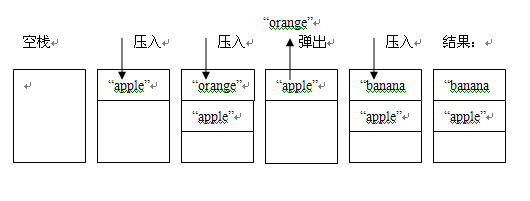
The original values are simple data segments stored on the stack, that is, their values are stored directly at the location of the variable access.
The heap is a data structure based on a hash algorithm that stores data. In JavaScript, reference values are stored in the heap.
The reference value is the object stored in the heap, that is, the value stored at the variable (i.e. the variable pointing to the object, stored in the stack) is a pointer pointing to the actual object stored in the heap.
Example: var obj = new Object(); obj is stored in the stack and points to the object new Object(), which is stored in the heap.
Then why are the reference values placed on the heap and the original values on the stack? Aren’t they both in memory? Why not put them together? Then, let’s explore the answer to the question!
First, let’s take a look at the code:
function Person(id,name,age){
this.id = id;
this.name = name;
this.age = age;
}
var num = 10;
var bol = true;
var str = "abc";
var obj = new Object();
var arr = ['a','b','c'];
var person = new Person(100,"jxl",22);
Then let’s take a look at the memory analysis diagram:
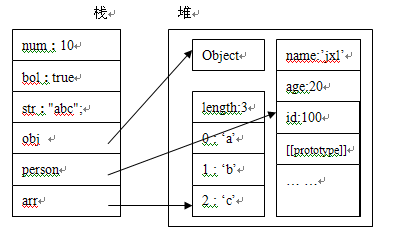
The variables num, bol, str are basic Data types and their values are stored directly on the stack. obj, person, and arr are composite data types. Their reference variables are stored on the stack and point to the actual objects stored in the heap.
As can be seen from the above figure, we cannot directly manipulate the data in the heap, which means that we cannot directly manipulate the object, but we can manipulate the object through the reference to the object in the stack, just like we operate through a remote control It's the same as a TV, but the difference is that the TV itself doesn't have control buttons.
Now let us answer the question of why the reference value is placed on the heap and the original value is placed on the stack:
Remember one sentence: energy is conserved , it’s nothing more than a matter of time exchanging space, and space exchanging time.
The heap is larger than the stack, and the stack operates faster than the heap. The object is a complex structure and can be expanded freely. For example, arrays can be expanded infinitely. Objects can freely add properties. They are placed on the heap so as not to affect the efficiency of the stack. Instead, the actual object in the heap is found through reference and then operated. Compared with simple data types, simple data types are relatively stable and occupy only a small amount of memory. The reason why simple data types are not placed on the heap is because it takes time to find the actual object in the heap by reference, and this comprehensive cost is much greater than the cost of obtaining the actual value directly from the stack. So values of simple data types are stored directly on the stack.
Summary:
The program is very simple, but it is the foundation of everything. The foundation is the most important, because skyscrapers are also built brick by brick.
Memory is the foundation for program execution. Understanding memory means understanding everything.
This is your hard work, encourage yourself, come on!
Reference:
JavaScript Advanced Programming

 Python vs. JavaScript: Use Cases and Applications ComparedApr 21, 2025 am 12:01 AM
Python is more suitable for data science and automation, while JavaScript is more suitable for front-end and full-stack development. 1. Python performs well in data science and machine learning, using libraries such as NumPy and Pandas for data processing and modeling. 2. Python is concise and efficient in automation and scripting. 3. JavaScript is indispensable in front-end development and is used to build dynamic web pages and single-page applications. 4. JavaScript plays a role in back-end development through Node.js and supports full-stack development.
 The Role of C/C in JavaScript Interpreters and CompilersApr 20, 2025 am 12:01 AM
C and C play a vital role in the JavaScript engine, mainly used to implement interpreters and JIT compilers. 1) C is used to parse JavaScript source code and generate an abstract syntax tree. 2) C is responsible for generating and executing bytecode. 3) C implements the JIT compiler, optimizes and compiles hot-spot code at runtime, and significantly improves the execution efficiency of JavaScript.
 JavaScript in Action: Real-World Examples and ProjectsApr 19, 2025 am 12:13 AM
JavaScript's application in the real world includes front-end and back-end development. 1) Display front-end applications by building a TODO list application, involving DOM operations and event processing. 2) Build RESTfulAPI through Node.js and Express to demonstrate back-end applications.
 JavaScript and the Web: Core Functionality and Use CasesApr 18, 2025 am 12:19 AM
The main uses of JavaScript in web development include client interaction, form verification and asynchronous communication. 1) Dynamic content update and user interaction through DOM operations; 2) Client verification is carried out before the user submits data to improve the user experience; 3) Refreshless communication with the server is achieved through AJAX technology.
 Understanding the JavaScript Engine: Implementation DetailsApr 17, 2025 am 12:05 AM
Understanding how JavaScript engine works internally is important to developers because it helps write more efficient code and understand performance bottlenecks and optimization strategies. 1) The engine's workflow includes three stages: parsing, compiling and execution; 2) During the execution process, the engine will perform dynamic optimization, such as inline cache and hidden classes; 3) Best practices include avoiding global variables, optimizing loops, using const and lets, and avoiding excessive use of closures.
 Python vs. JavaScript: The Learning Curve and Ease of UseApr 16, 2025 am 12:12 AM
Python is more suitable for beginners, with a smooth learning curve and concise syntax; JavaScript is suitable for front-end development, with a steep learning curve and flexible syntax. 1. Python syntax is intuitive and suitable for data science and back-end development. 2. JavaScript is flexible and widely used in front-end and server-side programming.
 Python vs. JavaScript: Community, Libraries, and ResourcesApr 15, 2025 am 12:16 AM
Python and JavaScript have their own advantages and disadvantages in terms of community, libraries and resources. 1) The Python community is friendly and suitable for beginners, but the front-end development resources are not as rich as JavaScript. 2) Python is powerful in data science and machine learning libraries, while JavaScript is better in front-end development libraries and frameworks. 3) Both have rich learning resources, but Python is suitable for starting with official documents, while JavaScript is better with MDNWebDocs. The choice should be based on project needs and personal interests.
 From C/C to JavaScript: How It All WorksApr 14, 2025 am 12:05 AM
The shift from C/C to JavaScript requires adapting to dynamic typing, garbage collection and asynchronous programming. 1) C/C is a statically typed language that requires manual memory management, while JavaScript is dynamically typed and garbage collection is automatically processed. 2) C/C needs to be compiled into machine code, while JavaScript is an interpreted language. 3) JavaScript introduces concepts such as closures, prototype chains and Promise, which enhances flexibility and asynchronous programming capabilities.


Hot AI Tools

Undresser.AI Undress
AI-powered app for creating realistic nude photos

AI Clothes Remover
Online AI tool for removing clothes from photos.

Undress AI Tool
Undress images for free

Clothoff.io
AI clothes remover

Video Face Swap
Swap faces in any video effortlessly with our completely free AI face swap tool!

Hot Article
Hot Tools

WebStorm Mac version
Useful JavaScript development tools

Notepad++7.3.1
Easy-to-use and free code editor

SublimeText3 Chinese version
Chinese version, very easy to use

MantisBT
Mantis is an easy-to-deploy web-based defect tracking tool designed to aid in product defect tracking. It requires PHP, MySQL and a web server. Check out our demo and hosting services.

Dreamweaver Mac version
Visual web development tools

