


 Operation and Maintenance
Linux Operation and Maintenance
Graphic tutorial for installing redmine on Linux using bitnami
Operation and Maintenance
Linux Operation and Maintenance
Graphic tutorial for installing redmine on Linux using bitnami
Graphic tutorial for installing redmine on Linux using bitnami

This is my first blog, please forgive me if there is anything wrong with my writing
One time at work, I had the opportunity to come into contact with redmine. At first I tried to install it manuallyinstallation, it took N days to install. None installed. Later I saw that bitnami was easier to install, but it took a few days because of insufficient server memory. But it was installed in the end, so I decided to record it on the blog. Hope it can be helpful to everyone
1. Log in to the website
https://bitnami.com/stack/redmine/installer
Download

2. I use scp from localUploadTo your own server
scp /本机目录/本机文件 root@ip:/目标服务器路径
Log in to the server through ssh
Check whether ruby is installed on your server
ruby -v
If ruby is not available, log in to the ruby official website
Download and install ruby
The highest version currently is 2.4.1
wget https:
Add the environment after downloading and decompressingVariables
vi /etc/profile
export PATH =/usr/local/ruby/ruby-2.4.1/:$PATH
source /etc/profile
Install gcc
yum install gcc
Enter ruby installation directory
./configure
make
sudo make install
Enter bitnami download directory

Start the installation program
./bitnami-redmine-3.3.3-0-linux-x64-installer.run
In fact, my installation was not as smooth as the posts on the Internet
For example, this error
Abort,Retry,Ignore?[A/r/i]
Installing 0%  50%  100%
 #######################Unable to create symbolic link /usr/local/bitnami/ruby/lib/ruby/gems/2.1.0/gems/ffi-1.9.0/ext/ffi_c/libffi-x86_64-linux/include/ffitarget.h -> ../../libffi/src/x86/ffitarget.h
Abort, Retry, Ignore ? [A/r/i]^C
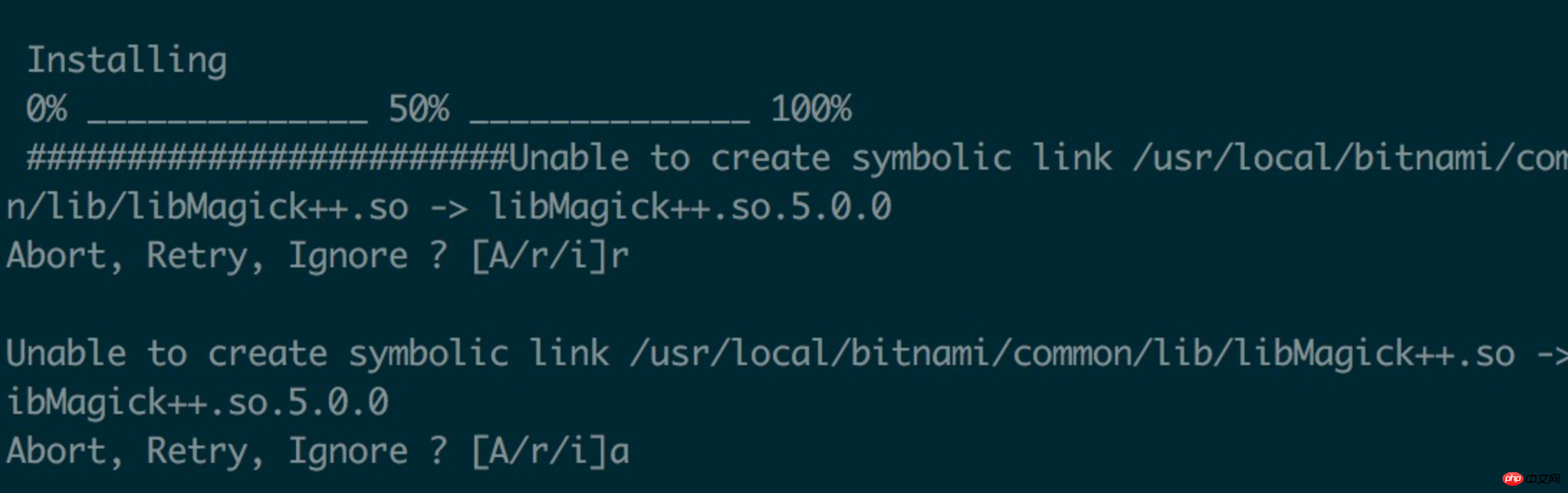
I searched for N days and found that the disk is full, but my machine is new and has not been installed. Otherwise, the disk will not be full
What I want to say to you is that if your server memory is 1G, change the machine to a high-end configuration. There are tears here~~~~
Then I encountered such an error again
 Installing 0%  50%  100%
 ########################################Warning: Problem running post-install step. Installation may not complete
correctly
 Unknown error while running chown -R root:subversion/usr/local/bitnami/subversion/tmp
Press [Enter] to continue:
Warning: Problem running post-install step. Installation may not complete
correctly
 Unknown error while running /usr/local/bitnami/ruby/bin/ruby -e"require('digest/sha1'); puts(Digest::SHA1.hexdigest('****'))"Press [Enter] to continue:
Warning: Problem running post-install step. Installation may not complete
correctly
 Error creating dynamic link /usr/local/bitnami/apps/redmine/bnconfig/usr/local/bitnami/apps/redmine/updateip
Press [Enter] to continue:
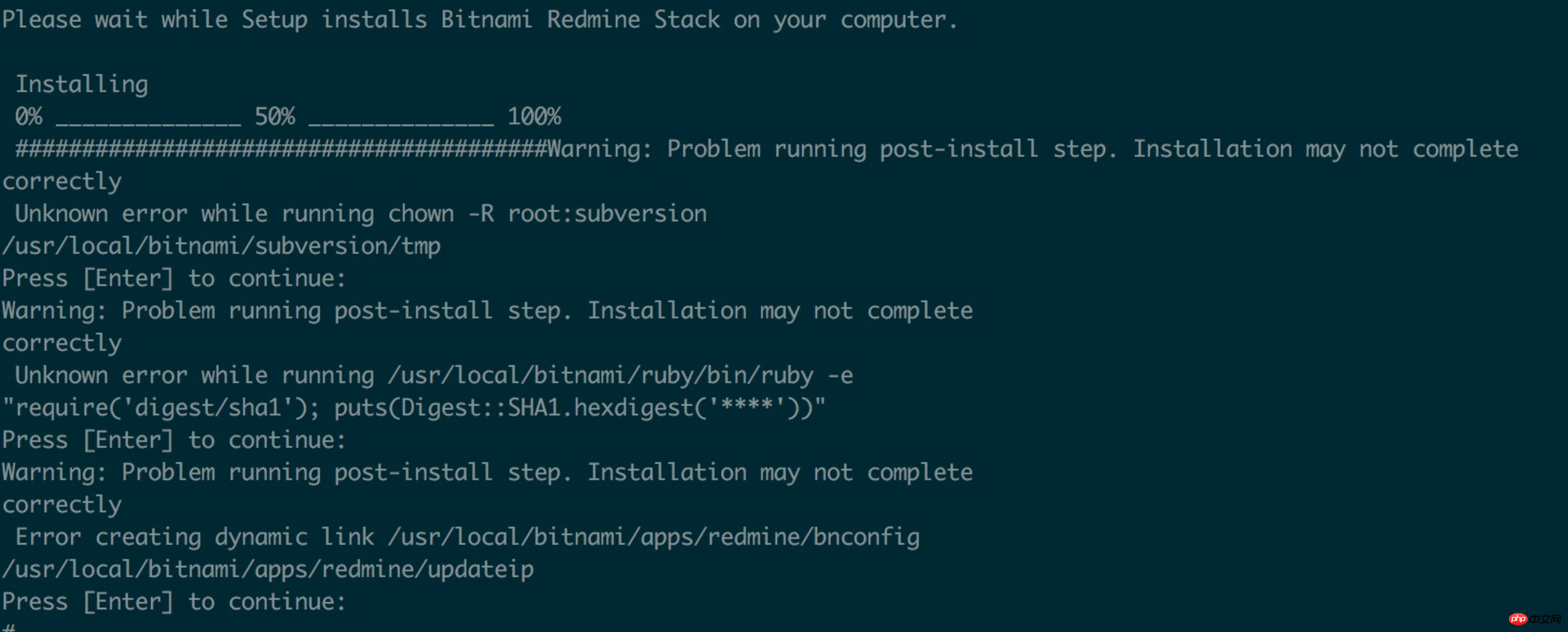
I was updating ruby #, canceled the subversion installation
Problem solved, but I mentioned ruby download and installation above, this problem should not occurThere is another problem as followsInstalling 0% 50% 100% ######################################## Error: Error running /usr/local/bitnami/mysql/scripts/myscript.sh/usr/local/bitnami/mysql "****": FATAL ERROR: please install the following Perl modules before executing scripts/mysql_install_db: Data::Dumper Logging to '/usr/local/bitnami/mysql/data/mysqld.log'. ERROR 2002 (HY000): Can't connect to local MySQL server through socket'/usr/local/bitnami/mysql/tmp/mysql.sock' (2) ERROR 2002 (HY000): Can't connect to local MySQL server through socket'/usr/local/bitnami/mysql/tmp/mysql.sock' (2) ERROR 2002 (HY000): Can't connect to local MySQL server through socket
yum -y install autoconf
./bitnami-redmine-3.3.3-0-linux-x64-installer.run
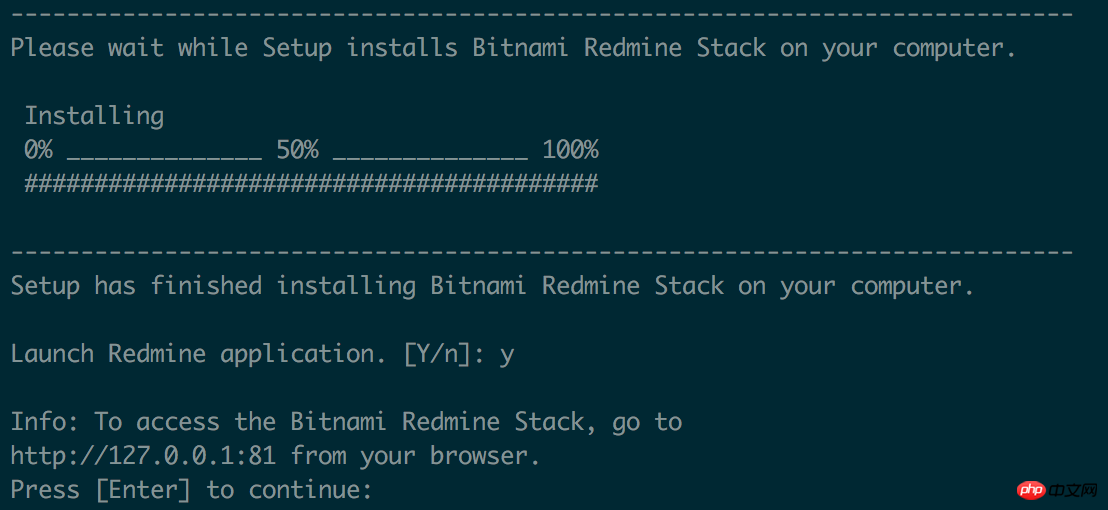

The above is the detailed content of Graphic tutorial for installing redmine on Linux using bitnami. For more information, please follow other related articles on the PHP Chinese website!

Hot AI Tools

Undresser.AI Undress
AI-powered app for creating realistic nude photos

AI Clothes Remover
Online AI tool for removing clothes from photos.

Undress AI Tool
Undress images for free

Clothoff.io
AI clothes remover

AI Hentai Generator
Generate AI Hentai for free.

Hot Article
Hot Tools

Notepad++7.3.1
Easy-to-use and free code editor

SublimeText3 Chinese version
Chinese version, very easy to use

Zend Studio 13.0.1
Powerful PHP integrated development environment

Dreamweaver CS6
Visual web development tools

SublimeText3 Mac version
God-level code editing software (SublimeText3)
Hot Topics
 1386
1386
 52
52

 Difference between centos and ubuntu
Apr 14, 2025 pm 09:09 PM
Difference between centos and ubuntu
Apr 14, 2025 pm 09:09 PM
The key differences between CentOS and Ubuntu are: origin (CentOS originates from Red Hat, for enterprises; Ubuntu originates from Debian, for individuals), package management (CentOS uses yum, focusing on stability; Ubuntu uses apt, for high update frequency), support cycle (CentOS provides 10 years of support, Ubuntu provides 5 years of LTS support), community support (CentOS focuses on stability, Ubuntu provides a wide range of tutorials and documents), uses (CentOS is biased towards servers, Ubuntu is suitable for servers and desktops), other differences include installation simplicity (CentOS is thin)
 How to use docker desktop
Apr 15, 2025 am 11:45 AM
How to use docker desktop
Apr 15, 2025 am 11:45 AM
How to use Docker Desktop? Docker Desktop is a tool for running Docker containers on local machines. The steps to use include: 1. Install Docker Desktop; 2. Start Docker Desktop; 3. Create Docker image (using Dockerfile); 4. Build Docker image (using docker build); 5. Run Docker container (using docker run).
 How to install centos
Apr 14, 2025 pm 09:03 PM
How to install centos
Apr 14, 2025 pm 09:03 PM
CentOS installation steps: Download the ISO image and burn bootable media; boot and select the installation source; select the language and keyboard layout; configure the network; partition the hard disk; set the system clock; create the root user; select the software package; start the installation; restart and boot from the hard disk after the installation is completed.
 What to do if the docker image fails
Apr 15, 2025 am 11:21 AM
What to do if the docker image fails
Apr 15, 2025 am 11:21 AM
Troubleshooting steps for failed Docker image build: Check Dockerfile syntax and dependency version. Check if the build context contains the required source code and dependencies. View the build log for error details. Use the --target option to build a hierarchical phase to identify failure points. Make sure to use the latest version of Docker engine. Build the image with --t [image-name]:debug mode to debug the problem. Check disk space and make sure it is sufficient. Disable SELinux to prevent interference with the build process. Ask community platforms for help, provide Dockerfiles and build log descriptions for more specific suggestions.
 How to view the docker process
Apr 15, 2025 am 11:48 AM
How to view the docker process
Apr 15, 2025 am 11:48 AM
Docker process viewing method: 1. Docker CLI command: docker ps; 2. Systemd CLI command: systemctl status docker; 3. Docker Compose CLI command: docker-compose ps; 4. Process Explorer (Windows); 5. /proc directory (Linux).
 Detailed explanation of docker principle
Apr 14, 2025 pm 11:57 PM
Detailed explanation of docker principle
Apr 14, 2025 pm 11:57 PM
Docker uses Linux kernel features to provide an efficient and isolated application running environment. Its working principle is as follows: 1. The mirror is used as a read-only template, which contains everything you need to run the application; 2. The Union File System (UnionFS) stacks multiple file systems, only storing the differences, saving space and speeding up; 3. The daemon manages the mirrors and containers, and the client uses them for interaction; 4. Namespaces and cgroups implement container isolation and resource limitations; 5. Multiple network modes support container interconnection. Only by understanding these core concepts can you better utilize Docker.
 What computer configuration is required for vscode
Apr 15, 2025 pm 09:48 PM
What computer configuration is required for vscode
Apr 15, 2025 pm 09:48 PM
VS Code system requirements: Operating system: Windows 10 and above, macOS 10.12 and above, Linux distribution processor: minimum 1.6 GHz, recommended 2.0 GHz and above memory: minimum 512 MB, recommended 4 GB and above storage space: minimum 250 MB, recommended 1 GB and above other requirements: stable network connection, Xorg/Wayland (Linux)
 How to switch Chinese mode with vscode
Apr 15, 2025 pm 11:39 PM
How to switch Chinese mode with vscode
Apr 15, 2025 pm 11:39 PM
VS Code To switch Chinese mode: Open the settings interface (Windows/Linux: Ctrl, macOS: Cmd,) Search for "Editor: Language" settings Select "Chinese" in the drop-down menu Save settings and restart VS Code
