


 Web Front-end
JS Tutorial
A brief discussion on JS prototype objects and prototype chains_javascript skills
Web Front-end
JS Tutorial
A brief discussion on JS prototype objects and prototype chains_javascript skills
A brief discussion on JS prototype objects and prototype chains_javascript skills

In Javascript, everything is an object, but objects are also different and can be roughly divided into two categories, namely: ordinary objects (Object) and function objects (Function).
Generally speaking, the objects generated through new Function are function objects, and other objects are ordinary objects.
Example:
function f1(){
  //todo
}
var f2 = function(){
  //todo
};
var f3 = new Function('x','console.log(x)');

var o1 = {};
var o2 = new Object();
var o3 = new f1();

console.log(
  typeof f1,//function
  typeof f2,//function
  typeof f3,//function
  typeof o1,//object
  typeof o2,//object
  typeof o3 //object
);
>> function function function object object object
f1 is a function declaration, the most common way to define a function. f2 is actually an anonymous function. This anonymous function is assigned to f2, which is a function expression. f3 is uncommon, but it is also a function object.
Function is an object that comes with JS. When f1 and f2 are created, JS will automatically build these objects through new Function(). Therefore, these three objects are all created through new Function().
There are two ways to create objects in Javascript: object literals and using new expressions. The creation of o1 and o2 corresponds to these two ways. Let’s focus on o3. If you use the ideas of Java and C# to understand it, , o3 is an instance object of f1, o3 and f1 are of the same type, at least I used to think so, but it is not the case...
So how do you understand it? It's very simple. Look at whether o3 is generated through new Function. Obviously not, since it is not a function object, it is an ordinary object.
After a simple understanding of function objects and ordinary objects, let’s take a look at the prototype and prototype chain in Javascript:
In JS, whenever a function object f1 is created, some properties will be built into the object, including prototype and __proto__. Prototype is the prototype object, which records some properties and methods of f1.
It should be noted that prototype is invisible to f1, that is to say, f1 will not look for the properties and methods in prototype.
function f(){}
f.prototype.foo = "abc";
console.log(f.foo); //undefined
So, what is the use of prototype? In fact, the main function of prototype is inheritance. In layman's terms, the properties and methods defined in the prototype are reserved for its own "descendants". Therefore, subclasses can fully access the properties and methods in the prototype.
To know how f1 leaves the prototype to "descendants", we need to understand the prototype chain in JS. At this time, __proto__ in JS enters the scene. This guy looks very strange and is also very hidden. It is so deep that you often don’t see it, but it exists in both ordinary objects and function objects. Its function is to save the prototype object of the parent class. When JS creates an object through the new expression, it usually saves the parent class. The prototype of the class is assigned to the __proto__ attribute of the new object, thus forming an inheritance from generation to generation...
function f(){}
f.prototype.foo = "abc";
var obj = new f();
console.log(obj.foo); //abcNow we know that __proto__ in obj saves the prototype of f, so what is saved in __proto__ in f’s prototype? Look at the picture below:
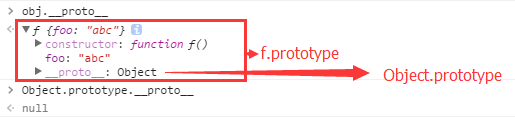
As shown in the figure, Object.prototype is stored in __proto__ of f.prototype. There is also __proto__ in the Object.prototype object. From the output results, Object.prototype.__proto__ is null, indicating the obj object prototype. The end of the chain. As shown below:
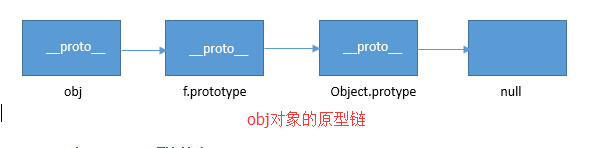
After the obj object has such a prototype chain, when obj.foo is executed, obj will first search whether it has the attribute, but will not search for its own prototype. When foo cannot be found, obj will follow the prototype chain. Go and search...
In the above example, we defined the foo attribute on the prototype of f, then obj will find this attribute on the prototype chain and execute it.
Finally, summarize the key points involved in this article in a few sentences:
- The formation of the prototype chain really relies on __proto__ rather than prototype. When the JS engine executes the method of the object, it first searches for whether the method exists in the object itself. If it does not exist, it will be searched on the prototype chain. , but will not find its own prototype.
- An object’s __proto__ records its own prototype chain and determines its own data type. Changing __proto__ is equivalent to changing the object’s data type.
- The prototype of a function does not belong to its own prototype chain. It is the core of subclass creation, determines the data type of the subclass, and is the bridge connecting the prototype chain of the subclass.
- The purpose of defining methods and properties on the prototype object is to be inherited and used by subclasses.
The above is the entire content of this article, I hope it will be helpful to everyone’s study.

Hot AI Tools

Undresser.AI Undress
AI-powered app for creating realistic nude photos

AI Clothes Remover
Online AI tool for removing clothes from photos.

Undress AI Tool
Undress images for free

Clothoff.io
AI clothes remover

AI Hentai Generator
Generate AI Hentai for free.

Hot Article
Hot Tools

Notepad++7.3.1
Easy-to-use and free code editor

SublimeText3 Chinese version
Chinese version, very easy to use

Zend Studio 13.0.1
Powerful PHP integrated development environment

Dreamweaver CS6
Visual web development tools

SublimeText3 Mac version
God-level code editing software (SublimeText3)
Hot Topics
 1381
1381
 52
52

 How do I create and publish my own JavaScript libraries?
Mar 18, 2025 pm 03:12 PM
How do I create and publish my own JavaScript libraries?
Mar 18, 2025 pm 03:12 PM
Article discusses creating, publishing, and maintaining JavaScript libraries, focusing on planning, development, testing, documentation, and promotion strategies.
 How do I optimize JavaScript code for performance in the browser?
Mar 18, 2025 pm 03:14 PM
How do I optimize JavaScript code for performance in the browser?
Mar 18, 2025 pm 03:14 PM
The article discusses strategies for optimizing JavaScript performance in browsers, focusing on reducing execution time and minimizing impact on page load speed.
 What should I do if I encounter garbled code printing for front-end thermal paper receipts?
Apr 04, 2025 pm 02:42 PM
What should I do if I encounter garbled code printing for front-end thermal paper receipts?
Apr 04, 2025 pm 02:42 PM
Frequently Asked Questions and Solutions for Front-end Thermal Paper Ticket Printing In Front-end Development, Ticket Printing is a common requirement. However, many developers are implementing...
 How do I debug JavaScript code effectively using browser developer tools?
Mar 18, 2025 pm 03:16 PM
How do I debug JavaScript code effectively using browser developer tools?
Mar 18, 2025 pm 03:16 PM
The article discusses effective JavaScript debugging using browser developer tools, focusing on setting breakpoints, using the console, and analyzing performance.
 Who gets paid more Python or JavaScript?
Apr 04, 2025 am 12:09 AM
Who gets paid more Python or JavaScript?
Apr 04, 2025 am 12:09 AM
There is no absolute salary for Python and JavaScript developers, depending on skills and industry needs. 1. Python may be paid more in data science and machine learning. 2. JavaScript has great demand in front-end and full-stack development, and its salary is also considerable. 3. Influencing factors include experience, geographical location, company size and specific skills.
 How do I use source maps to debug minified JavaScript code?
Mar 18, 2025 pm 03:17 PM
How do I use source maps to debug minified JavaScript code?
Mar 18, 2025 pm 03:17 PM
The article explains how to use source maps to debug minified JavaScript by mapping it back to the original code. It discusses enabling source maps, setting breakpoints, and using tools like Chrome DevTools and Webpack.
 How to merge array elements with the same ID into one object using JavaScript?
Apr 04, 2025 pm 05:09 PM
How to merge array elements with the same ID into one object using JavaScript?
Apr 04, 2025 pm 05:09 PM
How to merge array elements with the same ID into one object in JavaScript? When processing data, we often encounter the need to have the same ID...
 The difference in console.log output result: Why are the two calls different?
Apr 04, 2025 pm 05:12 PM
The difference in console.log output result: Why are the two calls different?
Apr 04, 2025 pm 05:12 PM
In-depth discussion of the root causes of the difference in console.log output. This article will analyze the differences in the output results of console.log function in a piece of code and explain the reasons behind it. �...
