


XML tree structure

An XML document example
The XML document uses a simple self-descriptive syntax:
<?xml version="1.0" encoding="ISO-8859-1"?> <note> <to>Tove</to> <from>Jani</from> <heading>Reminder</heading> <body>Don't forget me this weekend!</body> </note>
The first line is the XML declaration. It defines the version of XML (1.0) and the encoding used (ISO-8859-1 = Latin-1/Western European character set).
The next line describes the root element of the document (like saying: "This document is a sticky note"):
<note>
The next 4 lines describe the 4 child elements of the root (to, from, heading and body):
<to>Tove</to> <from>Jani</from> <heading>Reminder</heading> <body>Don't forget me this weekend!</body>
The last line defines the end of the root element:
</note>
You can assume from this example that the XML document contains a note written by Jani to Tove.
XML is brilliantly self-describing, don’t you agree?
XML documents form a tree structure
XML documents must contain a root element. This element is the parent element of all other elements.
The elements in an XML document form a document tree. The tree starts at the root and expands to the very bottom of the tree.
All elements can have child elements:
<root>
<child>
<subchild>.....</subchild>
</child>
</root>
Terms such as parent, child, and sibling are used to describe the relationship between elements. Parent elements own child elements. Child elements at the same level become siblings (brothers or sisters).
All elements can have text content and attributes (similar to HTML).
Example:
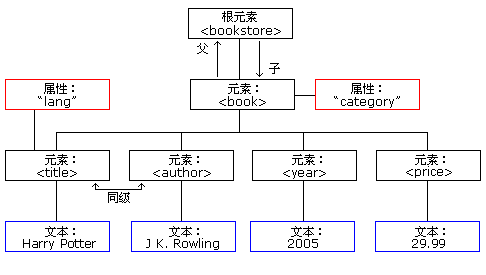
The above picture represents a book in the following XML:
<bookstore>
<book category="COOKING">
<title>Everyday Italian</title>
<author>Giada De Laurentiis</author>
<year>2005</year>
<price>30.00</price>
</book>
<book category="CHILDREN">
<title>Harry Potter</title>
<author>J K. Rowling</author>
<year>2005</year>
<price>29.99</price>
</book>
<book category="WEB">
<title>Learning XML</title>
<author>Erik T. Ray</author>
<year>2003</year>
<price>39.95</price>
</book>
</bookstore>
The above is the content of the XML tree structure, For more related content, please pay attention to the PHP Chinese website (m.sbmmt.com)!

Hot AI Tools

Undress AI Tool
Undress images for free

AI Clothes Remover
Online AI tool for removing clothes from photos.

Undresser.AI Undress
AI-powered app for creating realistic nude photos

ArtGPT
AI image generator for creative art from text prompts.

Stock Market GPT
AI powered investment research for smarter decisions

Hot Article
Popular tool

Notepad++7.3.1
Easy-to-use and free code editor

SublimeText3 Chinese version
Chinese version, very easy to use

Zend Studio 13.0.1
Powerful PHP integrated development environment

Dreamweaver CS6
Visual web development tools

SublimeText3 Mac version
God-level code editing software (SublimeText3)
Hot Topics
 20518
20518
 7
13631
4
7
13631
4

 JSON vs. XML: Why RSS Chose XML
May 05, 2025 am 12:01 AM
JSON vs. XML: Why RSS Chose XML
May 05, 2025 am 12:01 AM
RSS chose XML instead of JSON because: 1) XML's structure and verification capabilities are better than JSON, which is suitable for the needs of RSS complex data structures; 2) XML was supported extensively at that time; 3) Early versions of RSS were based on XML and have become a standard.
 Understanding RSS Documents: A Comprehensive Guide
May 09, 2025 am 12:15 AM
Understanding RSS Documents: A Comprehensive Guide
May 09, 2025 am 12:15 AM
RSS documents are a simple subscription mechanism to publish content updates through XML files. 1. The RSS document structure consists of and elements and contains multiple elements. 2. Use RSS readers to subscribe to the channel and extract information by parsing XML. 3. Advanced usage includes filtering and sorting using the feedparser library. 4. Common errors include XML parsing and encoding issues. XML format and encoding need to be verified during debugging. 5. Performance optimization suggestions include cache RSS documents and asynchronous parsing.
 Building XML Applications with C : Practical Examples
May 03, 2025 am 12:16 AM
Building XML Applications with C : Practical Examples
May 03, 2025 am 12:16 AM
You can use the TinyXML, Pugixml, or libxml2 libraries to process XML data in C. 1) Parse XML files: Use DOM or SAX methods, DOM is suitable for small files, and SAX is suitable for large files. 2) Generate XML file: convert the data structure into XML format and write to the file. Through these steps, XML data can be effectively managed and manipulated.
 RSS, XML and the Modern Web: A Content Syndication Deep Dive
May 08, 2025 am 12:14 AM
RSS, XML and the Modern Web: A Content Syndication Deep Dive
May 08, 2025 am 12:14 AM
RSS and XML are still important in the modern web. 1.RSS is used to publish and distribute content, and users can subscribe and get updates through the RSS reader. 2. XML is a markup language and supports data storage and exchange, and RSS files are based on XML.
 XML in C : Handling Complex Data Structures
May 02, 2025 am 12:04 AM
XML in C : Handling Complex Data Structures
May 02, 2025 am 12:04 AM
Working with XML data structures in C can use the TinyXML or pugixml library. 1) Use the pugixml library to parse and generate XML files. 2) Handle complex nested XML elements, such as book information. 3) Optimize XML processing code, and it is recommended to use efficient libraries and streaming parsing. Through these steps, XML data can be processed efficiently.
 Beyond Basics: Advanced RSS Features Enabled by XML
May 07, 2025 am 12:12 AM
Beyond Basics: Advanced RSS Features Enabled by XML
May 07, 2025 am 12:12 AM
RSS enables multimedia content embedding, conditional subscription, and performance and security optimization. 1) Embed multimedia content such as audio and video through tags. 2) Use XML namespace to implement conditional subscriptions, allowing subscribers to filter content based on specific conditions. 3) Optimize the performance and security of RSSFeed through CDATA section and XMLSchema to ensure stability and compliance with standards.
 Understanding RSS: An XML Perspective
Apr 25, 2025 am 12:14 AM
Understanding RSS: An XML Perspective
Apr 25, 2025 am 12:14 AM
RSS is an XML-based format used to publish frequently updated content. 1. RSSfeed organizes information through XML structure, including title, link, description, etc. 2. Creating RSSfeed requires writing in XML structure, adding metadata such as language and release date. 3. Advanced usage can include multimedia files and classified information. 4. Use XML verification tools during debugging to ensure that the required elements exist and are encoded correctly. 5. Optimizing RSSfeed can be achieved by paging, caching and keeping the structure simple. By understanding and applying this knowledge, content can be effectively managed and distributed.
 Inside the RSS Document: Essential XML Tags and Attributes
May 03, 2025 am 12:12 AM
Inside the RSS Document: Essential XML Tags and Attributes
May 03, 2025 am 12:12 AM
The core structure of RSS documents includes XML tags and attributes. The specific parsing and generation steps are as follows: 1. Read XML files, process and tags. 2. Extract,,, etc. tag information. 3. Handle custom tags and attributes to ensure version compatibility. 4. Use cache and asynchronous processing to optimize performance to ensure code readability.
