


Introduction and use of xml files

We often see xml files, but rarely use them. As the name suggests, xml is an extensible markup language. Its development is shown in the figure below:
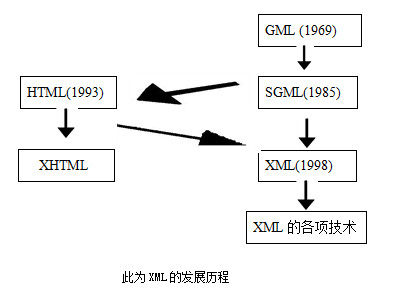
Comparison of xml and html:
| Comparison Content | HTML | XML |
| Extensibility | Does not allow users to define their own extension tags | Allows users to define their own extension tags |
| Structure description | Does not support deep nested expressions | Supports deep nested expressions, suitable for representing document data with complex structures |
| Readability and maintainability | Difficult to read and maintain | Clear structure, easy to read and maintain |
| Data and display Relationship | Content description and presentation form are integrated | Content description and presentation form are separated |
xml is more powerful than html, but its use is more standardized and strict:
(1). XML is case-sensitive;
(2). The starting and ending tags of all elements must appear in pairs and be correct Nesting;
(3). If an XML description is used, it must be the first line of the XML document:
(4). Element attributes must be in quotes Quotes can be single or double quotes, but they must appear in pairs. Such as:
(5). XML naming rules:
①.XML names start with an underscore or letter;
②.XML names can contain letters, numbers, periods, underscores and colons;
③.XML names cannot contain spaces;
④.XML names cannot start with numbers, but can contain numbers;
⑤.XML names are size-sensitive Write.
(6). Retain markup characters. If you want to display tags like
<: represents the character>
> ;: Represents >character
&: Represents & character
&apos: Represents 'character
": Represents "character
We can also use ENTITY custom entities:
In this way we can call it with &linux;.
(7). The spaces in the XML document content are meaningful and will be retained after conversion.
(8). Elements start with , such as
Look at a simple xml code:
Understand the concepts of elements, attributes and entities:
Element It is a tag such as the classes element; the attribute is additional information such as the englishname attribute of the name element; the entity is used to replace the string in xml, such as When using www.phpddt.com You can use the &website cross-border method!
DTD's "Document Type Definition" introduction:
standardizes the format of XML files, such as:
DTD is actually one or several files written in XML.

Hot AI Tools

Undress AI Tool
Undress images for free

AI Clothes Remover
Online AI tool for removing clothes from photos.

Undresser.AI Undress
AI-powered app for creating realistic nude photos

ArtGPT
AI image generator for creative art from text prompts.

Stock Market GPT
AI powered investment research for smarter decisions

Hot Article
Popular tool

Notepad++7.3.1
Easy-to-use and free code editor

SublimeText3 Chinese version
Chinese version, very easy to use

Zend Studio 13.0.1
Powerful PHP integrated development environment

Dreamweaver CS6
Visual web development tools

SublimeText3 Mac version
God-level code editing software (SublimeText3)
Hot Topics
 20519
20519
 7
13631
4
7
13631
4

 How to convert XML to YAML for DevOps? (Configuration Management)
Mar 12, 2026 am 12:11 AM
How to convert XML to YAML for DevOps? (Configuration Management)
Mar 12, 2026 am 12:11 AM
xmltodict PyYAMListhesafestcomboforDevOpsconfigfilesbecauseitpreservescomments,CDATA,namespaces,andattributesaccurately,unlikerawXML-to-YAMLtoolsorCLIutilitieslikeyqandxmllintwhichsilentlydropcriticalmetadata.
 How to format and beautify XML code in Notepad ? (Pretty Print)
Mar 07, 2026 am 12:20 AM
How to format and beautify XML code in Notepad ? (Pretty Print)
Mar 07, 2026 am 12:20 AM
Notepad needs to manually install and enable the XMLTools plug-in to format XML; if the tags are messed up or the content is lost after formatting, it means that the XML itself is illegal, and there are problems such as unclosed tags or illegal characters.
 How to minify XML files for faster web loading? (Performance Optimization)
Mar 08, 2026 am 12:16 AM
How to minify XML files for faster web loading? (Performance Optimization)
Mar 08, 2026 am 12:16 AM
RunningminifyonXMLwithoutunderstandingitsrulesbreaksparsingoralterssemanticsbecausewhitespacecanbemeaningful;safeminificationrequiresdata-orientedXML,controlledgeneration/consumption,andstrictparserawareness.
 How to convert an XML file to a Word document? (Reporting)
Mar 09, 2026 am 01:05 AM
How to convert an XML file to a Word document? (Reporting)
Mar 09, 2026 am 01:05 AM
python-docx does not support direct reading of XML files. You need to use xml.etree.ElementTree or lxml to parse the XML extraction fields first, and then write them into the Document object segment by segment. Explicit declaration of prefixes is required to process namespaces, and manual manipulation of the underlying XML is required for table merging and styling. Chinese paths should be avoided when saving.
 How to parse XML data from a URL API? (Rest Services)
Mar 13, 2026 am 12:06 AM
How to parse XML data from a URL API? (Rest Services)
Mar 13, 2026 am 12:06 AM
To parse remote XML API in Python, you need to use requests to get the response and then check the status code and Content-Type. Prioritize using r.text with xml.etree.ElementTree to parse; when encountering a namespace, you need to pass the namespace dictionary; use iterparse to stream large files and clear them manually; front-end JS requires CORS support or proxy.
 How to use Attributes vs Elements in XML? (Design Best Practices)
Mar 16, 2026 am 12:26 AM
How to use Attributes vs Elements in XML? (Design Best Practices)
Mar 16, 2026 am 12:26 AM
You should use attributes to store short metadata (such as id, type), and use elements to store scalable content data; because attributes do not support namespaces, duplication, nesting, and internationalization, their parsing is error-prone and maintenance is difficult.
 How to open and view XML files in Windows 11? (Beginner Guide)
Mar 12, 2026 am 01:02 AM
How to open and view XML files in Windows 11? (Beginner Guide)
Mar 12, 2026 am 01:02 AM
The XML file cannot be opened by double-clicking because it is associated with Notepad by default, causing confusion in the display. You should use Notepad, VSCode or Edge instead; Edge can format and report errors, while VSCode requires the installation of extensions such as RedHatXML for normal highlighting, indentation and verification.
 How to read XML data in C# using LINQ? (.NET Development)
Mar 15, 2026 am 12:43 AM
How to read XML data in C# using LINQ? (.NET Development)
Mar 15, 2026 am 12:43 AM
XDocument.Load() is the preferred method for reading local XML files and automatically handles encoding, BOM and format exceptions; absolute or correct relative paths are required; namespaces must be explicitly declared and participate in queries; Elements() and Descendants() behave differently and should be selected as needed; string parsing must capture XmlException and verify the source.
