


Create an OpenCart tool for exporting product CSV files

If you are running an online store or any web business and you don’t know the importance of CSV (Comma Separated Values), then it’s time to upgrade your knowledge about data manipulation. To understand its importance, let’s examine a scenario involving an OpenCart store and see how a product CSV export tool can be built as a solution.
Suppose you are running an online store with thousands of items, and you have to change the prices of all items for a special event. There may be two possible solutions:
- Go to the product's control panel (admin panel) and manually change the prices one by one.
- Give the relevant person direct access to the database and let him or her use your data.
In the first case, when you have to change the item price one by one according to the user interface provided by the store admin panel, this is a safe method, but changing the price of thousands of items may take a lot of time—— It may take several weeks for large amounts of data.
In the second case, security issues may arise when you provide direct access to the store database. Sometimes, serious problems can occur that cause your system to crash.
What is the solution?
So there must be a mechanism to format the projects and you can batch import/export them directly into your system. CSV is the best solution. That's what we'll do in the tutorial.
What is CSV?
CSV is short for "Comma Separated Values". It is a method of formatting information taken from a database so that it can be read and edited in ordinary spreadsheet software. You can then add large amounts of information back to the database.
Product Export in OpenCart
Considering the above scenario, sometimes it is difficult to add and edit products in bulk, so we will create a CSV export tool in the system. This way we can provide all of our products in a specific format so we can easily read, add and edit the information later. Let's start by building the export tool.
1. Export button in product page
1.1 Controller
- Navigate to
(your opencart store directory)/admin/controller/catalog/product.php. - Find the
getList()function. - Add the following lines after this line of code:
$this->data['products'] = array();
$this->data['export_csv'] = $this->url->link('catalog/product/exportCSV', 'token=' . $this->session->data['token'] . $url, 'SSL');
The controller simply resolves the export URL to the view so that it can be linked with the button.
1.2 View
- Navigate to
(your opencart store directory)/admin/view/template/catalog/product_list.tpl. - Found HTML:
<div class="buttons">. - Add export button HTML:
<a onclick="location = '<?php echo $export_csv; ?>'" class="button">Export CSV</a>
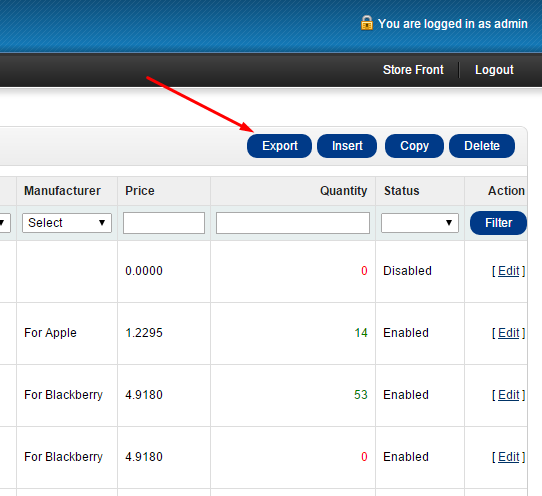
Go to your store's admin panel and select Catalog > Products , you will see the Export button as shown in the screenshot below.
2. Export products
2.1 Controller
- Navigate to
(your opencart store directory)/admin/controller/catalog/product.. - Create a new public function, namely
public function exportCSV(){ }. - Inside the function, just add the following lines of code.
$this->load->model('catalog/product'); // Loading the Model of Products

$temp_data = $this->model_catalog_product->getProducts(array('filter_status'=>1)); // Fetch all the Products where Status is Enabled

/* CSV Header Starts Here */

header("Content-Type: text/csv");
header("Content-Disposition: attachment; filename=ProductsCSV-".date('d-m-Y').".csv");
// Disable caching
header("Cache-Control: no-cache, no-store, must-revalidate"); // HTTP 1.1
header("Pragma: no-cache"); // HTTP 1.0
header("Expires: 0"); // Proxies

/* CSV Header Ends Here */

$output = fopen("php://output", "w"); //Opens and clears the contents of file; or creates a new file if it doesn't exist

$data = array();

// We don't want to export all the information to be exported so maintain a separate array for the information to be exported
foreach($temp_data as $data)
{
    $data[] = array(
    'product_id' =>$data['product_id'],
    'model' =>$data['model'],
    'name' =>$data['name'],
    'quantity' =>$data['quantity'],

    );

}

// Exporting the CSV
foreach($data as $row)
{
    fputcsv($output, $row); // here you can change delimiter/enclosure
}

fclose($output); // Closing the File
for you! You created a product export tool for your OpenCart panel. Just click the export button and the CSV file will download to your computer. You can add as many columns as you need.
in conclusion
“Time is gold.” As an entrepreneur or business owner, you don’t want to waste your precious time. When it comes to software, entrepreneurs are always looking for the best, most efficient way to get the job done.
So, in this tutorial, we created a business tool that helps export product information from OpenCart in a faster and easier way using CSV data format. I will also write a tutorial on "CSV Import" so that we can easily add and update information as per our requirements.
I hope you found this article helpful for your business. Please give your valuable feedback below. Thanks!
The above is the detailed content of Create an OpenCart tool for exporting product CSV files. For more information, please follow other related articles on the PHP Chinese website!

Hot AI Tools

Undresser.AI Undress
AI-powered app for creating realistic nude photos

AI Clothes Remover
Online AI tool for removing clothes from photos.

Undress AI Tool
Undress images for free

Clothoff.io
AI clothes remover

AI Hentai Generator
Generate AI Hentai for free.

Hot Article
Hot Tools

Notepad++7.3.1
Easy-to-use and free code editor

SublimeText3 Chinese version
Chinese version, very easy to use

Zend Studio 13.0.1
Powerful PHP integrated development environment

Dreamweaver CS6
Visual web development tools

SublimeText3 Mac version
God-level code editing software (SublimeText3)
Hot Topics
 1378
1378
 52
52

 Alipay PHP SDK transfer error: How to solve the problem of 'Cannot declare class SignData'?
Apr 01, 2025 am 07:21 AM
Alipay PHP SDK transfer error: How to solve the problem of 'Cannot declare class SignData'?
Apr 01, 2025 am 07:21 AM
Alipay PHP...
 Explain JSON Web Tokens (JWT) and their use case in PHP APIs.
Apr 05, 2025 am 12:04 AM
Explain JSON Web Tokens (JWT) and their use case in PHP APIs.
Apr 05, 2025 am 12:04 AM
JWT is an open standard based on JSON, used to securely transmit information between parties, mainly for identity authentication and information exchange. 1. JWT consists of three parts: Header, Payload and Signature. 2. The working principle of JWT includes three steps: generating JWT, verifying JWT and parsing Payload. 3. When using JWT for authentication in PHP, JWT can be generated and verified, and user role and permission information can be included in advanced usage. 4. Common errors include signature verification failure, token expiration, and payload oversized. Debugging skills include using debugging tools and logging. 5. Performance optimization and best practices include using appropriate signature algorithms, setting validity periods reasonably,
 Explain the concept of late static binding in PHP.
Mar 21, 2025 pm 01:33 PM
Explain the concept of late static binding in PHP.
Mar 21, 2025 pm 01:33 PM
Article discusses late static binding (LSB) in PHP, introduced in PHP 5.3, allowing runtime resolution of static method calls for more flexible inheritance.Main issue: LSB vs. traditional polymorphism; LSB's practical applications and potential perfo
 Framework Security Features: Protecting against vulnerabilities.
Mar 28, 2025 pm 05:11 PM
Framework Security Features: Protecting against vulnerabilities.
Mar 28, 2025 pm 05:11 PM
Article discusses essential security features in frameworks to protect against vulnerabilities, including input validation, authentication, and regular updates.
 How to send a POST request containing JSON data using PHP's cURL library?
Apr 01, 2025 pm 03:12 PM
How to send a POST request containing JSON data using PHP's cURL library?
Apr 01, 2025 pm 03:12 PM
Sending JSON data using PHP's cURL library In PHP development, it is often necessary to interact with external APIs. One of the common ways is to use cURL library to send POST�...
 Describe the SOLID principles and how they apply to PHP development.
Apr 03, 2025 am 12:04 AM
Describe the SOLID principles and how they apply to PHP development.
Apr 03, 2025 am 12:04 AM
The application of SOLID principle in PHP development includes: 1. Single responsibility principle (SRP): Each class is responsible for only one function. 2. Open and close principle (OCP): Changes are achieved through extension rather than modification. 3. Lisch's Substitution Principle (LSP): Subclasses can replace base classes without affecting program accuracy. 4. Interface isolation principle (ISP): Use fine-grained interfaces to avoid dependencies and unused methods. 5. Dependency inversion principle (DIP): High and low-level modules rely on abstraction and are implemented through dependency injection.
 Customizing/Extending Frameworks: How to add custom functionality.
Mar 28, 2025 pm 05:12 PM
Customizing/Extending Frameworks: How to add custom functionality.
Mar 28, 2025 pm 05:12 PM
The article discusses adding custom functionality to frameworks, focusing on understanding architecture, identifying extension points, and best practices for integration and debugging.
 How does session hijacking work and how can you mitigate it in PHP?
Apr 06, 2025 am 12:02 AM
How does session hijacking work and how can you mitigate it in PHP?
Apr 06, 2025 am 12:02 AM
Session hijacking can be achieved through the following steps: 1. Obtain the session ID, 2. Use the session ID, 3. Keep the session active. The methods to prevent session hijacking in PHP include: 1. Use the session_regenerate_id() function to regenerate the session ID, 2. Store session data through the database, 3. Ensure that all session data is transmitted through HTTPS.
