


 Java
javaTutorial
How to implement large-scale data processing using distributed computing framework in Java?
Java
javaTutorial
How to implement large-scale data processing using distributed computing framework in Java?
How to implement large-scale data processing using distributed computing framework in Java?

How to use the distributed computing framework in Java to achieve large-scale data processing?
Introduction:
With the advent of the big data era, we need to process increasingly large amounts of data. Traditional single-machine computing can no longer meet this demand, so distributed computing has become an effective means to solve large-scale data processing problems. As a widely used programming language, Java provides a variety of distributed computing frameworks, such as Hadoop, Spark, etc. This article will introduce how to use the distributed computing framework in Java to achieve large-scale data processing, and give corresponding code examples.
1. Use of Hadoop
Hadoop is an open source distributed computing framework. Its core is Hadoop Distributed File System (HDFS) and distributed computing framework (MapReduce). The following is a sample code using Hadoop for large-scale data processing:
import org.apache.hadoop.conf.Configuration;
import org.apache.hadoop.fs.Path;
import org.apache.hadoop.io.IntWritable;
import org.apache.hadoop.io.Text;
import org.apache.hadoop.mapreduce.Job;
import org.apache.hadoop.mapreduce.Mapper;
import org.apache.hadoop.mapreduce.Reducer;
import org.apache.hadoop.mapreduce.lib.input.FileInputFormat;
import org.apache.hadoop.mapreduce.lib.output.FileOutputFormat;

import java.io.IOException;
import java.util.StringTokenizer;

public class WordCount {

    public static class TokenizerMapper extends Mapper<Object, Text, Text, IntWritable> {

        private final static IntWritable one = new IntWritable(1);
        private Text word = new Text();

        public void map(Object key, Text value, Context context) throws IOException, InterruptedException {
            StringTokenizer itr = new StringTokenizer(value.toString());
            while (itr.hasMoreTokens()) {
                word.set(itr.nextToken());
                context.write(word, one);
            }
        }
    }

    public static class IntSumReducer extends Reducer<Text, IntWritable, Text, IntWritable> {

        private IntWritable result = new IntWritable();

        public void reduce(Text key, Iterable<IntWritable> values, Context context) throws IOException, InterruptedException {
            int sum = 0;
            for (IntWritable val : values) {
                sum += val.get();
            }
            result.set(sum);
            context.write(key, result);
        }
    }

    public static void main(String[] args) throws Exception {
        Configuration conf = new Configuration();
        Job job = Job.getInstance(conf, "word count");
        job.setJarByClass(WordCount.class);
        job.setMapperClass(TokenizerMapper.class);
        job.setCombinerClass(IntSumReducer.class);
        job.setReducerClass(IntSumReducer.class);
        job.setOutputKeyClass(Text.class);
        job.setOutputValueClass(IntWritable.class);
        FileInputFormat.addInputPath(job, new Path(args[0]));
        FileOutputFormat.setOutputPath(job, new Path(args[1]));
        System.exit(job.waitForCompletion(true) ? 0 : 1);
    }
}The above code implements a simple word counting function. By inheriting the Mapper and Reducer classes and overloading the map and reduce methods, we can implement customized data processing logic. The Job class is responsible for configuring and managing the entire job, including input and output paths, etc.
2. Use of Spark
Spark is another popular distributed computing framework. It provides a wider range of computing models and APIs and supports a variety of large-scale data processing scenarios. The following is a sample code that uses Spark for large-scale data processing:
import org.apache.spark.SparkConf;
import org.apache.spark.api.java.JavaRDD;
import org.apache.spark.api.java.JavaSparkContext;
import org.apache.spark.api.java.function.FlatMapFunction;
import org.apache.spark.api.java.function.Function2;
import org.apache.spark.api.java.function.PairFunction;
import scala.Tuple2;

import java.util.Arrays;
import java.util.Iterator;

public class WordCount {

    public static void main(String[] args) {
        SparkConf conf = new SparkConf().setAppName("wordCount").setMaster("local");
        JavaSparkContext sc = new JavaSparkContext(conf);

        String inputPath = args[0];
        String outputPath = args[1];

        JavaRDD<String> lines = sc.textFile(inputPath);
        JavaRDD<String> words = lines.flatMap(new FlatMapFunction<String, String>() {
            @Override
            public Iterator<String> call(String s) throws Exception {
                return Arrays.asList(s.split(" ")).iterator();
            }
        });

        JavaRDD<Tuple2<String, Integer>> pairs = words.mapToPair(new PairFunction<String, String, Integer>() {
            @Override
            public Tuple2<String, Integer> call(String s) throws Exception {
                return new Tuple2<>(s, 1);
            }
        });

        JavaRDD<Tuple2<String, Integer>> counts = pairs.reduceByKey(new Function2<Integer, Integer, Integer>() {
            @Override
            public Integer call(Integer v1, Integer v2) throws Exception {
                return v1 + v2;
            }
        });

        counts.saveAsTextFile(outputPath);

        sc.close();
    }
}The above code also implements the word counting function. By creating SparkConf and JavaSparkContext objects, we can configure and initialize Spark applications and implement data processing logic by calling various API methods.
Conclusion:
This article introduces how to use the distributed computing frameworks Hadoop and Spark in Java to achieve large-scale data processing, and gives corresponding code examples. By using these distributed computing frameworks, we can make full use of cluster resources and process large-scale data efficiently. We hope that this article will be helpful to readers who are interested in big data processing. We also hope that readers can conduct in-depth research and application of distributed computing technology and contribute to the development of the big data era.
The above is the detailed content of How to implement large-scale data processing using distributed computing framework in Java?. For more information, please follow other related articles on the PHP Chinese website!

Hot AI Tools

Undresser.AI Undress
AI-powered app for creating realistic nude photos

AI Clothes Remover
Online AI tool for removing clothes from photos.

Undress AI Tool
Undress images for free

Clothoff.io
AI clothes remover

AI Hentai Generator
Generate AI Hentai for free.

Hot Article
Hot Tools

Notepad++7.3.1
Easy-to-use and free code editor

SublimeText3 Chinese version
Chinese version, very easy to use

Zend Studio 13.0.1
Powerful PHP integrated development environment

Dreamweaver CS6
Visual web development tools

SublimeText3 Mac version
God-level code editing software (SublimeText3)
Hot Topics
 1386
1386
 52
52

 Perfect Number in Java
Aug 30, 2024 pm 04:28 PM
Perfect Number in Java
Aug 30, 2024 pm 04:28 PM
Guide to Perfect Number in Java. Here we discuss the Definition, How to check Perfect number in Java?, examples with code implementation.
 Weka in Java
Aug 30, 2024 pm 04:28 PM
Weka in Java
Aug 30, 2024 pm 04:28 PM
Guide to Weka in Java. Here we discuss the Introduction, how to use weka java, the type of platform, and advantages with examples.
 Smith Number in Java
Aug 30, 2024 pm 04:28 PM
Smith Number in Java
Aug 30, 2024 pm 04:28 PM
Guide to Smith Number in Java. Here we discuss the Definition, How to check smith number in Java? example with code implementation.
 Java Spring Interview Questions
Aug 30, 2024 pm 04:29 PM
Java Spring Interview Questions
Aug 30, 2024 pm 04:29 PM
In this article, we have kept the most asked Java Spring Interview Questions with their detailed answers. So that you can crack the interview.
 Break or return from Java 8 stream forEach?
Feb 07, 2025 pm 12:09 PM
Break or return from Java 8 stream forEach?
Feb 07, 2025 pm 12:09 PM
Java 8 introduces the Stream API, providing a powerful and expressive way to process data collections. However, a common question when using Stream is: How to break or return from a forEach operation? Traditional loops allow for early interruption or return, but Stream's forEach method does not directly support this method. This article will explain the reasons and explore alternative methods for implementing premature termination in Stream processing systems. Further reading: Java Stream API improvements Understand Stream forEach The forEach method is a terminal operation that performs one operation on each element in the Stream. Its design intention is
 TimeStamp to Date in Java
Aug 30, 2024 pm 04:28 PM
TimeStamp to Date in Java
Aug 30, 2024 pm 04:28 PM
Guide to TimeStamp to Date in Java. Here we also discuss the introduction and how to convert timestamp to date in java along with examples.
 Java Program to Find the Volume of Capsule
Feb 07, 2025 am 11:37 AM
Java Program to Find the Volume of Capsule
Feb 07, 2025 am 11:37 AM
Capsules are three-dimensional geometric figures, composed of a cylinder and a hemisphere at both ends. The volume of the capsule can be calculated by adding the volume of the cylinder and the volume of the hemisphere at both ends. This tutorial will discuss how to calculate the volume of a given capsule in Java using different methods. Capsule volume formula The formula for capsule volume is as follows: Capsule volume = Cylindrical volume Volume Two hemisphere volume in, r: The radius of the hemisphere. h: The height of the cylinder (excluding the hemisphere). Example 1 enter Radius = 5 units Height = 10 units Output Volume = 1570.8 cubic units explain Calculate volume using formula: Volume = π × r2 × h (4
 How to Run Your First Spring Boot Application in Spring Tool Suite?
Feb 07, 2025 pm 12:11 PM
How to Run Your First Spring Boot Application in Spring Tool Suite?
Feb 07, 2025 pm 12:11 PM
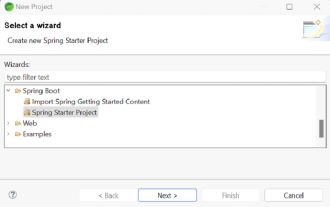
Spring Boot simplifies the creation of robust, scalable, and production-ready Java applications, revolutionizing Java development. Its "convention over configuration" approach, inherent to the Spring ecosystem, minimizes manual setup, allo
