
"Leave the dirty work to functions", first, let's take a look at how to define functions in Python.
def Function name (parameter 1, parameter 2...):
return 'result'
The main purpose of the function is to handle recurring tasks. For example, calculating the area of a right triangle requires defining two right sides and the corresponding formula. Define a function to calculate the area of a right triangle by inputting the length of the right side.
def function(a,b):
  return '1/2*a*b'

#也可以写出这样
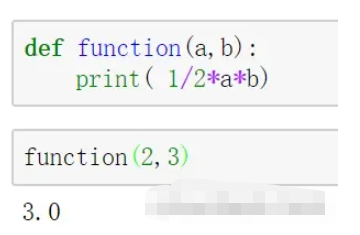
def function(a,b):
print( 1/2*a*b)Don’t worry too much about their differences. Using return returns a value, while the second one calls the function and performs the printing operation. You can call a function to calculate the area of a right triangle with sides 2 and 3 by entering function(2,3).
The judgment statement format of Python is as follows:
if condition:
  do
else:
  do
# 注意:冒号和缩进不要忘记了

# 再看一下多重条件的格式
if condition:
  do
elif condition:
  do
else:
  do
Here, we give a score and return its score.
a = 78
if a >= 90:
    print('优秀')
elif a>=80:
    print('良好')
elif a>=60:
    print('合格')
else:
print('不合格')Python’s loop statements include for loops and while loops, as shown in the following code.
#for循环
for item in iterable:
    do
#item表示元素,iterable是集合
for i in range(1,11):
    print(i)
#其结果为依次输出1到10,切记11是不输出的,range为Python内置函数。

#while循环
while condition:
doFor example, design a small program to calculate the sum of 1 to 100:
i = 0
sum = 0
while i < 100:
    i = i + 1
    sum = sum + i
print(sum)
# result 5050Finally, when using loops and judgments together, you need to learn the usage of break and continue. Break is to terminate the loop. , and continue skips this loop and then continues the loop.
for i in range(10):
    if i == 5:
        break
    print(i)

for i in range(10):
    if i == 5:
        continue
print(i)The above is the detailed content of Python function and control statement usage example analysis. For more information, please follow other related articles on the PHP Chinese website!





























![[Web front-end] Node.js quick start](https://img.php.cn/upload/course/000/000/067/662b5d34ba7c0227.png)