


Architectural analysis of swoole

The content of this article is about the architectural analysis of swoole. It has certain reference value. Friends in need can refer to it. I hope it will be helpful to you.
The structure diagram is as follows:
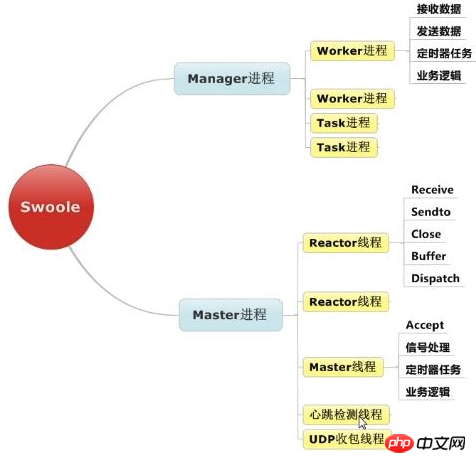
swoole is mainly used by the Master process (main process) and the Manager process to complete its functions.
Master process
is a multi-threaded program. There is a very important group of threads called Reactor threads. It is the thread that actually handles TCP connections and sends and receives data.
Manager process
Manage worker/task process. The worker/task processes are all forked and managed by the Manager process.
Reactor thread
After accepting a new connection, the main thread (Master process) will assign the connection to a fixed Reactor thread, and this thread will be responsible for monitoring the socket. Read the data when the socket is readable, perform protocol analysis, and deliver the request to the Worker process.
Responsible for maintaining client
TCPconnection, processing networkIO, processing protocol, sending and receiving dataCompletely asynchronous non-blocking mode
All are
Ccodes, exceptStart/ShudownExcept the event callback, no PHP code is executedBuffer, splice, and split the data sent by the
TCPclient into a complete request data PackageReactorRun in a multi-threaded manner
Work process
Similar to php- fpm process.
Accept the request packet delivered by the
Reactorthread, and execute thePHPcallback function to process the data-
Generate response data and send it to the
Reactorthread, which is sent by theReactorthread to theTCPclient Yes It is asynchronous mode or synchronous mode
WorkerRun in multi-process mode
TaskWorker process
A process that handles other tasks asynchronously, the usage method is similar to Gearman.
Accept tasks delivered by the
Workerprocess through theswoole_server->task/taskwaitmethodProcess the task and return the result data (
swoole_server->finish) to theWorkerprocessTaskWorkerRun in multi-process mode
Relationship
can be understood as Reactor is nginx, Worker is php-fpm. ReactorThe thread processes the network request asynchronously and in parallel, and then forwards it to the Worker process for processing (processed in the callback function). Reactor and Worker communicate through UnixSocket.
Event processing process
#To understand the swoole event processing process, first understand the two network event processing modes.
Reactor mode
It requires the main thread (I/O processing unit) to only monitor whether there is an event on the file descriptor, and if so, immediately notify the worker thread/process of the event. (logical unit). Other than that, the main thread doesn't do any other work. Reading and writing data, accepting new connections, and processing customer requests are all done in worker threads.
Proactor mode
Two implementations
Use the I/O asynchronous model to implement the Proactor mode. Principle: All I/O operations are handed over to the main thread, which cooperates with the kernel to handle them, and business logic operations are handed over to the logic unit. For example, use aio_read to achieve this.
Workflow:
The main thread calls the aio_read function to register the read completion event on the socket with the kernel.
The main thread continues to process other I/O events.
When the data on the socket is read into the user buffer, the kernel sends a signal to the application (logical unit) to notify the application that the data is available.
The application reads the data (client request), and after processing, calls the aio_write function to register the write event on the socket with the kernel.
The main thread continues to process other logic.
When the data in the user buffer is written to the socket, the kernel sends a signal to the application to notify the application that the data has been sent.
The application has pre-defined signal processing functions to handle the aftermath, such as closing the socket.
Use the I/O synchronization model to implement Proactor model. Principle: The main thread performs the read and write operations of I/O event data, and the business logic operations are handed over to the logic unit. For example, use epoll to achieve this.
Workflow:
The main thread registers the read-ready event on the socket in the epoll kernel event table.
The main thread calls epoll_wait to wait for data to be read on the socket.
After epoll_wait returns, the main thread reads data from the socket, then encapsulates the read data into a request object (client's request), and inserts it into the request queue.
So the consumer thread of the queue processes the request object, and then registers the write-ready event on the socket in the epoll kernel event table.
The main thread calls epoll_wait to wait for the socket to be writable.
When the socket is writable, epoll_wait notifies the main thread. The main thread writes the request result to the socket.
swoole event architecture diagram
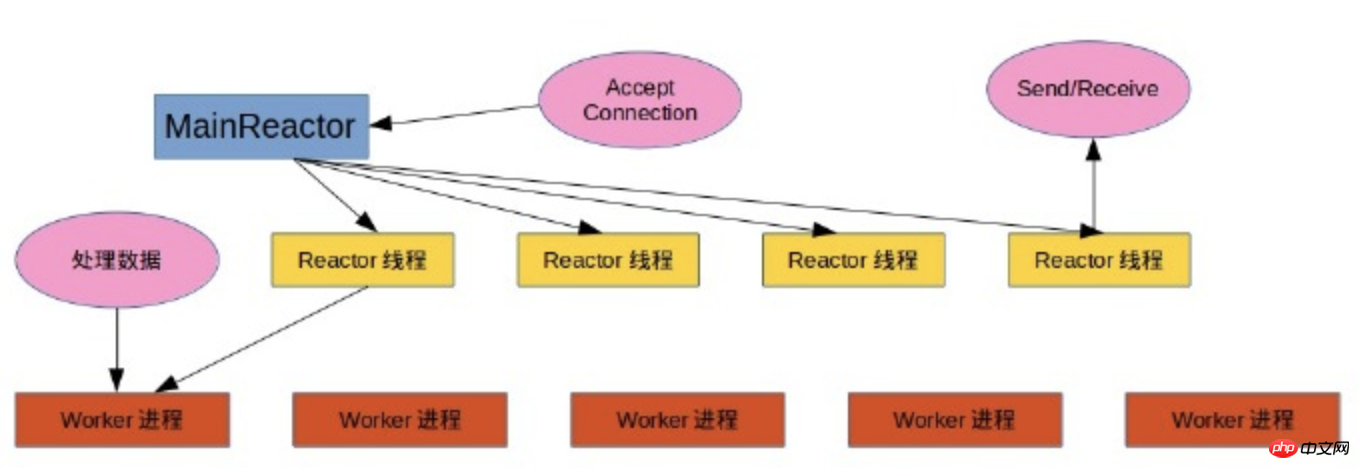
As can be seen from the figure, if we combine the Reactor thread and the Work process, it can be seen as For worker threads, swoole uses the reactor event processing mode.
The steps a request goes through are as follows:
1. The server main thread waits for the client to connect.
2. The Reactor thread processes the connected socket, reads the request data on the socket (Receive), encapsulates the request and delivers it to the work process.
3. The Work process is a logical unit that processes business data.
4. Work process results are returned to the Reactor thread.
5. The Reactor thread writes the result back to the socket (Send).
Please review the above structure introduction for the work of each module.
Related recommendations:
How to customize a Model? Usage of ThinkPHP3.2 custom base class Model
How to use PHP to read the contents of excel files and obtain cell data
The above is the detailed content of Architectural analysis of swoole. For more information, please follow other related articles on the PHP Chinese website!

Hot AI Tools

Undresser.AI Undress
AI-powered app for creating realistic nude photos

AI Clothes Remover
Online AI tool for removing clothes from photos.

Undress AI Tool
Undress images for free

Clothoff.io
AI clothes remover

AI Hentai Generator
Generate AI Hentai for free.

Hot Article
Hot Tools

Notepad++7.3.1
Easy-to-use and free code editor

SublimeText3 Chinese version
Chinese version, very easy to use

Zend Studio 13.0.1
Powerful PHP integrated development environment

Dreamweaver CS6
Visual web development tools

SublimeText3 Mac version
God-level code editing software (SublimeText3)
Hot Topics
 1379
1379
 52
52

 Alipay PHP SDK transfer error: How to solve the problem of 'Cannot declare class SignData'?
Apr 01, 2025 am 07:21 AM
Alipay PHP SDK transfer error: How to solve the problem of 'Cannot declare class SignData'?
Apr 01, 2025 am 07:21 AM
Alipay PHP...
 Explain JSON Web Tokens (JWT) and their use case in PHP APIs.
Apr 05, 2025 am 12:04 AM
Explain JSON Web Tokens (JWT) and their use case in PHP APIs.
Apr 05, 2025 am 12:04 AM
JWT is an open standard based on JSON, used to securely transmit information between parties, mainly for identity authentication and information exchange. 1. JWT consists of three parts: Header, Payload and Signature. 2. The working principle of JWT includes three steps: generating JWT, verifying JWT and parsing Payload. 3. When using JWT for authentication in PHP, JWT can be generated and verified, and user role and permission information can be included in advanced usage. 4. Common errors include signature verification failure, token expiration, and payload oversized. Debugging skills include using debugging tools and logging. 5. Performance optimization and best practices include using appropriate signature algorithms, setting validity periods reasonably,
 Explain the concept of late static binding in PHP.
Mar 21, 2025 pm 01:33 PM
Explain the concept of late static binding in PHP.
Mar 21, 2025 pm 01:33 PM
Article discusses late static binding (LSB) in PHP, introduced in PHP 5.3, allowing runtime resolution of static method calls for more flexible inheritance.Main issue: LSB vs. traditional polymorphism; LSB's practical applications and potential perfo
 Framework Security Features: Protecting against vulnerabilities.
Mar 28, 2025 pm 05:11 PM
Framework Security Features: Protecting against vulnerabilities.
Mar 28, 2025 pm 05:11 PM
Article discusses essential security features in frameworks to protect against vulnerabilities, including input validation, authentication, and regular updates.
 Describe the SOLID principles and how they apply to PHP development.
Apr 03, 2025 am 12:04 AM
Describe the SOLID principles and how they apply to PHP development.
Apr 03, 2025 am 12:04 AM
The application of SOLID principle in PHP development includes: 1. Single responsibility principle (SRP): Each class is responsible for only one function. 2. Open and close principle (OCP): Changes are achieved through extension rather than modification. 3. Lisch's Substitution Principle (LSP): Subclasses can replace base classes without affecting program accuracy. 4. Interface isolation principle (ISP): Use fine-grained interfaces to avoid dependencies and unused methods. 5. Dependency inversion principle (DIP): High and low-level modules rely on abstraction and are implemented through dependency injection.
 Customizing/Extending Frameworks: How to add custom functionality.
Mar 28, 2025 pm 05:12 PM
Customizing/Extending Frameworks: How to add custom functionality.
Mar 28, 2025 pm 05:12 PM
The article discusses adding custom functionality to frameworks, focusing on understanding architecture, identifying extension points, and best practices for integration and debugging.
 How to send a POST request containing JSON data using PHP's cURL library?
Apr 01, 2025 pm 03:12 PM
How to send a POST request containing JSON data using PHP's cURL library?
Apr 01, 2025 pm 03:12 PM
Sending JSON data using PHP's cURL library In PHP development, it is often necessary to interact with external APIs. One of the common ways is to use cURL library to send POST�...
 How to automatically set permissions of unixsocket after system restart?
Mar 31, 2025 pm 11:54 PM
How to automatically set permissions of unixsocket after system restart?
Mar 31, 2025 pm 11:54 PM
How to automatically set the permissions of unixsocket after the system restarts. Every time the system restarts, we need to execute the following command to modify the permissions of unixsocket: sudo...
