


 Web Front-end
JS Tutorial
Analysis of the difference between vue computed properties and methods and listeners
Web Front-end
JS Tutorial
Analysis of the difference between vue computed properties and methods and listeners
Analysis of the difference between vue computed properties and methods and listeners

This article mainly introduces the detailed explanation of the difference between vue calculated properties and methods and listeners (interview test points). The content is quite good. Now I will share it with you and give it as a reference.
Computed properties
Expressions within templates are very convenient, but they are designed for simple operations. Putting too much logic into a template can make it overweight and difficult to maintain. For example:
<p id="example">
{{ message.split('').reverse().join('') }}
</p>Here, the template is no longer simple declarative logic. You have to watch for a while to realize that here you want to display the flipped string of the variable message. It becomes more difficult to deal with when you want to reference the flipped string here multiple times in the template.
So, for any complex logic, you should use computed properties.
Basic example
<p id="app">
{{fullName}}
</p>
var vm = new Vue({
el: '#app',
data: {
firstName: "王",
lastName: "小智",
age: 28
},
// 计算属性
computed: {
fullName: function () {
console.log("计算了一次")
return this.firstName + " " + this.lastName
}
}
})Result:
王小智
Then we Change the value of the age attribute through the browser and let the page re-render:

#As you can see, we changed the method of calculating the age value and the attribute was not called, then if the calculation If the value of an attribute changes, such as lastName or firstName, what will happen to the printing result?
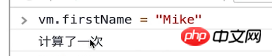
As you can see, when the dependency changes, Computed properties will be recalculated once.
Computed property caching vs methods
You may have noticed that we can achieve the same effect by calling methods in expressions:
<p>Reversed message: "{{ fullName() }}"</p>


// 在组件中
methods: {
 fullName: function () {
  console.log("计算了一次")
  return this.firstName + " " + this.lastName;
 }
}Result:
王小智
Similarly referring to the above, we change the value of the age attribute through the browser to let the page re- Rendering:
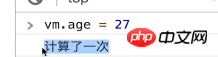
It can be seen that as long as our page is re-rendered, the method will be executed once, and the calculated property will only be re-evaluated when its related dependencies change.
Why do we need caching? Suppose we have a computationally expensive property A, which requires traversing a huge array and doing a lot of calculations. Then we might have other computed properties that depend on A. Without caching, we would inevitably execute A's getter multiple times! If you don't want caching, use methods instead.
Computed properties vs listening properties
You may have noticed that we can also achieve the same effect through listening properties:
var vm = new Vue({
 el: '#app',
 data: {
  firstName: "王",
  lastName: "小智",
  age: 28,
  fullName
 },
 // 计算属性
 watch: {
   firstName: function () {
    console.log("计算了一次");
    this.fullNmae = this.firstName + this.lastName;
   },
   lastName: function () {
    console.log("计算了一次")
    this.fullNmae = this.firstName + this.lastName;
   }
 }
})Result:
王小智
Similarly referring to the above, we change the value of the age attribute through the browser and let the page re-render:
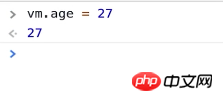
As you can see, for changes that are not related to fullname, fullName has not changed. Similar to calculated properties, there will be a cache, only when its related dependencies change. would re-evaluate it, compare it to the computed property version, much better, isn't it?
When you have some data that needs to change as other data changes, it's easy to abuse watches - especially if you've used
AngularJS before. However, it is often better to use computed properties instead of imperative watch callbacks.
The above is the entire content of this article. I hope it will be helpful to everyone's study. For more related content, please pay attention to the PHP Chinese website!
Related recommendations:
Analysis of Cookies issues about Vue SSR
Introduction to iview table render integrated switch switch
Introduction to the code for vue-scroller to record the scroll position
The above is the detailed content of Analysis of the difference between vue computed properties and methods and listeners. For more information, please follow other related articles on the PHP Chinese website!

Hot AI Tools

Undresser.AI Undress
AI-powered app for creating realistic nude photos

AI Clothes Remover
Online AI tool for removing clothes from photos.

Undress AI Tool
Undress images for free

Clothoff.io
AI clothes remover

AI Hentai Generator
Generate AI Hentai for free.

Hot Article
Hot Tools

Notepad++7.3.1
Easy-to-use and free code editor

SublimeText3 Chinese version
Chinese version, very easy to use

Zend Studio 13.0.1
Powerful PHP integrated development environment

Dreamweaver CS6
Visual web development tools

SublimeText3 Mac version
God-level code editing software (SublimeText3)
Hot Topics
 1385
1385
 52
52

 How to add functions to buttons for vue
Apr 08, 2025 am 08:51 AM
How to add functions to buttons for vue
Apr 08, 2025 am 08:51 AM
You can add a function to the Vue button by binding the button in the HTML template to a method. Define the method and write function logic in the Vue instance.
 How to use bootstrap in vue
Apr 07, 2025 pm 11:33 PM
How to use bootstrap in vue
Apr 07, 2025 pm 11:33 PM
Using Bootstrap in Vue.js is divided into five steps: Install Bootstrap. Import Bootstrap in main.js. Use the Bootstrap component directly in the template. Optional: Custom style. Optional: Use plug-ins.
 How to use watch in vue
Apr 07, 2025 pm 11:36 PM
How to use watch in vue
Apr 07, 2025 pm 11:36 PM
The watch option in Vue.js allows developers to listen for changes in specific data. When the data changes, watch triggers a callback function to perform update views or other tasks. Its configuration options include immediate, which specifies whether to execute a callback immediately, and deep, which specifies whether to recursively listen to changes to objects or arrays.
 How to reference js file with vue.js
Apr 07, 2025 pm 11:27 PM
How to reference js file with vue.js
Apr 07, 2025 pm 11:27 PM
There are three ways to refer to JS files in Vue.js: directly specify the path using the <script> tag;; dynamic import using the mounted() lifecycle hook; and importing through the Vuex state management library.
 What does vue multi-page development mean?
Apr 07, 2025 pm 11:57 PM
What does vue multi-page development mean?
Apr 07, 2025 pm 11:57 PM
Vue multi-page development is a way to build applications using the Vue.js framework, where the application is divided into separate pages: Code Maintenance: Splitting the application into multiple pages can make the code easier to manage and maintain. Modularity: Each page can be used as a separate module for easy reuse and replacement. Simple routing: Navigation between pages can be managed through simple routing configuration. SEO Optimization: Each page has its own URL, which helps SEO.
 How to return to previous page by vue
Apr 07, 2025 pm 11:30 PM
How to return to previous page by vue
Apr 07, 2025 pm 11:30 PM
Vue.js has four methods to return to the previous page: $router.go(-1)$router.back() uses <router-link to="/" component window.history.back(), and the method selection depends on the scene.
 How to query the version of vue
Apr 07, 2025 pm 11:24 PM
How to query the version of vue
Apr 07, 2025 pm 11:24 PM
You can query the Vue version by using Vue Devtools to view the Vue tab in the browser's console. Use npm to run the "npm list -g vue" command. Find the Vue item in the "dependencies" object of the package.json file. For Vue CLI projects, run the "vue --version" command. Check the version information in the <script> tag in the HTML file that refers to the Vue file.
 How to pass parameters for vue function
Apr 08, 2025 am 07:36 AM
How to pass parameters for vue function
Apr 08, 2025 am 07:36 AM
There are two main ways to pass parameters to Vue.js functions: pass data using slots or bind a function with bind, and provide parameters: pass parameters using slots: pass data in component templates, accessed within components and used as parameters of the function. Pass parameters using bind binding: bind function in Vue.js instance and provide function parameters.
