


 Backend Development
PHP Tutorial
Detailed explanation of the steps to submit a form in the form of an array using the yii framework form model
Backend Development
PHP Tutorial
Detailed explanation of the steps to submit a form in the form of an array using the yii framework form model
Detailed explanation of the steps to submit a form in the form of an array using the yii framework form model

This time I will bring you a detailed explanation of the steps for submitting a form in the form of an array using the yii framework form model. What are the precautions for the yii framework form model to submit a form in the form of an array? The following is a practical case. Let’s take a look. one time.
According to the description in Yii documentation, the general process of Yii processing forms is:
Create the model class corresponding to the form, and set the fields Validation rules
Create the action corresponding to the form submission and process the submitted content
Create in the viewForm
In a small project just now, I wanted to use ajax to submit the form information and verify and save it, but I didn’t want to Use a hidden iframe for non-refresh submission, and the verification method of the model class can be used in the action, so I thought of using a form array to submit.
Example, form code:
<form action='' method='post' name='form_test'>
<input type='text' name='arr[]' value='1'>
<input type='text' name='arr[]' value='2'>
<input type='text' name='arr[]' value='3'>
</form>After submission, you can directly use $_POST['arr'] to obtain the submitted data, $_POST['arr'] is:
Array
(
    [0] => a
    [1] => b
    [2] => c
)Similarly, if you use the following form to submit:
<form action='' method='post' name='form_test'>
<input type='text' name='arr[3]' value='a'>
<input type='text' name='arr[6]' value='b'>
<input type='text' name='arr[8]' value='c'>
</form>
$_POST['arr']
Array
(
[3] => a
[6] => b
[8] => c
)Of course you can also submit two-dimensional array:
<form action='http://127.0.0.1/zhaobolu/test.php' method='post' name='form_test'> <input type='text' name='arr[][name1]' value='a'> <input type='text' name='arr[][name2]' value='b'> <input type='text' name='arr[][name3]' value='c'></form> $_POST['arr'] 为:Array( [0] => Array ( [name1] => a ) [1] => Array ( [name2] => b ) [2] => Array ( [name3] => c ))
There is a problem here, If you do not set the key of the first sub-array, each value will be added to arr sequentially when generating the array. If you want to save the information in an array, just add a key value, as follows:
<form action='http://127.0.0.1/zhaobolu/test.php' method='post' name='form_test'> <input type='text' name='arr[a][name1]' value='a1'> <input type='text' name='arr[a][value1]' value='a2'> <input type='text' name='arr[b][name2]' value='b1'> <input type='text' name='arr[b][value2]' value='b2'></form> $_POST['arr'] 为:Array( [a] => Array ( [name1] => a1 [value1] => a2 ) [b] => Array ( [name2] => b1 [value2] => b2 ))
Use ajax to submit the form and use yii formModel verificationExample, first is the model class part, only the simplest verification method:
<?php
class LandingForm extends CFormModel
{
public $landing_title;
public $landing_content;
public $landing_position;
public function rules()
{
return array(
array('landing_title, landing_content', 'required'),
array('landing_position', 'default', 'value'=>''),
);
}
}Model class When setting the parameter verification method, you need to set rules for each public parameter. If there are parameters without set rules, after assigning values to the model using the form value in $_POST, the parameter values without set rules will be empty# Get the parameters submitted by the form in ##action and verify them:
$model = new LandingForm;
$model->attributes = $_POST['form'];
if($model->validate()){
    $info = $model->attributes;
    ...
}var info = new Object();
info = { 'form[landing_title]': landing_title,
'form[landing_content]': landing_content,
'form[landing_position]': landing_position,
};
var url = "...";
$.post(url, info, function(rst){
...
});Detailed explanation of the steps to create scheduled tasks through the yii framework through console commands
PHP accelerator eAccelerator configuration and usage steps Detailed explanation
The above is the detailed content of Detailed explanation of the steps to submit a form in the form of an array using the yii framework form model. For more information, please follow other related articles on the PHP Chinese website!

Hot AI Tools

Undresser.AI Undress
AI-powered app for creating realistic nude photos

AI Clothes Remover
Online AI tool for removing clothes from photos.

Undress AI Tool
Undress images for free

Clothoff.io
AI clothes remover

AI Hentai Generator
Generate AI Hentai for free.

Hot Article
Hot Tools

Notepad++7.3.1
Easy-to-use and free code editor

SublimeText3 Chinese version
Chinese version, very easy to use

Zend Studio 13.0.1
Powerful PHP integrated development environment

Dreamweaver CS6
Visual web development tools

SublimeText3 Mac version
God-level code editing software (SublimeText3)
Hot Topics
 1386
1386
 52
52

 The world's most powerful open source MoE model is here, with Chinese capabilities comparable to GPT-4, and the price is only nearly one percent of GPT-4-Turbo
May 07, 2024 pm 04:13 PM
The world's most powerful open source MoE model is here, with Chinese capabilities comparable to GPT-4, and the price is only nearly one percent of GPT-4-Turbo
May 07, 2024 pm 04:13 PM
Imagine an artificial intelligence model that not only has the ability to surpass traditional computing, but also achieves more efficient performance at a lower cost. This is not science fiction, DeepSeek-V2[1], the world’s most powerful open source MoE model is here. DeepSeek-V2 is a powerful mixture of experts (MoE) language model with the characteristics of economical training and efficient inference. It consists of 236B parameters, 21B of which are used to activate each marker. Compared with DeepSeek67B, DeepSeek-V2 has stronger performance, while saving 42.5% of training costs, reducing KV cache by 93.3%, and increasing the maximum generation throughput to 5.76 times. DeepSeek is a company exploring general artificial intelligence
 KAN, which replaces MLP, has been extended to convolution by open source projects
Jun 01, 2024 pm 10:03 PM
KAN, which replaces MLP, has been extended to convolution by open source projects
Jun 01, 2024 pm 10:03 PM
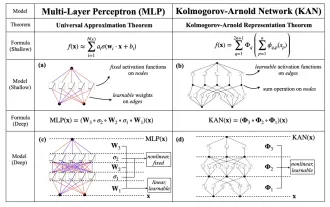
Earlier this month, researchers from MIT and other institutions proposed a very promising alternative to MLP - KAN. KAN outperforms MLP in terms of accuracy and interpretability. And it can outperform MLP running with a larger number of parameters with a very small number of parameters. For example, the authors stated that they used KAN to reproduce DeepMind's results with a smaller network and a higher degree of automation. Specifically, DeepMind's MLP has about 300,000 parameters, while KAN only has about 200 parameters. KAN has a strong mathematical foundation like MLP. MLP is based on the universal approximation theorem, while KAN is based on the Kolmogorov-Arnold representation theorem. As shown in the figure below, KAN has
 Tesla robots work in factories, Musk: The degree of freedom of hands will reach 22 this year!
May 06, 2024 pm 04:13 PM
Tesla robots work in factories, Musk: The degree of freedom of hands will reach 22 this year!
May 06, 2024 pm 04:13 PM
The latest video of Tesla's robot Optimus is released, and it can already work in the factory. At normal speed, it sorts batteries (Tesla's 4680 batteries) like this: The official also released what it looks like at 20x speed - on a small "workstation", picking and picking and picking: This time it is released One of the highlights of the video is that Optimus completes this work in the factory, completely autonomously, without human intervention throughout the process. And from the perspective of Optimus, it can also pick up and place the crooked battery, focusing on automatic error correction: Regarding Optimus's hand, NVIDIA scientist Jim Fan gave a high evaluation: Optimus's hand is the world's five-fingered robot. One of the most dexterous. Its hands are not only tactile
 Comprehensively surpassing DPO: Chen Danqi's team proposed simple preference optimization SimPO, and also refined the strongest 8B open source model
Jun 01, 2024 pm 04:41 PM
Comprehensively surpassing DPO: Chen Danqi's team proposed simple preference optimization SimPO, and also refined the strongest 8B open source model
Jun 01, 2024 pm 04:41 PM
In order to align large language models (LLMs) with human values and intentions, it is critical to learn human feedback to ensure that they are useful, honest, and harmless. In terms of aligning LLM, an effective method is reinforcement learning based on human feedback (RLHF). Although the results of the RLHF method are excellent, there are some optimization challenges involved. This involves training a reward model and then optimizing a policy model to maximize that reward. Recently, some researchers have explored simpler offline algorithms, one of which is direct preference optimization (DPO). DPO learns the policy model directly based on preference data by parameterizing the reward function in RLHF, thus eliminating the need for an explicit reward model. This method is simple and stable
 No OpenAI data required, join the list of large code models! UIUC releases StarCoder-15B-Instruct
Jun 13, 2024 pm 01:59 PM
No OpenAI data required, join the list of large code models! UIUC releases StarCoder-15B-Instruct
Jun 13, 2024 pm 01:59 PM
At the forefront of software technology, UIUC Zhang Lingming's group, together with researchers from the BigCode organization, recently announced the StarCoder2-15B-Instruct large code model. This innovative achievement achieved a significant breakthrough in code generation tasks, successfully surpassing CodeLlama-70B-Instruct and reaching the top of the code generation performance list. The unique feature of StarCoder2-15B-Instruct is its pure self-alignment strategy. The entire training process is open, transparent, and completely autonomous and controllable. The model generates thousands of instructions via StarCoder2-15B in response to fine-tuning the StarCoder-15B base model without relying on expensive manual annotation.
 LLM is all done! OmniDrive: Integrating 3D perception and reasoning planning (NVIDIA's latest)
May 09, 2024 pm 04:55 PM
LLM is all done! OmniDrive: Integrating 3D perception and reasoning planning (NVIDIA's latest)
May 09, 2024 pm 04:55 PM
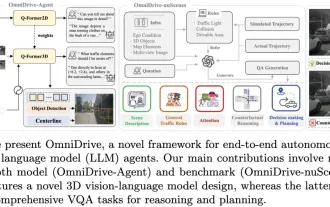
Written above & the author’s personal understanding: This paper is dedicated to solving the key challenges of current multi-modal large language models (MLLMs) in autonomous driving applications, that is, the problem of extending MLLMs from 2D understanding to 3D space. This expansion is particularly important as autonomous vehicles (AVs) need to make accurate decisions about 3D environments. 3D spatial understanding is critical for AVs because it directly impacts the vehicle’s ability to make informed decisions, predict future states, and interact safely with the environment. Current multi-modal large language models (such as LLaVA-1.5) can often only handle lower resolution image inputs (e.g.) due to resolution limitations of the visual encoder, limitations of LLM sequence length. However, autonomous driving applications require
 PHP array key value flipping: Comparative performance analysis of different methods
May 03, 2024 pm 09:03 PM
PHP array key value flipping: Comparative performance analysis of different methods
May 03, 2024 pm 09:03 PM
The performance comparison of PHP array key value flipping methods shows that the array_flip() function performs better than the for loop in large arrays (more than 1 million elements) and takes less time. The for loop method of manually flipping key values takes a relatively long time.
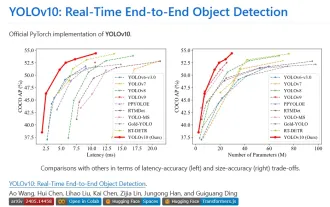 Yolov10: Detailed explanation, deployment and application all in one place!
Jun 07, 2024 pm 12:05 PM
Yolov10: Detailed explanation, deployment and application all in one place!
Jun 07, 2024 pm 12:05 PM
1. Introduction Over the past few years, YOLOs have become the dominant paradigm in the field of real-time object detection due to its effective balance between computational cost and detection performance. Researchers have explored YOLO's architectural design, optimization goals, data expansion strategies, etc., and have made significant progress. At the same time, relying on non-maximum suppression (NMS) for post-processing hinders end-to-end deployment of YOLO and adversely affects inference latency. In YOLOs, the design of various components lacks comprehensive and thorough inspection, resulting in significant computational redundancy and limiting the capabilities of the model. It offers suboptimal efficiency, and relatively large potential for performance improvement. In this work, the goal is to further improve the performance efficiency boundary of YOLO from both post-processing and model architecture. to this end
