


 Database
Mysql Tutorial
Use the mysql_fetch_object() function to obtain a row in the result set as an object (PHP method 5 for operating MySQL database)
Database
Mysql Tutorial
Use the mysql_fetch_object() function to obtain a row in the result set as an object (PHP method 5 for operating MySQL database)
Use the mysql_fetch_object() function to obtain a row in the result set as an object (PHP method 5 for operating MySQL database)

Use the mysql_fetch_object() function to obtain a row in the result set as an object (Method 5 of PHP operating MySQL database)
Use the mysql_fetch_object() function to also obtain the difference Selecting the data in the result set is similar to the function introduced in the previous article. Let's learn the difference in the use of these two functions through different methods in the same example.
In the previous article "Use mysql_fetch_array() to obtain information in the array result set (PHP method 4 for operating MySQL database)" we introduced the mysql_fetch_array() function to obtain the result set. So today we continue to introduce the mysql_fetch_object() function to obtain the result set.
First we look at the syntax format of the function as follows:
object mysql_fetch_object(resource result)
Note:
This extension is Obsolete in PHP 5.5.0, it was removed in PHP 7.0.0. Instead, the mysqli extension or pdo_mysql should be used. See the MySQL: Selection API Guide and related FAQ for more information.
The mysql_fetch_object() function is similar to the mysql_fetch_array() function, with one difference. The former returns an object instead of an array. This function only accesses the array through the field name. Use the following format to obtain it. The element value of the row in the result set.
$row->col_name //col_name为列名,$row代表结果集
For example, if you retrieve id and name values from a data table, you can use $row->id and $row->name to access the element values in the row.
Note:
#The fields returned by this function are also case-sensitive. This is the most easily overlooked issue for beginners learning programming. .
The following example uses the mysql_fetch_object() function to obtain the data information in the result set, and then uses the echo statement to output the book corresponding to each field from the result set in the form of "result set->column name" information.
The specific steps are as follows:
1. Create a PHP dynamic page, name it index.php, add a form, a text box and a submit button to index.php. The specific code is as follows:
<html>
<body>
    <!--上传文件表单-->
    <form method="post" action="" name = form1>
        <table>
           <tr>
               <td width="605" height="51" bgcolor="#CC99FF">
                   <p align="center">请输入查询内容
                       <input type="text" name="txt_book" id="txt_book" size="25">
                       <input type="submit" name="Submit" value="查询">
                   </p>
               </td>
           </tr>
            </table>
        </form>
</body>
</html>2. Connect to the MySQL database server, select the database php_cn, and set the encoding format of the database to GB2312. The specific code is as follows:
<?php
header("Content-Type:text/html; charset=utf-8");
$link = mysql_connect("localhost","root","root")or die("连接数据库失败".mysql_error());
mysql_select_db("php_cn",$link);
mysql_query("set names gb2312");   //设置编码,防止发生乱发
?>3. Use the mysql_fetch_object() function to obtain the data in the query result set, and the returned value is an object:
<?php
header("Content-Type:text/html; charset=utf-8");
$sql = mysql_query("select from tb_book"); //执行查询语句
$info = mysql_fetch_object($sql); //获取查询结果,返回值为数组
if($_POST['Submit']=="查询"){ // 判断按钮的值是否为查询
$txt_book = $_POST['txt_book']; //获取文本框提交的值
$sql = mysql_query("select * from tb_book where bookname like '%".trim($txt_book)."%'"); //执行模糊查询
$info = mysql_fetch_array($sql); // 获取查询结果
}
?>4. Use the do...while loop statement , output the graphic and text information in the result set using the "Result Column -> Column Name" method. The code is as follows:
<?php
do {      //do...while 循环
    ?>
    <table>
        <tr align="left" bgcolor="#FFFFFF">
            <td height="20" align="center"><?php echo $info->id; ?></td>
            <td height="20" align="center"><?php echo $info->bookname; ?></td>
            <td height="20" align="center"><?php echo $info->data; ?></td>
            <td height="20" align="center"><?php echo $info->price; ?></td>
            <td height="20" align="center"><?php echo $info->maker; ?></td>
            <td height="20" align="center"><?php echo $info->publisher; ?></td>
        </tr>
    </table>
    <?php
}while($info = mysql_fetch_object($sql));
?>The output result is:
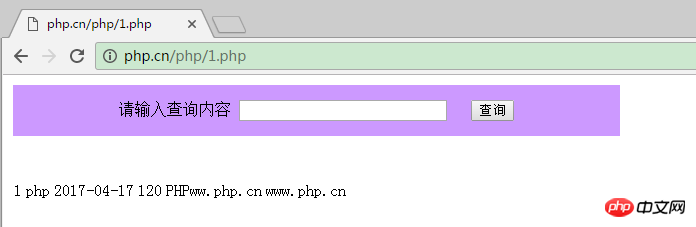
The The function is introduced here. In the next article, we will introduce another function, which is to obtain each record in the result set row by row. For details, please read "Using the mysql_fetch_row() function to obtain each record in the result set row by row (PHP Method 6 of operating MySQL database)》!
The above is the detailed content of Use the mysql_fetch_object() function to obtain a row in the result set as an object (PHP method 5 for operating MySQL database). For more information, please follow other related articles on the PHP Chinese website!

Hot AI Tools

Undresser.AI Undress
AI-powered app for creating realistic nude photos

AI Clothes Remover
Online AI tool for removing clothes from photos.

Undress AI Tool
Undress images for free

Clothoff.io
AI clothes remover

AI Hentai Generator
Generate AI Hentai for free.

Hot Article
Hot Tools

Notepad++7.3.1
Easy-to-use and free code editor

SublimeText3 Chinese version
Chinese version, very easy to use

Zend Studio 13.0.1
Powerful PHP integrated development environment

Dreamweaver CS6
Visual web development tools

SublimeText3 Mac version
God-level code editing software (SublimeText3)
Hot Topics
 1378
1378
 52
52

 The Future of PHP: Adaptations and Innovations
Apr 11, 2025 am 12:01 AM
The Future of PHP: Adaptations and Innovations
Apr 11, 2025 am 12:01 AM
The future of PHP will be achieved by adapting to new technology trends and introducing innovative features: 1) Adapting to cloud computing, containerization and microservice architectures, supporting Docker and Kubernetes; 2) introducing JIT compilers and enumeration types to improve performance and data processing efficiency; 3) Continuously optimize performance and promote best practices.
 MySQL: Simple Concepts for Easy Learning
Apr 10, 2025 am 09:29 AM
MySQL: Simple Concepts for Easy Learning
Apr 10, 2025 am 09:29 AM
MySQL is an open source relational database management system. 1) Create database and tables: Use the CREATEDATABASE and CREATETABLE commands. 2) Basic operations: INSERT, UPDATE, DELETE and SELECT. 3) Advanced operations: JOIN, subquery and transaction processing. 4) Debugging skills: Check syntax, data type and permissions. 5) Optimization suggestions: Use indexes, avoid SELECT* and use transactions.
 How to open phpmyadmin
Apr 10, 2025 pm 10:51 PM
How to open phpmyadmin
Apr 10, 2025 pm 10:51 PM
You can open phpMyAdmin through the following steps: 1. Log in to the website control panel; 2. Find and click the phpMyAdmin icon; 3. Enter MySQL credentials; 4. Click "Login".
 PHP vs. Python: Understanding the Differences
Apr 11, 2025 am 12:15 AM
PHP vs. Python: Understanding the Differences
Apr 11, 2025 am 12:15 AM
PHP and Python each have their own advantages, and the choice should be based on project requirements. 1.PHP is suitable for web development, with simple syntax and high execution efficiency. 2. Python is suitable for data science and machine learning, with concise syntax and rich libraries.
 MySQL and SQL: Essential Skills for Developers
Apr 10, 2025 am 09:30 AM
MySQL and SQL: Essential Skills for Developers
Apr 10, 2025 am 09:30 AM
MySQL and SQL are essential skills for developers. 1.MySQL is an open source relational database management system, and SQL is the standard language used to manage and operate databases. 2.MySQL supports multiple storage engines through efficient data storage and retrieval functions, and SQL completes complex data operations through simple statements. 3. Examples of usage include basic queries and advanced queries, such as filtering and sorting by condition. 4. Common errors include syntax errors and performance issues, which can be optimized by checking SQL statements and using EXPLAIN commands. 5. Performance optimization techniques include using indexes, avoiding full table scanning, optimizing JOIN operations and improving code readability.
 How to use single threaded redis
Apr 10, 2025 pm 07:12 PM
How to use single threaded redis
Apr 10, 2025 pm 07:12 PM
Redis uses a single threaded architecture to provide high performance, simplicity, and consistency. It utilizes I/O multiplexing, event loops, non-blocking I/O, and shared memory to improve concurrency, but with limitations of concurrency limitations, single point of failure, and unsuitable for write-intensive workloads.
 PHP: Is It Dying or Simply Adapting?
Apr 11, 2025 am 12:13 AM
PHP: Is It Dying or Simply Adapting?
Apr 11, 2025 am 12:13 AM
PHP is not dying, but constantly adapting and evolving. 1) PHP has undergone multiple version iterations since 1994 to adapt to new technology trends. 2) It is currently widely used in e-commerce, content management systems and other fields. 3) PHP8 introduces JIT compiler and other functions to improve performance and modernization. 4) Use OPcache and follow PSR-12 standards to optimize performance and code quality.
 MySQL: An Introduction to the World's Most Popular Database
Apr 12, 2025 am 12:18 AM
MySQL: An Introduction to the World's Most Popular Database
Apr 12, 2025 am 12:18 AM
MySQL is an open source relational database management system, mainly used to store and retrieve data quickly and reliably. Its working principle includes client requests, query resolution, execution of queries and return results. Examples of usage include creating tables, inserting and querying data, and advanced features such as JOIN operations. Common errors involve SQL syntax, data types, and permissions, and optimization suggestions include the use of indexes, optimized queries, and partitioning of tables.
