


Day Introduction to ReactJS

Welcome to Day 1 of the "30 Days of ReactJS" challenge! Today, we'll begin our journey by understanding what ReactJS is, why it has become one of the most popular libraries in web development, and how it can help you build dynamic, modern web applications.
What is ReactJS?
ReactJS, commonly known as React, is an open-source JavaScript library developed by Facebook. It was initially released in 2013 and has since become a go-to tool for building user interfaces (UIs), particularly single-page applications (SPAs). Unlike traditional JavaScript libraries, React focuses on creating components—reusable pieces of code that define parts of the user interface.
Real-Life Example: Building with LEGO Blocks
Imagine you're building a complex LEGO structure. Instead of working with a single giant piece, you use smaller, individual blocks that can be combined in various ways. React works similarly. Instead of creating an entire web page as one large entity, React allows you to build it piece by piece using components. Each component is like a LEGO block that can be reused and combined to create complex UIs efficiently.
Why Use ReactJS?
ReactJS offers several advantages that make it an essential tool for modern web development:
Component-Based Architecture: React allows you to break down your UI into smaller, reusable components. This modular approach makes your code more organized, easier to manage, and more scalable.
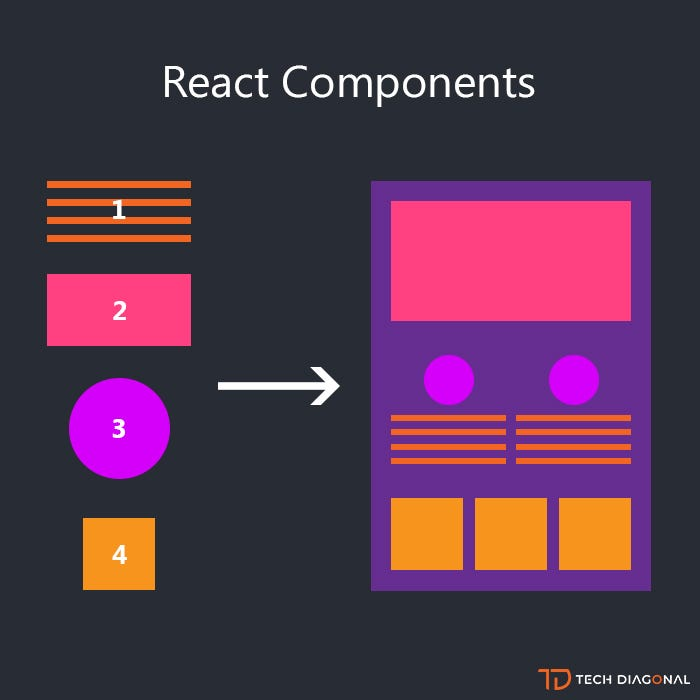
Real-Life Example: Think of an e-commerce website. You can create a ProductCard component that displays a product’s image, name, and price. This component can be reused throughout the site wherever you need to show a product.
Virtual DOM: React uses a virtual DOM to optimize updates and rendering. Instead of updating the entire page whenever something changes, React updates only the parts that need to change, making the app faster and more efficient.

Real-Life Example: Consider how your social media feed updates. When you like a post, only that specific post's like count updates instead of reloading the entire page. This is similar to how React's virtual DOM efficiently manages updates.
Declarative UI: React lets you describe what the UI should look like based on the application's state, and it takes care of the rest. This approach is easier to reason about and leads to more predictable code.
Real-Life Example: Think of writing a recipe. Instead of describing each step in detail (imperative), you just list the ingredients and instructions (declarative). React works similarly by letting you declare what you want your UI to look like, and it handles the underlying steps.
Strong Community and Ecosystem: React has a vast and active community, which means you can find countless tutorials, libraries, tools, and resources to help you solve problems and build your projects.
Real-Life Example: Consider learning a new language in a city where everyone speaks it. The more people using it, the easier it is to find help, resources, and opportunities to practice. React’s community provides a similar environment for developers.
Where is ReactJS Used?
ReactJS is used by some of the biggest names in tech, including Facebook, Instagram, Airbnb, Netflix, and Uber. These companies rely on React to build fast, interactive, and scalable web applications that serve millions of users daily.
Real-Life Example: React in Action
Take Facebook as an example. Every time you interact with a post—whether you're liking, sharing, or commenting—React is working behind the scenes to ensure that these interactions are quick and that the UI updates efficiently without reloading the entire page.
Setting Up for the Challenge
Throughout this 30-day challenge, you'll get hands-on experience with ReactJS. By the end of the series, you'll have built several projects and gained a deep understanding of how React works.
For tomorrow, make sure to have a basic understanding of JavaScript and be ready to set up your development environment. We'll dive into setting up React on your local machine and getting your first React app up and running.
Final Thoughts
ReactJS is more than just a tool—it's a paradigm shift in how we think about building user interfaces. Whether you're creating a small personal project or working on a large-scale application, React provides the tools and patterns needed to build efficient, maintainable, and scalable UIs.
Stay tuned for Day 2, where we’ll set up your development environment and start coding with ReactJS!
The above is the detailed content of Day Introduction to ReactJS. For more information, please follow other related articles on the PHP Chinese website!

Hot AI Tools

Undresser.AI Undress
AI-powered app for creating realistic nude photos

AI Clothes Remover
Online AI tool for removing clothes from photos.

Undress AI Tool
Undress images for free

Clothoff.io
AI clothes remover

AI Hentai Generator
Generate AI Hentai for free.

Hot Article
Hot Tools

Notepad++7.3.1
Easy-to-use and free code editor

SublimeText3 Chinese version
Chinese version, very easy to use

Zend Studio 13.0.1
Powerful PHP integrated development environment

Dreamweaver CS6
Visual web development tools

SublimeText3 Mac version
God-level code editing software (SublimeText3)
Hot Topics
 1381
1381
 52
52

 How do I create and publish my own JavaScript libraries?
Mar 18, 2025 pm 03:12 PM
How do I create and publish my own JavaScript libraries?
Mar 18, 2025 pm 03:12 PM
Article discusses creating, publishing, and maintaining JavaScript libraries, focusing on planning, development, testing, documentation, and promotion strategies.
 How do I optimize JavaScript code for performance in the browser?
Mar 18, 2025 pm 03:14 PM
How do I optimize JavaScript code for performance in the browser?
Mar 18, 2025 pm 03:14 PM
The article discusses strategies for optimizing JavaScript performance in browsers, focusing on reducing execution time and minimizing impact on page load speed.
 What should I do if I encounter garbled code printing for front-end thermal paper receipts?
Apr 04, 2025 pm 02:42 PM
What should I do if I encounter garbled code printing for front-end thermal paper receipts?
Apr 04, 2025 pm 02:42 PM
Frequently Asked Questions and Solutions for Front-end Thermal Paper Ticket Printing In Front-end Development, Ticket Printing is a common requirement. However, many developers are implementing...
 How do I debug JavaScript code effectively using browser developer tools?
Mar 18, 2025 pm 03:16 PM
How do I debug JavaScript code effectively using browser developer tools?
Mar 18, 2025 pm 03:16 PM
The article discusses effective JavaScript debugging using browser developer tools, focusing on setting breakpoints, using the console, and analyzing performance.
 Who gets paid more Python or JavaScript?
Apr 04, 2025 am 12:09 AM
Who gets paid more Python or JavaScript?
Apr 04, 2025 am 12:09 AM
There is no absolute salary for Python and JavaScript developers, depending on skills and industry needs. 1. Python may be paid more in data science and machine learning. 2. JavaScript has great demand in front-end and full-stack development, and its salary is also considerable. 3. Influencing factors include experience, geographical location, company size and specific skills.
 How do I use source maps to debug minified JavaScript code?
Mar 18, 2025 pm 03:17 PM
How do I use source maps to debug minified JavaScript code?
Mar 18, 2025 pm 03:17 PM
The article explains how to use source maps to debug minified JavaScript by mapping it back to the original code. It discusses enabling source maps, setting breakpoints, and using tools like Chrome DevTools and Webpack.
 How to merge array elements with the same ID into one object using JavaScript?
Apr 04, 2025 pm 05:09 PM
How to merge array elements with the same ID into one object using JavaScript?
Apr 04, 2025 pm 05:09 PM
How to merge array elements with the same ID into one object in JavaScript? When processing data, we often encounter the need to have the same ID...
 The difference in console.log output result: Why are the two calls different?
Apr 04, 2025 pm 05:12 PM
The difference in console.log output result: Why are the two calls different?
Apr 04, 2025 pm 05:12 PM
In-depth discussion of the root causes of the difference in console.log output. This article will analyze the differences in the output results of console.log function in a piece of code and explain the reasons behind it. �...
